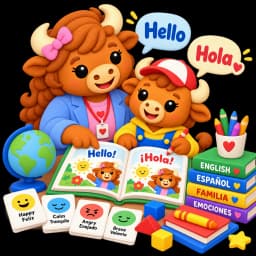
Bilingual & Spanish Homeschool Curriculum for Character & Emotional Learning
Character education and social-emotional learning in English and Spanish for homeschool families, with curriculum options, a feelings vocabulary list, and tips for teaching in two languages.
Many homeschool families teach in two languages. Some speak Spanish at home and want their children to grow strong in both languages. Some are raising bilingual children on purpose. Others are learning Spanish together as a family. In all of these homes, character and emotional learning raise a special question: in which language should a child learn to name feelings, calm down, and talk about kindness and honesty?
This guide covers why language matters for emotional learning, bilingual and Spanish character curriculum options for homeschool families, a bilingual feelings and character vocabulary list, and practical tips for teaching character and social-emotional skills in two languages.
Disclosure: This guide is published by Be The Buffalo, one of the options listed. Prices and availability were checked in October 2026 where noted. Confirm current details with each publisher.
Why Language Matters for Emotional Learning
Learning to name feelings is one of the foundations of social-emotional learning. Research on multilingualism suggests that emotion words often carry particular weight in the language a person learned first, and that bilingual people may express and experience emotions somewhat differently in each language.[1]
Children often find it easier to express strong feelings in their home language, especially when they are upset.
Learning feeling words in both languages gives children more ways to understand and describe what they feel.
Using the home language for emotional learning can strengthen family connection, especially with grandparents and extended family.
Families learning Spanish as a second language can use feelings and character vocabulary as an engaging, everyday way to build language.
Who This Guide Is For
Spanish-Speaking Families
Who want character and emotional lessons in Spanish, or in both languages, while homeschooling.
Bilingual Families
Raising children in English and Spanish who want both languages used for emotional learning.
Families Learning Spanish
Who want a meaningful way to add Spanish to everyday conversation.
Curriculum and Resource Options

Full English & Spanish versions · $149.99/yr · First 4 weeks free
A 40-week character education and social-emotional learning curriculum for K-5 with complete English and Spanish versions of every lesson, switchable with one click. Lessons include interactive activities, stories with Benny and Bella the buffalo, original songs, a guide for the adult, and printables, all organized into three age bands (K-1, 2-3, 4-5). The first four weeks are free with no credit card; the full year is $149.99.
Best for: Families who want the same lesson available in both languages, or who want to alternate languages week to week.
Keep in mind: It has not yet been independently evaluated in a published study.
A Spanish-language deck of 52 virtue cards with descriptions and activity suggestions, matching the English educator's edition.[4] A simple way to add Spanish character vocabulary to daily routines.
Best for: Families who want an inexpensive Spanish tool for daily virtue discussions.
Keep in mind: A tool rather than a full curriculum.
Free · Translated materials available
A free kindness curriculum from the Random Acts of Kindness Foundation, with Pre-K through high school lessons.[5] CASEL notes that translated materials are available in many languages, including Spanish.[6]
Best for: Families who want a free, structured kindness sequence and can work with translated materials.
Keep in mind: Lessons are written for classrooms and focus mainly on kindness.
Free · Bilingual website
A free bilingual website with resources for families and educators of English language learners, including reading and family engagement resources in English and Spanish.[7]
Best for: Spanish-speaking families looking for bilingual reading and learning support that can connect to character themes.
Bilingual Picture Books from Your Library
Free
Many libraries carry bilingual and Spanish picture books about feelings, kindness, friendship, and courage. Reading the same story in both languages, or pairing an English and a Spanish book on the same theme, is one of the easiest ways to teach character bilingually. See SEL read-alouds.
For more free options, see free homeschool character education resources and our free bilingual SEL activities.
Bilingual Feelings & Character Vocabulary
Use these words in conversation, on a feelings chart, or as part of daily check-ins. Spanish adjectives change form for gender (for example, contento for a boy, contenta for a girl).
FeelingsSentimientos
happy
feliz, contento / contenta
sad
triste
angry
enojado / enojada
scared
asustado / asustada
worried
preocupado / preocupada
frustrated
frustrado / frustrada
nervous
nervioso / nerviosa
proud
orgulloso / orgullosa
calm
tranquilo / tranquila
excited
emocionado / emocionada
lonely
solo / sola ("me siento solo")
embarrassed
avergonzado / avergonzada
Character TraitsValores y cualidades
kind
amable
honest
honesto / honesta
brave
valiente
patient
paciente
responsible
responsable
respectful
respetuoso / respetuosa
fair
justo / justa
grateful
agradecido / agradecida
helpful
servicial, dispuesto / dispuesta a ayudar
a good friend
un buen amigo / una buena amiga
Useful PhrasesFrases útiles
How do you feel?
¿Cómo te sientes?
I feel...
Me siento...
Take a deep breath.
Respira profundo.
Can I play too?
¿Puedo jugar también?
I'm sorry.
Lo siento.
Thank you.
Gracias.
Please.
Por favor.
Can you help me?
¿Me puedes ayudar?
It's my turn / your turn.
Es mi turno / tu turno.
I can't do it yet.
Todavía no puedo hacerlo.
Ways to Teach Character in Two Languages
One lesson, two languages
Teach the lesson in one language, then review the key words and do a short activity in the other.
Alternate weeks
Teach one week’s theme in English and the next in Spanish. With a curriculum that has both versions, the content stays consistent while the language changes.
Home language for feelings, both languages for practice
Some families use the home language for emotional check-ins and calming routines, and both languages for stories, songs, and games.
Bilingual anchor charts
Post a feelings chart and a calming strategies chart with both languages side by side.
Songs in both languages
Songs are one of the easiest ways to learn vocabulary. Sing the same feelings or kindness song in English and Spanish. See our kindergarten sing-along songs.
Involve extended family
Invite grandparents or other relatives to share stories, sayings, or values from their own upbringing. Many families have dichos (sayings) that teach character in memorable ways.
Let children choose
Especially when children are upset, let them use whichever language feels most natural to express how they feel.
By Age
Ages 5–7 (K-1)
- Basic feelings words in both languages
- Songs, picture books, and puppets
- One calming phrase in each language, such as “Respira profundo”
Ages 7–9 (Grades 2-3)
- Expanding feelings vocabulary in both languages
- Bilingual role-plays for friendship and problem solving
- Short bilingual journaling or drawing
Ages 9–11 (Grades 4-5)
- Discussing values and dilemmas in both languages
- Comparing how a word or idea feels different in each language
- Family interviews about values and traditions
What to Avoid
Correcting language during emotional moments.
When a child is upset, focus on the feeling, not the grammar.
Literal translations that lose meaning.
Some emotion words do not translate exactly. Talk about the differences.
Treating one language as only for "school".
Use both languages for real-life emotional conversations, not just lessons.
Overloading vocabulary.
A few words used daily stick better than long lists.
Assuming one approach fits every family.
Families have different language goals. Choose what fits yours.
Final Thoughts
Teaching character and emotional skills in two languages gives children more ways to understand and express what they feel, and strengthens their connection to family and culture. Research suggests that emotion words can carry particular meaning in a person's first language, which makes the home language a natural place for emotional learning.[1] The skills themselves — naming feelings, calming down, being kind, and solving problems — are supported by a strong body of SEL research.[2][3]
Whether your family speaks Spanish at home, is raising bilingual children, or is learning Spanish together, a few words, a song, and a shared story in both languages can make character lessons stronger.
References
- [1]
Pavlenko, A. (2005). Emotions and multilingualism. Cambridge University Press.
https://www.academia.edu/83730972/ANETA_PAVLENKO_Emotions_and_multilingualism - [2]
Durlak, J. A., Weissberg, R. P., Dymnicki, A. B., Taylor, R. D., & Schellinger, K. B. (2011). The impact of enhancing students' social and emotional learning: A meta-analysis of school-based universal interventions. Child Development, 82(1), 405-432.
https://doi.org/10.1111/j.1467-8624.2010.01564.x - [3]
Cipriano, C., Strambler, M. J., Naples, L. H., et al. (2023). The state of evidence for social and emotional learning: A contemporary meta-analysis of universal school-based SEL interventions. Child Development, 94(5), 1181-1204.
https://doi.org/10.1111/cdev.13968 - [4]
The Virtues Project. (2026). Virtues Cards: Educator's Edition (Spanish).
https://www.virtuesproject.com/store/decks-educators-cards-spanish - [5]
Random Acts of Kindness Foundation. (2026). Kindness in the Classroom curriculum.
https://randomactsofkindness.org/pre-k-lesson-plans - [6]
CASEL Program Guide. (n.d.). Kindness in the Classroom.
https://pg.casel.org/kindness-in-the-classroom/ - [7]
Colorín Colorado. (n.d.). Research and reports on bilingual literacy and English language learners.
https://www.colorincolorado.org/research-reports
Character Lessons in English and Spanish
Be The Buffalo gives homeschool families 40 weeks of short, no-prep character and social-emotional lessons for K-5 with complete English and Spanish versions of every activity, story, song, and printable. Switch languages with one click. Start with four free weeks, including 12 printables, with no credit card.
Sign Up Free