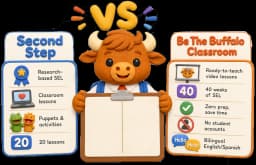
Quick Answer
CharacterStrong is a K-12 social-emotional learning and character education program. Its elementary product, PurposeFull People, delivers 36 weekly lessons per grade level through a digital platform that requires teacher login. CharacterStrong was acquired by FullBloom in February 2025 and now operates within FullBloom's mental health division.[1][4]
Schools looking for CharacterStrong alternatives typically want one or more of: lower total cost, less digital infrastructure, K-5 specific design rather than K-12 breadth, a projector-led delivery model that does not require individual student accounts, or a shorter training footprint.
The main alternatives worth evaluating for elementary implementation are Second Step Elementary, Move This World, Harmony SEL, and Be The Buffalo Classroom.
Key Takeaways
- •CharacterStrong's elementary curriculum, PurposeFull People, is one program inside a K-12 vertical. Alternatives built specifically for elementary grades handle developmental band differences differently.
- •The main axes of comparison are grade band design, delivery model (digital platform vs projector vs print), prep time, bilingual delivery, evidence base, and pricing model.
- •There is no single “best” program. The right fit depends on your district size, budget, existing tech stack, teacher capacity, and language demographics.
- •Panorama Education is often mentioned alongside these programs but functions as an assessment and resource library rather than a lesson curriculum. It complements a curriculum choice rather than replacing one.[9]
What is CharacterStrong?
CharacterStrong is a K-12 social-emotional learning and character education provider founded in 2016 in Auburn, Washington. Its elementary curriculum is called PurposeFull People and covers PreK through 5th grade.[1]
Verified public details
- •36 weekly lessons per grade level, PreK through 5th grade
- •Three implementation options: flexible, daily, or weekly
- •Ten character traits: Kindness, Courage, Respect, Responsibility, Perseverance, Empathy, Cooperation, Creativity, Honesty, and Gratitude
- •Three SEL competency areas: Emotion Regulation Skills, Social Skills, and Executive Functioning Skills
- •Digital delivery via a platform requiring teacher login[2]
- •Three-hour whole-staff training for initial implementation
- •“CharacterDare” component that invites students to apply lesson content outside of class
- •Evidence for ESSA rates PurposeFull People as demonstrating a “Strong” evidence tier based on a 2023 RCT (Zhang, Cook, & Larson)[2][11]
In February 2025, CharacterStrong was acquired by FullBloom, a K-12 education and behavioral health company. Co-founder John Norlin now serves as General Manager of FullBloom Mental Health. Post-acquisition changes to pricing, packaging, or curriculum are possible but not yet documented in public sources at the time of writing.[4]
Why Do Schools Look for CharacterStrong Alternatives?
The reasons vary. Some of the most common ones we hear from teachers and counselors:
What Should You Compare When Evaluating Alternatives?
Use the same framework for every candidate program. It makes decisions defensible and it makes procurement conversations shorter.
- •CASEL alignment. Does the program map to the five CASEL competencies? Is it listed in the CASEL Program Guide?
- •Grade band design. K-5 only, K-8, K-12, or PreK-12? How are grade bands structured within elementary?
- •Delivery model. Digital platform requiring student or teacher login, projector-led whole-class, print kits, or hybrid?
- •Prep time per lesson. How much teacher preparation does each lesson require?
- •Bilingual support. English only, English with Spanish family materials, or fully bilingual instruction?
- •Evidence base. Peer-reviewed studies, ESSA evidence tier rating, CASEL Program Guide status?
- •Pricing model. Per teacher, per school, per district, per student seat, or free?
- •Contract length and exit terms.
- •Student account requirements. Does the program require individual student accounts and student data collection? This has implications for FERPA and district data privacy review.
For a deeper dive on this framework, see our guide on how to choose an SEL curriculum for elementary schools.
CharacterStrong Alternatives Worth Considering for K-5
Second Step Elementary (Committee for Children)
Second Step is one of the longest-established SEL programs on the market. Committee for Children, the nonprofit publisher, was founded in 1979. Second Step Elementary covers K-5 and is offered in two versions: a digital web-based program and print-based classroom kits with puppets. For the 2025–2026 school year, Committee for Children rebranded Second Step under the “human skills” framing and added Tier 2 supports for elementary and middle school.[5]
Public evidence base includes multiple randomized controlled trials. The CASEL Program Guide lists Second Step Elementary with evidence of effectiveness in grades K-4. Spanish translations of instructional materials are available.[6]
Best for: Districts that need extensive third-party research documentation for procurement, and schools that want the option to choose between digital and print delivery.
Move This World
Move This World is a video-based PreK-12 SEL program founded in 2007 and rooted in creative arts therapy and positive psychology. Lessons are led by on-screen “hosts” with pauses for educator-facilitated discussion. Weekly structure covers 36 weeks per grade level.
Move This World markets a low prep model. Per the company's own materials, no teacher preparation or training is required and each lesson is self-contained and pre-loaded. A subset of foundational content is translated into Spanish. CASEL Program Guide lists evidence of effectiveness in grades K-3.[7]
Best for: Schools that want a short daily video routine as their SEL delivery, particularly those integrating brief morning-meeting or transition-time practices.
Harmony SEL (National University)
Harmony SEL, developed originally at Arizona State University with Sanford funding and now offered by National University, is a free PreK-6 SEL program. It covers approximately 20 lessons per grade band across five units: diversity and inclusion, empathy and critical thinking, communication, problem-solving, and peer relationships. Lower elementary uses storybooks; upper elementary uses games. Spanish translations are available.[8]
The lesson count is lower than CharacterStrong, Second Step, or Move This World, and prep time is higher. Harmony's evidence base includes older peer-reviewed studies but is less extensive than Second Step's.
Best for: Schools with zero curriculum budget that can absorb higher teacher prep time.
Be The Buffalo Classroom
Be The Buffalo Classroom is a K-5 specific SEL and character education program built entirely for the elementary grade band. It delivers 40 weeks of weekly content designed to project from the teacher's screen to the whole class, with no student accounts, no student devices, and zero teacher prep. Content is organized across three elementary grade bands: K-1, 2-3, and 4-5. Bilingual English and Spanish delivery is built in as a single toggle rather than as a separate translated add-on.
The curriculum includes weekly projector activities, illustrated stories, a 40-week lesson planner with CASEL color-coding, printables, songs, and safety modules. The platform is CASEL aligned. Pricing is $149.99 per teacher per year, with a free tier covering the first four weeks.
Best for: Elementary teachers, counselors, and schools that want K-5 built curriculum with zero teacher prep, projector-based whole-class delivery, and native bilingual instruction.
A Note on Panorama Education
Panorama is often mentioned in the same conversation as CharacterStrong, Second Step, and Move This World, but it functions differently. Panorama's core product is an SEL and school climate assessment platform for districts. Its Playbook resource library aggregates strategies and lesson plans from third-party providers, including Committee for Children's Second Step content.[9]
Panorama is best understood as a district-level measurement and intervention-recommendation layer that complements a chosen curriculum, not a replacement for one. If your district is evaluating whether to buy CharacterStrong for instruction, Panorama would sit alongside that decision rather than substitute for it.
How Does Be The Buffalo Compare to CharacterStrong?
Feature-by-feature comparison for elementary implementation.
| Feature | CharacterStrong (PurposeFull People) | Be The Buffalo Classroom |
|---|---|---|
| Grade band | PreK-5 (within a K-12 vertical) | K-5 specific |
| Weekly structure | 36 weekly lessons per grade | 40 weeks per grade band |
| Grade bands within elementary | Per-grade | K-1, 2-3, 4-5 |
| Delivery model | Digital platform, teacher login required | Projector-led whole class |
| Teacher prep required | 3-hour whole-staff training + ongoing supports | Zero |
| Student accounts required | No (teacher-facing digital platform) | No |
| Student devices required | No for lesson delivery | No |
| Bilingual (English/Spanish) | Spanish translation for foundational content | Native English/Spanish toggle |
| CASEL aligned | Yes | Yes |
| Evidence tier | ESSA “Strong” rating (2023 RCT) | Currently building evidence base |
| Parent company | FullBloom (acquired Feb 2025) | Mindwired Labs LLC |
| Founding year | 2016 | 2024 |
The honest tradeoff: CharacterStrong has a longer track record and a peer-reviewed RCT behind it. Be The Buffalo is newer and does not yet have a published RCT. For districts where procurement requires ESSA-tier evidence documentation, that gap matters. For teachers, counselors, and schools that prioritize implementation ease, K-5 specific design, and native bilingual delivery, the tradeoff can be worth it.
Which Program is Right for Your School?
Large district with K-12 vertical procurement. CharacterStrong or Second Step likely fit better because both offer K-12 continuity and both have published evidence. If the district also wants assessment integration, Panorama sits well alongside either curriculum.
K-5 specific implementation at a single school or small charter network. Be The Buffalo, Second Step Elementary, or Harmony SEL cover the elementary band without paying for grades you do not teach.
Small school or individual teacher with limited budget. Harmony SEL is free. Be The Buffalo is $149.99 per teacher per year with a free tier covering the first four weeks. Both remove the enterprise-contract barrier.
Video-first daily routine. Move This World is designed for short daily video segments.
Data-driven district with SEL measurement mandates. Panorama for assessment, paired with whichever curriculum fits your instructional model.
Schools moving toward reduced screen time or phone-free classrooms. Be The Buffalo's projector-led whole-class model or Second Step's print classroom kits reduce individual student device dependency compared to a login-based digital platform.
What the Research Says
The overall SEL evidence base is substantial. A 2011 meta-analysis of 213 school-based SEL programs (Durlak et al., published in Child Development) found an 11-percentile-point academic achievement gain for students in SEL programs compared to controls, along with improvements in social skills, attitudes, and behavior. Follow-up meta-analyses in the years since have generally supported these findings.[10]
Program-level evidence varies considerably. Second Step has the deepest independent research portfolio, spanning multiple decades and multiple RCTs. CharacterStrong's PurposeFull People has a 2023 RCT supporting effectiveness in problem behavior, social relationships, and academic engagement outcomes. Move This World has quasi-experimental evidence at K-3. Harmony SEL has older peer-reviewed studies. Newer programs, including Be The Buffalo, are building evidence bases.[11]
No SEL curriculum has evidence of universal superiority. Implementation quality, teacher buy-in, dosage fidelity, and school climate factors all substantially moderate outcomes. A curriculum with strong published evidence that teachers do not actually teach with fidelity will underperform a curriculum with less published evidence that teachers actually use consistently.
How to Run a Fair Comparison at Your School
If you are evaluating CharacterStrong against alternatives for a real adoption decision, the process most likely to produce a good outcome:
- 1Define your must-haves before looking at any program. Grade band, delivery model, budget ceiling, language requirements, and evidence tier.
- 2Score each candidate against the same rubric. Do not let a single vendor demo drive the decision.
- 3Ask each vendor for a sample lesson at your grade level. Actually teach it to a class before you commit.
- 4Ask each vendor about contract length, cancellation terms, and per-year pricing changes. Get answers in writing.
- 5Talk to at least two current customer schools at similar size to yours, not just the ones the vendor introduces you to.
Sources
- CharacterStrong. “CharacterStrong Overview.” characterstrong.com/characterstrong-overview
- Evidence for ESSA. “CharacterStrong's PurposeFull People Elementary Curriculum.” evidenceforessa.org
- CASEL Program Guide. “CharacterStrong's Secondary Curriculum.” pg.casel.org
- FullBloom. “FullBloom Acquires CharacterStrong.” February 26, 2025. fullbloom.org
- Committee for Children. “Second Step Elementary.” secondstep.org/elementary-school-curriculum
- CASEL Program Guide. “Second Step Elementary.” pg.casel.org
- CASEL Program Guide. “Move This World.” pg.casel.org
- CASEL Program Guide. “Harmony SEL.” pg.casel.org
- Panorama Education. “Playbook.” panoramaed.com/playbook
- Durlak, J. A., Weissberg, R. P., Dymnicki, A. B., Taylor, R. D., & Schellinger, K. B. (2011). The impact of enhancing students' social and emotional learning: A meta-analysis of school-based universal interventions. Child Development, 82(1), 405–432. PubMed
- Zhang, Y., Cook, C., & Larson, M. (2023). A multi-site cluster randomized trial of CharacterStrong's PurposeFull People elementary SEL and character education program. SAGE Journals
What the Research Says
(and Doesn't Say)
The overall SEL evidence base is substantial. A 2011 meta-analysis of 213 school-based SEL programs found an 11-percentile-point academic achievement gain for students in SEL programs compared to controls.
Program-level evidence varies considerably. No SEL curriculum has evidence of universal superiority. Implementation quality, teacher buy-in, dosage fidelity, and school climate factors all substantially moderate outcomes.
Research also shows:
- Second Step has the deepest independent research portfolio, spanning multiple decades and multiple RCTs.
- CharacterStrong's PurposeFull People has a 2023 RCT supporting effectiveness in problem behavior, social relationships, and academic engagement outcomes.
- Implementation quality matters as much as curriculum choice. A curriculum with strong evidence that teachers don't use consistently will underperform one with less evidence that teachers actually use.
Follow-up meta-analyses since 2011 have generally supported Durlak's findings, with specific effect sizes and mediating factors continuing to be studied.
This article compares multiple K-5 SEL programs. Be The Buffalo publishes this article and is transparent about that relationship throughout.
Want to see how Be The Buffalo works?
Try the first four weeks free. No student accounts, no devices, no prep. Open and teach.
Sign Up FreeRelated Resources
Best SEL Curriculum for Elementary (2026 Guide)
A practical guide to choosing SEL curriculum that works in real K-5 classrooms
How to Choose an SEL Curriculum
What to look for, what to avoid, and the right questions to ask
Character Education vs. SEL
Where they overlap, where they diverge, and why it matters
Best Character Education for Elementary
What to look for in a K-5 character education program