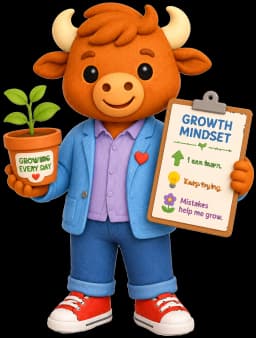
“I can't do this.”
Every elementary teacher has heard it. A student hits a math problem they cannot solve, a writing prompt they cannot start, or a social situation they cannot navigate, and they shut down. The belief behind the shutdown is specific and measurable: this student believes their ability is fixed, and this task has just exceeded it.
Growth mindset, the belief that abilities can be developed through effort, effective strategies, and help from others, directly addresses this pattern.[1] It is not a motivational slogan. It is a learnable cognitive framework that changes how students interpret difficulty, mistakes, and feedback. When taught well, it shifts students from “I can't do this” to “I can't do this yet,” and that single word changes the trajectory of their response.
Growth mindset instruction maps directly to self-awareness, the first CASEL competency. Students who can identify their own thoughts about learning, recognize when they are operating from a fixed mindset, and consciously reframe those thoughts are practicing a foundational social-emotional skill. This is not a detour from SEL instruction. It is SEL instruction.
What the Research Actually Shows
Growth mindset is one of the most studied concepts in educational psychology. It is also one of the most oversimplified. The evidence is real, but it comes with important qualifiers that affect how teachers should implement it.
The Landmark Studies
Carol Dweck's original research established the core distinction: students who believe intelligence is malleable (growth mindset) respond to challenges differently than students who believe intelligence is fixed.[1] They persist longer, seek more effective strategies, and interpret failure as information rather than verdict.
A landmark 2019 national experiment published in Nature, the National Study of Learning Mindsets, tested a brief online growth mindset intervention with over 12,000 ninth graders in a nationally representative sample. The intervention improved grades among lower-achieving students and increased enrollment in advanced mathematics courses.[2] Critically, the effects were strongest in schools where peer norms supported the growth mindset message, suggesting that classroom culture matters as much as the intervention itself.
A 2022 meta-analysis by Burnette et al. synthesizing growth mindset intervention research found that with high-fidelity implementation and targeted populations, academic achievement effects averaged d = 0.14 and mental health effects averaged d = 0.32.[3] The mental health effect is notable: growth mindset instruction appears to benefit students' psychological wellbeing even more reliably than their test scores.
The Important Qualifiers
Praising effort alone does not build a growth mindset. Dweck herself has cautioned against “false growth mindset,” where teachers equate growth mindset with effort and then praise effort even in the absence of progress or strategy.[4] A student who tries hard but uses the same ineffective approach repeatedly is not demonstrating growth mindset. They are demonstrating persistence without strategy, and praising that pattern reinforces it.
Classroom environment must support the message. The Yeager et al. (2022) study found that a direct-to-student growth mindset intervention only improved academic performance when students were taught by teachers who personally endorsed growth mindset beliefs.[5] The researchers described this as planting a seed in fertile versus infertile soil. A teacher who talks about growth mindset on Monday but sorts students into ability groups on Tuesday is sending a contradictory message.
Sustained instruction beats one-time interventions. Brief, one-time interventions can shift beliefs but sustained change requires sustained instruction. The most effective implementations embed growth mindset concepts into daily classroom practice rather than treating them as a standalone lesson or assembly topic.[4][5]
The Neuroscience That Makes It Concrete
For elementary students, growth mindset becomes real when they learn that their brain physically changes when they learn. This is not metaphor. It is neuroscience.
What Students Can Understand
Neuroplasticity, the brain's ability to reorganize itself by forming new neural connections, is well-documented in children.[6] When a student practices a new skill, neurons in the relevant brain regions fire together repeatedly, strengthening the connections between them. With continued practice, these connections become faster and more efficient. This is, literally, the brain growing.
Elementary students do not need to understand synaptic pruning or myelination. They need to understand three things:
These three facts are accurate, age-appropriate, and powerful. They give students a physiological explanation for why effort works, which is far more convincing than a poster telling them to “try harder.”
How to Teach Brain Science by Grade Band
K-2 Students
Keep the explanation physical and visual. The brain is like a muscle that gets stronger with practice. When you learn something new, your brain builds a tiny bridge. The more you practice, the stronger the bridge gets. Use hand gestures: fingers spreading apart to show neural connections forming.
Grades 3-5
Introduce slightly more precision. Your brain is made of billions of tiny cells called neurons. When you learn, neurons connect to each other. Practicing a skill makes those connections faster and stronger, which is why things get easier over time. Mistakes actually help your brain grow because they force your brain to try different pathways. You can introduce the word “neuroplasticity” with upper elementary students. They remember it, and knowing the scientific term gives them ownership of the concept.
Growth Mindset as Self-Awareness Practice
Growth mindset instruction is most effective when framed as an SEL competency rather than a standalone character trait. Self-awareness, the ability to recognize your own emotions, thoughts, and values and understand how they influence your behavior, is the mechanism through which growth mindset operates.
A student using growth mindset is doing several self-awareness tasks simultaneously: noticing their internal reaction to difficulty (“I feel frustrated”), identifying the belief driving that reaction (“I think I'm not smart enough to do this”), evaluating whether that belief is accurate (“Is this actually something I can't learn, or is it something I haven't learned yet?”), and choosing a different response based on that evaluation (“I'll try a different strategy”).
Connecting to Other CASEL Competencies
Self-Management
Persevering through difficulty requires regulating the frustration that comes with it. A student who knows their brain is growing during a challenge is better equipped to manage the discomfort.
Social Awareness
Understanding that other people also struggle and grow builds empathy. When students see a classmate succeed after visible effort, growth mindset gives them a framework for understanding what happened.
Relationship Skills
Asking for help is a growth mindset behavior. Students who believe ability is fixed avoid asking for help because it confirms their limitation. Students who believe ability is malleable see help as a learning strategy.
Responsible Decision-Making
Choosing to attempt a challenging task instead of avoiding it is a decision. Growth mindset provides the reasoning framework for making that choice.
Practical Classroom Strategies
Reframe Fixed Mindset Language in Real Time
The most immediate and effective growth mindset strategy is catching fixed mindset statements as they happen and modeling the reframe.
| Student says | Teacher reframes |
|---|---|
| “I can't do this.” | “You can't do this yet. What's the part that's tripping you up?” |
| “This is too hard.” | “This is hard, which means your brain is working. What strategy could you try?” |
| “I'm not good at math.” | “You're still learning math. What part of math feels hardest right now?” |
| “I made a mistake.” | “Good. Mistakes are data, not verdicts. What did this one teach you?” |
| “She's better than me.” | “She's had more practice. What can you learn from watching her approach?” |
Notice that every reframe does two things: it corrects the fixed mindset belief and it redirects to a specific next action. The reframe without the action is incomplete.
Teach “Yet” as a Thinking Tool
The word “yet” is the simplest growth mindset intervention available. When students add “yet” to a fixed mindset statement, they transform it from a conclusion into a status update.
This works best when students practice identifying fixed mindset thoughts first, then applying “yet” as a deliberate strategy. It is not enough to tell students to say “yet.” They need to understand why it works: because it changes a statement about permanent ability into a statement about current progress, which aligns with how the brain actually learns.
Normalize Mistakes as Learning Data
Students in growth mindset classrooms need to see mistakes treated as information, not failure. This requires consistent, specific teacher behavior:
When a student makes a mistake publicly, respond with curiosity, not correction. “Interesting. Walk me through your thinking on that.” This models that the thinking process matters more than the answer.
Share your own mistakes. “I tried a new recipe this weekend and it was terrible. But I figured out what went wrong, so next time I'll adjust the temperature.” Adults modeling growth mindset in low-stakes contexts gives students permission to do the same in high-stakes ones.
Create classroom language around mistakes. “Mistakes are data, not verdicts” is one example. Whatever phrase you use, repeat it until students use it themselves without prompting.
Use Stories and Characters
Young children learn abstract concepts best through narrative. A story about a character who faces a challenge, feels frustrated, considers giving up, tries a new strategy, and eventually succeeds is a complete growth mindset lesson delivered through a medium children are already wired to process.
The most effective growth mindset stories share several features: the character's struggle is genuine and relatable (not trivially easy), the character's internal thoughts are made visible to the reader, the turning point involves a strategy change rather than just more effort, and the resolution is earned rather than handed to the character.
Praise Process, Not Person
The research on praise and mindset is specific.[1] Praise that attributes success to fixed traits (“You're so smart”) reinforces fixed mindset. Praise that attributes success to process (“You tried three different strategies before you found one that worked”) reinforces growth mindset.
This kind of praise is harder than “Good job” because it requires the teacher to observe and name specific behaviors. But it is meaningfully more effective because it tells the student exactly what to repeat next time.
What to Avoid
Treating growth mindset as a personality trait
Growth mindset is not something students either have or do not have. Everyone holds a mix of growth and fixed mindset beliefs that vary by domain. A student might have a strong growth mindset about reading and a fixed mindset about math. The goal is not to make students “growth mindset people.” It is to help them recognize when they are operating from a fixed mindset and choose to shift.
Equating growth mindset with effort
This is the most common implementation error. A student who tries hard but never changes their approach is not demonstrating growth mindset. Growth mindset includes effort, but it also includes seeking effective strategies, asking for help, learning from mistakes, and adjusting approaches based on feedback.[4] Praising effort without progress reinforces the idea that trying hard is sufficient, which is inaccurate and eventually discouraging.
Using growth mindset to dismiss real difficulty
“You just need a growth mindset” is not an appropriate response to a student with a learning disability, a student dealing with trauma, or a student who lacks foundational skills for the task at hand. Growth mindset is a cognitive framework that supports learning. It does not replace accommodations, differentiated instruction, or targeted intervention when those are what a student needs.
Making it a one-time lesson
A single growth mindset lesson or assembly produces short-term belief change that fades without reinforcement. The schools that see lasting results are the ones that embed growth mindset language, praise patterns, and mistake-handling into daily classroom practice over months and years.[5] It needs to become part of the classroom culture, not a calendar event.
Ignoring teacher mindset
Students in classrooms where teachers personally endorse growth mindset beliefs show stronger growth mindset development than students in classrooms where teachers teach the concept but do not embody it.[5][7] If you talk about growth mindset but use ability grouping that communicates fixed expectations, students will absorb the practice, not the lesson.
Fitting Growth Mindset Into Your Schedule
Growth mindset instruction does not require a separate block of time. It integrates into existing routines.
Morning Meeting (5-10 minutes)
Open with a growth mindset prompt: “Share a time this week when something felt hard and you kept going.” Follow with a brief partner share. This normalizes struggle as a daily experience rather than a sign of inadequacy.
During Academic Instruction
Growth mindset is most powerful when applied to real academic challenges in real time. When a student hits a wall during math or writing, that moment is the lesson. The fixed mindset thought is live, which means the reframe is authentic rather than hypothetical.
After Mistakes and Setbacks
Debrief mistakes explicitly. “What happened? What did you learn? What will you try differently?” This three-question sequence turns a negative experience into usable data and reinforces the growth mindset pattern of learning from failure.
Weekly SEL Block
If your school has dedicated SEL time, use it for deeper growth mindset activities: reading a story about a character who struggles, practicing fixed-to-growth reframes, or discussing how the brain changes with practice. Projector-based interactive activities work well here because they engage the whole class simultaneously without requiring individual student devices.
Measuring Growth
Tracking growth mindset development does not require a formal assessment. Look for observable indicators:
Language Shifts
Are students using “yet” spontaneously? Are they reframing fixed mindset statements without prompting? Are they using growth mindset language with each other, not just with the teacher?
Behavioral Indicators
Are students more willing to attempt challenging tasks? Are they asking for help more frequently? Are they persisting longer before giving up? Are they responding to mistakes with curiosity rather than distress?
Discussion Quality
In classroom discussions, are students referencing growth mindset concepts when discussing characters' decisions? Are they connecting brain science to their own experiences?
Student Self-Reflection
For grades 2-5, periodic self-assessments asking students to identify fixed and growth mindset thoughts they noticed in themselves during the week. This builds metacognitive awareness and gives teachers data.
Final Thoughts
Growth mindset is not magic. It does not make hard things easy. It does not guarantee success. What it does, when taught accurately and consistently, is give students a framework for interpreting difficulty that leads to more productive behavior: persisting, seeking strategies, asking for help, and learning from mistakes rather than being defined by them.
The neuroscience backs this up. The brain does grow and change with practice.[6] Mistakes do activate learning processes that success alone does not.[1] These are facts, and when students understand them, their relationship with difficulty changes.
The most effective growth mindset instruction is not a poster or an assembly. It is a teacher who models growth mindset in their own language, embeds it in daily academic instruction, praises process over person, treats mistakes as data, and creates a classroom culture where struggle is expected, supported, and valued.[5][7]
Start with one reframe. Practice it until it becomes automatic. Build from there.
References
- [1]
Dweck, C. S. (2006). Mindset: The new psychology of success. New York: Random House.
- [2]
Yeager, D. S., Hanselman, P., Walton, G. M., et al. (2019). A national experiment reveals where a growth mindset improves achievement. Nature, 573, 364-369.
https://doi.org/10.1038/s41586-019-1466-y - [3]
Burnette, J. L., Billingsley, J., Banks, G. C., Knouse, L. E., Hoyt, C. L., Pollack, J. M., & Simon, S. (2022). A systematic review and meta-analysis of growth mindset interventions: For whom, how, and why might such interventions work? Psychological Bulletin, 149(3-4), 174-205.
https://doi.org/10.1037/bul0000368 - [4]
Dweck, C. S. & Yeager, D. S. (2019). Mindsets: A view from two eras. Perspectives on Psychological Science, 14(3), 481-496.
https://doi.org/10.1177/1745691618804166 - [5]
Yeager, D. S., Carroll, J. M., Buontempo, J., Cimpian, A., et al. (2022). Teacher mindsets help explain where a growth-mindset intervention does and doesn't work. Psychological Science, 33(1), 18-32.
https://doi.org/10.1177/09567976211028984 - [6]
Weyandt, L. L., Clarkin, C. M., Holding, E. Z., et al. (2020). Neuroplasticity in children and adolescents in response to treatment intervention: A systematic review of the literature. Clinical and Translational Neuroscience, 4(4).
https://doi.org/10.1177/2514183X20974231 - [7]
Rissanen, I., Kuusisto, E., Tuominen, M., & Tirri, K. (2019). In search of a growth mindset pedagogy: A case study of one teacher's classroom practices in a Finnish elementary school. Teaching and Teacher Education, 77, 204-213.
https://doi.org/10.1016/j.tate.2018.10.002 - [8]
Sarrasin, J. B., Nenciovici, L., Foisy, L-M. B., Allaire-Duquette, G., Riopel, M., & Masson, S. (2018). Effects of teaching the concept of neuroplasticity to induce a growth mindset on motivation, achievement, and brain activity: A meta-analysis. Trends in Neuroscience and Education, 12, 22-31.
https://doi.org/10.1016/j.tine.2018.07.003
Help Students Build a Growth Mindset Every Week
Be The Buffalo teaches growth mindset through interactive projector activities, songs, stories, and printable worksheets. 40 weeks of CASEL-aligned K-5 lessons. Bilingual. No student devices required.
Sign Up FreeRelated Resources
Teaching Perseverance to Elementary Students
How to build the capacity to keep going when things get hard, without glorifying struggle
Understanding the CASEL Framework
A simple guide to the five CASEL competencies and how teachers use them
Goal Setting for Elementary Students
How to teach K-5 students to set, track, and achieve goals that build self-efficacy