Quick Answer
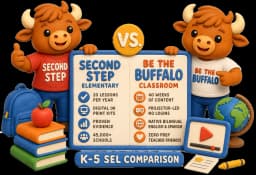
Second Step Elementary and Be The Buffalo Classroom are both K-5 focused social-emotional learning curricula. They differ substantially in delivery model, evidence base, prep footprint, and pricing.
Second Step Elementary, from Committee for Children, is a mature program with decades of research behind it. It delivers 20 lessons per grade per year across four units, offered as either a web-based digital program or a print classroom kit with puppets. Committee for Children reports use in 45,000+ schools.[1]
Be The Buffalo Classroom is a newer K-5 specific curriculum built around 40 weeks of projector-led whole-class content with zero teacher prep, no student accounts, and native bilingual English and Spanish delivery. Evidence base is currently in development.[8]
The right choice depends on whether you need the deepest published evidence base (Second Step), or lower prep, higher weekly dosage, and native bilingual delivery (Be The Buffalo).
Key Takeaways
- •Second Step delivers 20 lessons per year per grade. Be The Buffalo delivers 40 weeks of content per grade band. If weekly dosage matters to your implementation, that gap is meaningful.
- •Second Step's digital program is web-based and refreshed annually. Be The Buffalo runs entirely from the teacher's projector with no student devices required.
- •Second Step has multiple randomized controlled trials. Be The Buffalo does not yet. For districts where procurement requires ESSA-tier evidence, that matters.[7]
- •Second Step handles Spanish through full translation of student and family materials. Be The Buffalo handles Spanish as a native single-toggle bilingual delivery.
What is Second Step Elementary?
Second Step is published by Committee for Children, a nonprofit founded in 1979 and headquartered in Seattle. The Second Step Elementary curriculum covers Kindergarten through Grade 5 and is offered in two versions.[1]
Digital program
Web-based, accessed entirely at SecondStep.org. Four units per grade level, five lessons per unit, for 20 lessons per year. Lesson length runs 15–20 minutes for K-1 and 25–30 minutes for grades 2-5. The four units are Growth Mindset & Goal-Setting, Emotion Management, Empathy & Kindness, and Problem-Solving. The fifth lesson of each unit is a performance task where students demonstrate learning. Includes over 200 advisory activities such as Class Meetings, Service-Learning Projects, and Weekly Check-Ins.[2]
Classroom kits
Print-based, one kit per grade, with scripted lesson cards, posters, brain-builder games, and (in K-1) Puppy and Snail puppets. Weekly lessons run 20–35 minutes depending on grade level, followed by 5–10 minute daily reinforcement activities. Online access to lesson media in English or Spanish is included with each kit.[3]
2025–2026 updates
Committee for Children rebranded the program under a “human skills” framing, added 11 new videos and 33 additional lesson plans, and released Tier 2 small-group intervention resources (18 targeted lessons per grade band).[6]
Language support
All student-facing lesson materials and family communications are available in Spanish. Family communications are additionally available in Arabic, Chinese (simplified and traditional), Canadian French, Haitian Creole, Hmong, Korean, Russian, Somali, Tagalog, and Vietnamese.
Evidence
CASEL Program Guide lists Second Step Elementary with evidence of effectiveness in grades K-4. Multiple randomized controlled trials support the program, including Low et al. (2015), which studied 61 schools and 6,558 K-2 students across Arizona and Washington, and Low et al. (2019), a two-year impact study.[4][10][11]
Pricing
Evidence for ESSA lists Second Step Elementary at $2,359 for the K-5 Bundle. Actual district pricing for the digital program varies by school and district size. Contact Committee for Children for a current quote.[5]
What is Be The Buffalo Classroom?
Be The Buffalo Classroom is a K-5 specific social-emotional learning and character education curriculum published by Mindwired Labs LLC. Unlike Second Step, it was designed from the start for elementary grades only, without a K-12 vertical to accommodate.[8]
Structure. 40 weeks of content per grade band, organized across three elementary grade bands: K-1, 2-3, and 4-5.
Delivery model. Projector-led whole-class. The teacher opens the curriculum on their own computer and projects the daily or weekly content to the class. No student accounts. No student devices. No student login required.
Content library. Includes weekly projector activities, illustrated stories (including choose-your-own-adventure formats for grades 4-5), original SEL songs, printables, and a 40-week lesson planner with CASEL color-coding across the five competencies. Also includes safety modules covering topics such as lockdown response, delivered in age-appropriate format.
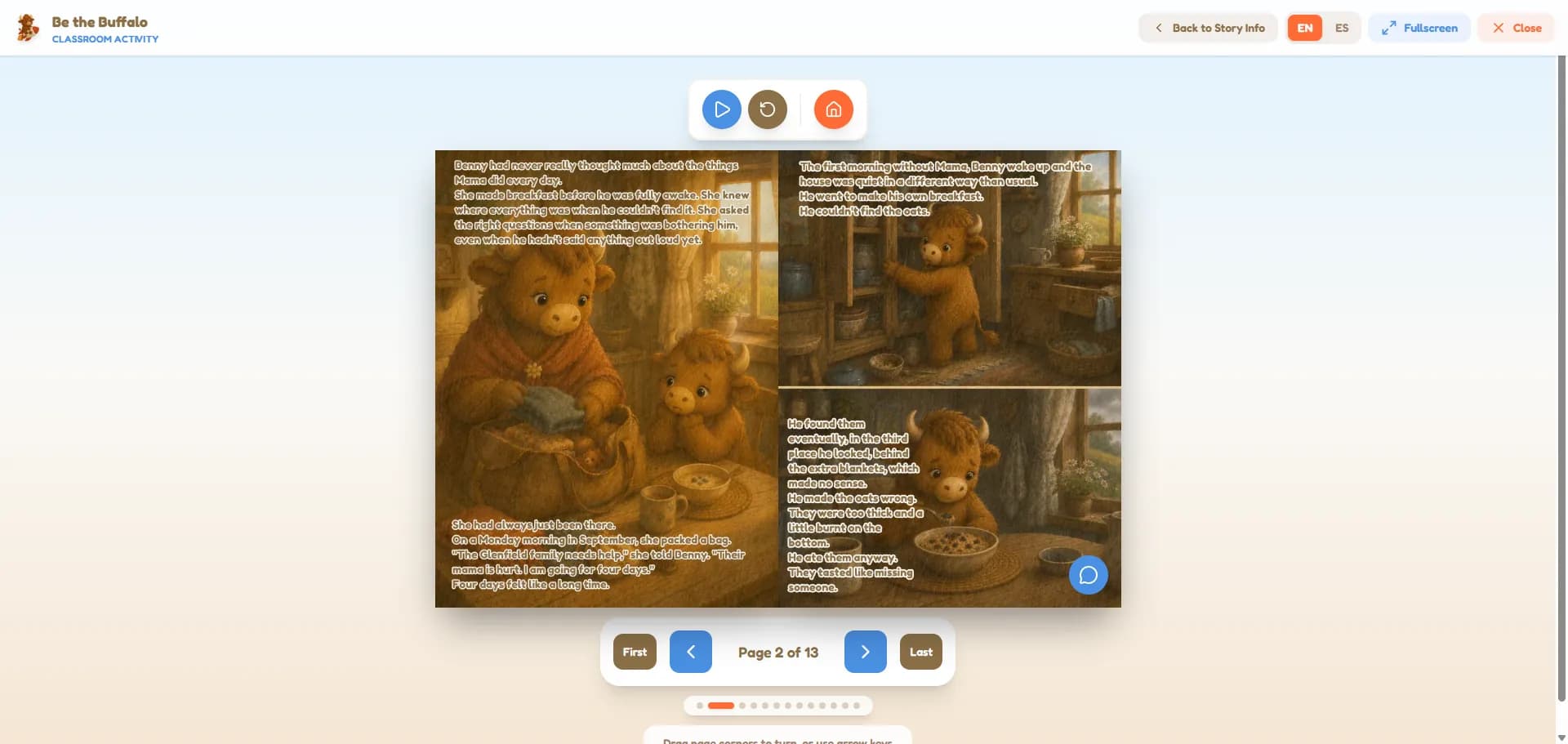
Be The Buffalo illustrated story activity, projected whole-class
Language support. English and Spanish are both native, delivered through a single toggle in the interface. Spanish is not a separate translated add-on but a built-in delivery mode with matching audio and text.
Prep time. Zero. Lessons are designed to be opened and taught without advance preparation.
Evidence. Currently building an evidence base. Not yet listed in CASEL Program Guide or Evidence for ESSA. CASEL competency alignment is documented.
Pricing. Free tier available covering the first four weeks of curriculum content. Full curriculum is $149.99 per teacher per year.
Direct Comparison
| Feature | Second Step Elementary | Be The Buffalo Classroom |
|---|---|---|
| Grade band | K-5 (part of PreK-12 vertical) | K-5 specific |
| Weekly content | 20 lessons per grade per year | 40 weeks per grade band |
| Grade organization | Per-grade (K, 1, 2, 3, 4, 5) | Grade bands (K-1, 2-3, 4-5) |
| Delivery, digital option | Web-based via SecondStep.org, teacher login | Projector-led whole class |
| Delivery, print option | Classroom kits with puppets and cards | Not offered |
| Lesson length | 15–30 minutes | Varies by content type |
| Teacher prep required | ~1 hour online training + per-lesson review | Zero |
| Student accounts required | No (teacher-facing platform) | No |
| Student devices required | No | No |
| Spanish support | Full translation of student and family materials | Native bilingual toggle |
| Additional languages | Family materials in 10 additional languages | English and Spanish only |
| CASEL Program Guide listed | Yes, K-4 evidence | Not yet listed |
| Published RCTs | Multiple | None yet |
| ESSA evidence tier | Yes | Not yet |
| Tier 2 small-group supports | Yes (added 2025–2026) | Not currently offered |
| Assessment toolkit included | Yes (universal screener, rubric) | Not currently offered |
| Character education component | Integrated with SEL | Explicit character education alongside SEL |
| Publisher | Committee for Children (nonprofit, founded 1979) | Mindwired Labs LLC (founded 2024) |
| Public pricing reference | $2,359 K-5 Bundle (per Evidence for ESSA); digital pricing varies | Free tier; $149.99/teacher/year |
| Free content available | No | Yes, first 4 weeks |
Delivery Model: What Actually Happens in the Classroom
The delivery models are structurally different, which affects how each program fits into a teacher's day.
Second Step digital
Teacher signs in to SecondStep.org, navigates to the current lesson, and delivers it from their screen. Requires an internet connection to access all program parts, including lessons, training, advisory activities, and the Leader Dashboard. Committee for Children recommends desktop, laptop, or tablet for teacher-facing use. Not recommended to project from a phone.[2]
Second Step classroom kits
Teacher pulls physical cards, posters, and materials from the kit. Streams accompanying media online. Puppets in the K-1 kits are used for lesson delivery to younger students.[3]
Be The Buffalo
Teacher opens the curriculum on their laptop or classroom computer and projects the day's or week's content. Whole class watches the same content together on the projector or smart board. No individual student accounts to manage, no login troubleshooting, no student device rotation.[8]
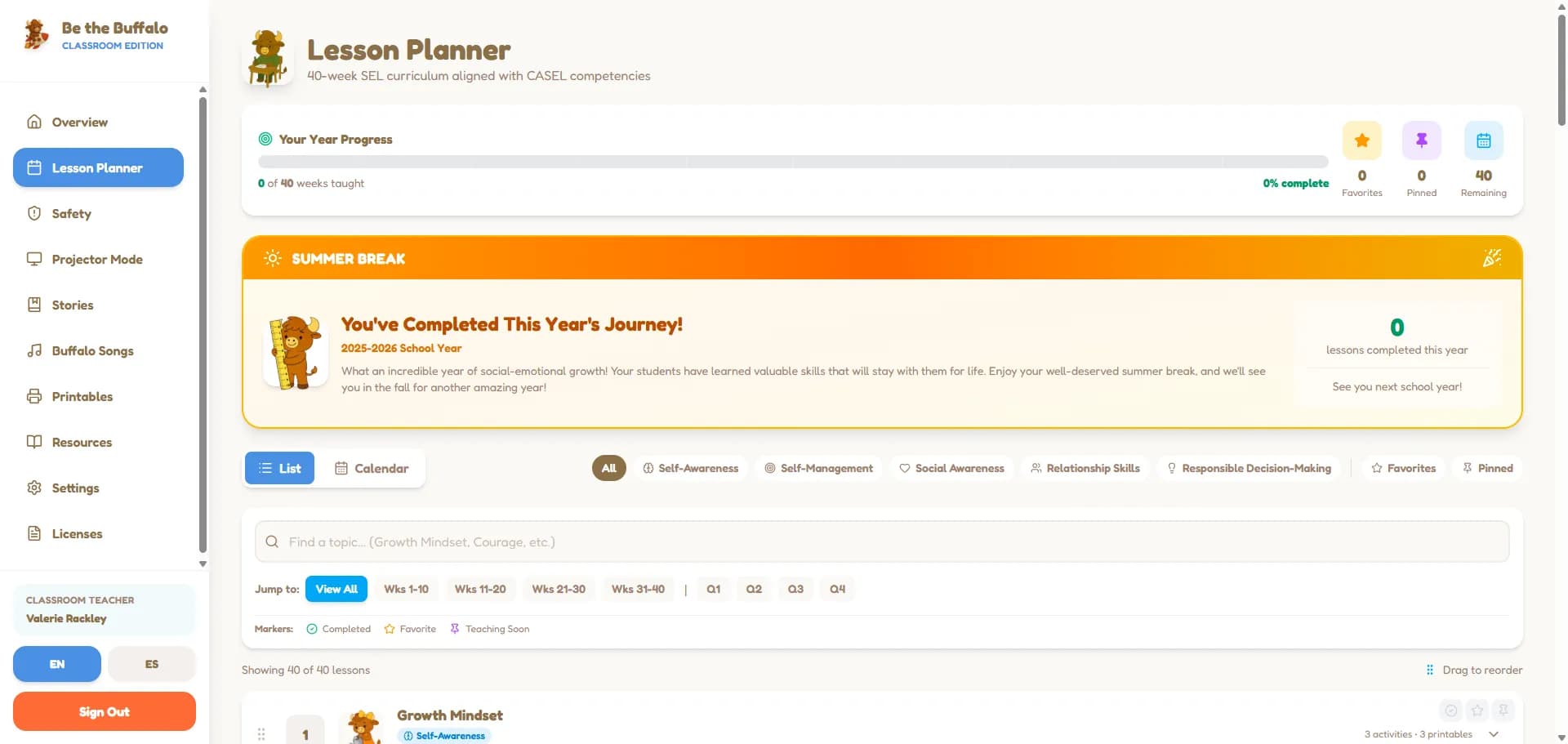
Be The Buffalo projector view — the teacher opens and projects, no student devices needed
The choice here often comes down to your school's device infrastructure and screen-time philosophy. Schools moving toward reduced student screen time or phone-free classrooms often prefer projector-based delivery. Schools that already have well-supported 1:1 device programs may find the digital platform model works fine.
Bilingual Support: Translation vs Native Toggle
Both programs support Spanish, but the delivery model matters if you have a large Spanish-speaking student population.
Second Step provides full Spanish translations of student-facing lesson materials and family communications. In practice, this means Spanish-speaking students and families receive translated versions of English-designed content.
Be The Buffalo builds English and Spanish as parallel native delivery modes, controlled by a single interface toggle. The Spanish audio and text are delivered as a native mode rather than as a translation layer on top of English content.
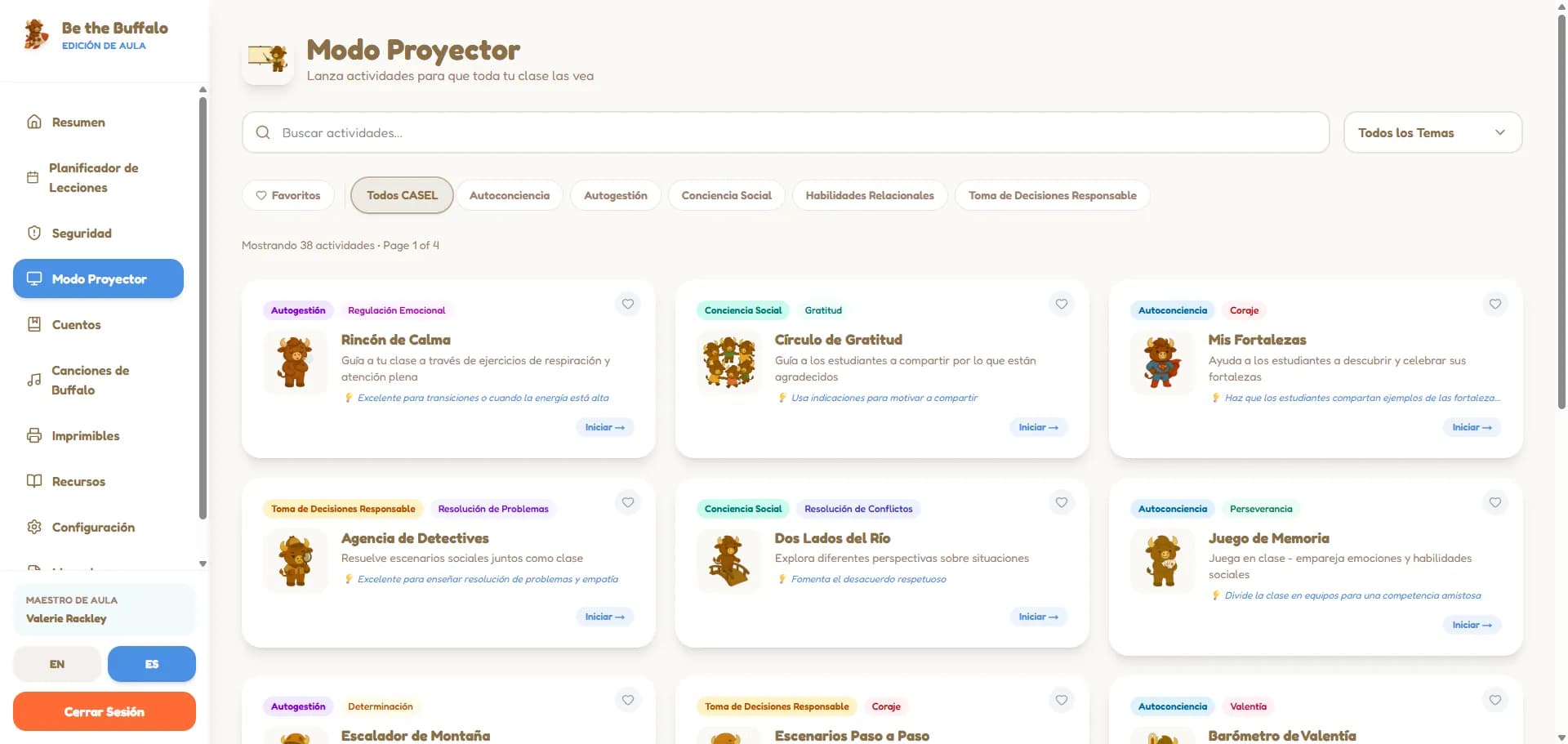
Be The Buffalo bilingual toggle — one click switches the entire lesson between English and Spanish
Both approaches can work. The native toggle model tends to be easier for classrooms that switch languages within a single lesson or serve mixed-language groups.
Evidence Base: The Honest Comparison
This is the axis on which Second Step has a clear advantage, and any comparison article that pretends otherwise is not worth trusting.
Second Step has decades of published research. The 2015 Low et al. study alone included 61 schools and over 6,000 students across two states. The program is listed in the CASEL Program Guide with evidence of effectiveness in grades K-4 and appears in Evidence for ESSA. Multiple randomized controlled trials support the program.[4][5][10]
Be The Buffalo does not yet have peer-reviewed research or an ESSA evidence tier rating. This is a real gap. For districts where procurement requires documented evidence at a particular tier, Second Step meets that bar and Be The Buffalo does not.
For teachers, counselors, and schools where the evidence tier is important but not the sole deciding factor, the comparison shifts to fit, dosage, prep, and delivery model.
Note on the Second Step evidence base
Not every study of Second Step has shown strong effects. The National Institute of Justice CrimeSolutions rated the 2011 edition of Second Step as “Ineffective” based on one specific study by Low et al. (2015), which found statistically significant reduction in hyperactivity but no significant differences on conduct problems, peer problems, social-emotional competence, or disruptive behaviors in that particular study. Committee for Children's more recent digital program studies show positive academic motivation, self-management, and school climate outcomes. The overall body of evidence is strong but not uniformly so, which is true of essentially every SEL curriculum on the market.[7]
Prep Time and Training
Second Step's digital program includes about one hour of online training across three modules, included in the purchase price. Beyond initial training, teachers preview and prepare lessons on a per-week basis. Committee for Children reports the classroom kits include “little to no prep time” beyond the training.[2]
Be The Buffalo advertises zero teacher prep. The curriculum is designed to open and teach without prior preparation. This is possible partly because delivery is projector-led whole-class rather than teacher-facilitated with scripted questions and student handouts.[8]
Prep time claims from any vendor deserve a grain of salt. The honest way to test them is to ask each vendor for a sample lesson at your grade level and time yourself preparing to teach it.
Cost and Total Cost of Ownership
Direct pricing comparison is difficult because the two programs price differently.
Second Step Elementary pricing available publicly: $2,359 for K-5 Bundle per Evidence for ESSA. Individual grade-level kits are also sold separately. Digital program pricing scales by school and district size and is quoted directly by Committee for Children. Committee for Children is a nonprofit publisher, which does not necessarily mean cheaper, but is a structural difference from for-profit vendors.[5]
Be The Buffalo pricing includes a free tier covering the first four weeks of curriculum. Full curriculum access is $149.99 per teacher per year. Because there is no separate print kit and no per-classroom hardware, total cost of ownership at the school level depends primarily on the number of subscribing teachers or the site license.[8]
For a small school or a single teacher, the free tier plus subscription model is likely to be lower total cost. For a large district that would already absorb Second Step's Committee for Children pricing across many schools, the total cost gap narrows and the decision shifts to fit rather than cost.
Which is Right for Your School?
Large district with procurement requirements for ESSA evidence tier. Second Step meets the evidence documentation bar. Be The Buffalo does not yet.
Elementary-only school or small charter network prioritizing K-5 fit. Both work. Be The Buffalo is K-5 specific by design; Second Step is elementary within a PreK-12 family of products.
School with limited device infrastructure or phone-free instructional philosophy. Be The Buffalo's projector-led delivery may fit better. Second Step's classroom kits are also print-based if that model appeals.
School with large Spanish-speaking population and mixed-language classrooms. Be The Buffalo's native bilingual toggle is designed for this. Second Step provides Spanish translations of student and family materials, which also serves this population but with a different UX.
Individual teacher, counselor, or small school with tight budget. Be The Buffalo's free tier removes the up-front barrier. Second Step's classroom kits can also be purchased per-grade at lower per-unit cost than a full bundle.
School that wants Tier 2 small-group intervention resources. Second Step added these for 2025–2026. Be The Buffalo does not currently offer a distinct Tier 2 product.
School that wants a universal screener and assessment toolkit bundled with the curriculum. Second Step includes an Assessment Toolkit. Be The Buffalo does not currently offer one.
Teacher whose priority is opening the curriculum and teaching it without preparation. Be The Buffalo's zero-prep model is built around this. Second Step's classroom kits are described as low prep after training.
What the Research Says
The overall SEL evidence base is well established. A 2011 meta-analysis by Durlak and colleagues, published in Child Development, reviewed 213 school-based SEL programs and found an 11-percentile-point academic achievement gain for students in SEL programs compared to controls. Follow-up meta-analyses in the years since have generally supported these findings, with the specific effect sizes and mediating factors continuing to be studied.[9]
At the program level, evidence quality varies. Second Step has one of the deepest independent research portfolios in the K-5 SEL space. Newer programs, including Be The Buffalo, are building evidence bases and have not yet published peer-reviewed studies.
Implementation quality matters as much as curriculum choice. A curriculum with strong published evidence that teachers do not actually teach with fidelity will underperform a curriculum with less published evidence that teachers actually use consistently.
How to Run a Fair Comparison at Your School
If you are choosing between Second Step and Be The Buffalo for a real adoption decision:
- 1Define your must-haves before looking at either program. Evidence tier requirements, delivery model preferences, budget ceiling, language demographics.
- 2Ask both vendors for a sample lesson at the grade level you teach. Actually teach it. Time your prep and delivery.
- 3Ask both vendors for their scope and sequence in writing. Second Step publishes theirs on their store page. Be The Buffalo can provide theirs on request.
- 4Ask both vendors about contract length, cancellation terms, and per-year pricing changes.
- 5If you can, talk to two current customer schools of similar size to yours for each program. Not just the reference schools the vendor introduces you to.
Sources
- Committee for Children. “Second Step Elementary.” secondstep.org/elementary-school-curriculum
- Committee for Children. “Second Step Elementary Digital Program.” secondstep.org/elementary-school-curriculum/digital-program
- Committee for Children. “Second Step Elementary Digital Programs.” store.secondstep.org
- CASEL Program Guide. “Second Step Elementary.” pg.casel.org
- Evidence for ESSA. “Second Step Social-Emotional Learning.” evidenceforessa.org
- Educational Records Bureau. “What's New in Second Step for 2025–2026.” erblearn.org
- National Institute of Justice CrimeSolutions. “Second Step for Elementary School (2011 Edition).” crimesolutions.ojp.gov
- Be The Buffalo Classroom. bethebuffaloclassroom.com
- Durlak, J. A., Weissberg, R. P., Dymnicki, A. B., Taylor, R. D., & Schellinger, K. B. (2011). The impact of enhancing students' social and emotional learning: A meta-analysis of school-based universal interventions. Child Development, 82(1), 405–432. PubMed
- Low, S., Cook, C. R., Smolkowski, K., & Buntain-Ricklefs, J. (2015). Promoting social-emotional competence: An evaluation of the elementary version of Second Step. Journal of School Psychology, 53, 463–477. PubMed
- Low, S., Smolkowski, K., Cook, C., & Desfosses, D. (2019). Two-year impact of a universal social-emotional learning curriculum: Group differences from developmentally sensitive trends over time. Developmental Psychology, 55(2), 415–433. PubMed
What the Research Says
(and Doesn't Say)
The overall SEL evidence base is well established. A 2011 meta-analysis by Durlak and colleagues found an 11-percentile-point academic achievement gain for students in SEL programs compared to controls.
At the program level, evidence quality varies. Second Step has one of the deepest independent research portfolios in the K-5 SEL space. Newer programs, including Be The Buffalo, are building evidence bases and have not yet published peer-reviewed studies.
Research also shows:
- Implementation quality matters as much as curriculum choice. A program only works if teachers actually use it.
- Fidelity drives outcomes. A curriculum with strong evidence that teachers don't teach consistently will underperform a curriculum with less evidence that teachers actually use.
- Not every study of Second Step has shown strong effects across all measured outcomes, which is true of essentially every SEL curriculum.
Follow-up meta-analyses since 2011 have generally supported Durlak's findings, with specific effect sizes and mediating factors continuing to be studied.
This article compares two specific K-5 SEL programs. Be The Buffalo publishes this article and is transparent about that relationship throughout.
Want to see how Be The Buffalo works?
Try the first four weeks free. No student accounts, no devices, no prep. Open and teach.
Sign Up FreeRelated Resources
Best SEL Curriculum for Elementary (2026 Guide)
A practical guide to choosing SEL curriculum that works in real K-5 classrooms
How to Choose an SEL Curriculum
What to look for, what to avoid, and the right questions to ask
Character Education vs. SEL
Where they overlap, where they diverge, and why it matters
Best Character Education Curriculum for Elementary Schools
K-5 character education programs ranked by classroom fit