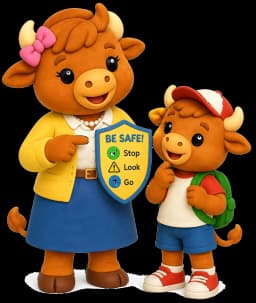
Safety drills save lives. They can also cause lasting anxiety in young children if handled poorly. The goal is not to choose between preparedness and wellbeing. It is to do both.
Ninety-eight percent of U.S. public schools practice lockdown drills.[1] Nearly a third of principals and teachers report being aware of students experiencing trauma or heightened anxiety afterward, with elementary school leaders reporting this at higher rates than secondary.[2] A 2023 study published in the Journal of School Violence found that traditional surprise drills increased anxiety in 87 percent of students surveyed, with effects lasting weeks.[3]
These numbers sit in tension. Schools are legally required to conduct safety drills. The Standard Response Protocol (SRP), now adopted by thousands of districts nationwide, provides a clear operational framework: Hold, Secure, Lockdown, Evacuate, and Shelter.[4] But operational clarity for adults does not automatically translate to emotional safety for a five-year-old sitting in the dark, quiet, and unsure whether the danger is real.
The challenge for elementary educators is specific: how do you teach young children to respond effectively in an emergency without introducing fear that outlasts the drill? The research points to a consistent answer: preparation before the drill matters more than the drill itself.
Why Young Children Respond Differently
The developmental gap between a kindergartner and a fifth grader is not just a matter of maturity. It reflects fundamental differences in how children process threat, understand abstract concepts, and regulate their emotional responses.
Pre-K Through Grade 2 (Ages 4-7)
Children at this stage experience tremendous progress in physical and social skills, but their capacity for abstract reasoning is limited.[5] They cannot reliably distinguish between a drill and a real emergency. They may not understand the concept of “practicing for something that probably won't happen.” They are highly attuned to adult emotional cues, meaning a teacher's anxiety during a drill can amplify their own.[6]
Grades 3 Through 5 (Ages 8-11)
These students have stronger cognitive skills and can understand the concept of practice and preparation. But they are also more aware of real-world events. They may have seen news coverage of school shootings. They are capable of imagining worst-case scenarios in a way that younger children are not, which introduces a different kind of anxiety: not confusion, but fear grounded in awareness.[5]
Both age groups require deliberate, differentiated approaches. A single drill protocol applied uniformly from kindergarten through fifth grade will either under-prepare older students or overwhelm younger ones.
What the Research Says About Effective Approaches
The National Academies of Sciences, Engineering, and Medicine published a comprehensive report in 2025 on school active shooter drills. The core recommendation: drills should be planned with a developmentally appropriate, trauma-informed approach that includes accessibility adaptations for students with functional and access needs.[5]
NASP and NASRO jointly recommend against highly sensorial drills that simulate a real experience, as these “can be traumatizing.”[2] Instead, they recommend:
Tennessee's Department of Education adds a critical point: schools should explicitly embed social-emotional competencies into daily instruction so that students already have coping skills before they ever participate in a drill.[7] This is where SEL instruction and safety instruction converge.
The SEL Connection: Self-Regulation Is a Safety Skill
A lockdown drill asks a kindergartner to do several things at once: stop what they are doing, move to a specific location, stay quiet, stay still, and manage their fear. Every one of those actions requires self-regulation, the second CASEL competency and one of the hardest skills for young children to develop.
A student who has practiced calming strategies (deep breathing, body awareness, focusing on a teacher's voice) in a low-stakes SEL lesson is better equipped to use those same strategies during a high-stakes drill. A student who has practiced following multi-step directions through classroom routines is better equipped to execute “Locks, Lights, Out of Sight” without freezing. A student who has learned to name and manage their emotions is less likely to spiral into panic when the hallway suddenly goes quiet.[7][8]
Safety preparedness does not start with the drill. It starts with the daily SEL instruction that gives students the internal tools to manage their response when the drill happens.
How to Teach Safety Without Teaching Fear
1Before the Drill: Build Understanding Through Story and Discussion
Use age-appropriate language
For K-2 students, avoid terms like “active shooter,” “intruder,” or “dangerous person.” Instead, use concrete, behavioral language: “Sometimes we practice being very quiet and safe in our classroom.”[3][6]
Introduce safety concepts through characters and stories
Young children learn best through narrative. A story about a character who practices being brave and quiet during a safety drill gives students a model to follow. This is the same mechanism that makes SEL read-alouds effective.[9]
Always announce drills in advance
NASP, NASRO, and the National Academies all recommend against unannounced drills for elementary students.[2][5][6] Tell students when the drill will happen, what it will look and sound like, and what they will do.
Practice the physical actions in low-stakes contexts first
Practice lining up quickly. Practice moving to the safe spot. Practice sitting still and silent for 60 seconds, then two minutes, then three. Build the behavioral muscle before combining all actions under drill conditions.[3][7]
Teach coping skills explicitly
Before the first drill, teach students one or two calming strategies: slow breathing, squeezing their hands together, focusing on the teacher's face. Frame these as “brave skills” or “calm body skills.” For students already practicing these through daily SEL instruction, the drill becomes another context to apply skills they already have.[7]
2During the Drill: Model Calm and Confidence
The teacher's affect sets the tone
A teacher who appears calm, steady, and in control communicates safety more effectively than any instruction. A teacher who appears anxious signals danger, even during a drill.[6][7]
Use a quiet, steady voice
“Let's move to our safe spot. Quiet bodies. I'm right here with you.” Avoid rushing, raising your voice, or adding unnecessary urgency.
Keep the drill brief
For K-2, an initial lockdown practice of two to three minutes is sufficient. Extend gradually. A 20-minute lockdown drill for kindergartners is not developmentally appropriate.[5]
3After the Drill: Process and Reassure
Debrief immediately
Take five minutes to talk with students. Ask what they noticed. Ask how their body felt. Normalize any fear: “Some people feel a little nervous during practice, and that is okay. That is why we practice, so it feels less scary each time.”[6][7]
Reinforce what they did well
“You moved to the safe spot so quickly. You were so quiet. You used your calm breathing.” Positive reinforcement builds confidence and makes the next drill less intimidating.
Watch for delayed reactions
Some children will seem fine during and after the drill but show signs of anxiety later: difficulty sleeping, reluctance to go to school, regression in behavior, or repeated questions about safety.[6]
Do not use drills as the only safety instruction
Ongoing, low-stakes safety instruction throughout the year keeps the drill in context as one part of a broader preparedness routine, not a standalone fear-inducing event.[7]
Adapting for Different Safety Scenarios
The SRP covers five response types, each requiring slightly different developmental considerations for young children.[4]
Hold — “In Your Classroom or Area”
The easiest for young children. Frame it as “We stay in our room and keep learning.”
Secure — “Get Inside, Lock Outside Doors”
For young children: “The grownups are locking the outside doors to keep everyone safe inside. We stay in our classroom.”
Lockdown — “Locks, Lights, Out of Sight”
The most challenging because it requires silence, stillness, and darkness. Build up gradually. Practice quiet and stillness separately before combining with lights off. Use calming strategies explicitly.
Evacuate
Frame as “We walk together to our outside spot, just like a fire drill.” Connect the new concept to the familiar one.
Shelter
Frame around the physical action: “We go to the hallway, sit down, and cover our heads.” Weather drills are often less anxiety-producing because children can understand weather as a natural event.
What to Avoid
Simulations and role-play of actual emergencies
NASP and NASRO explicitly recommend against simulations that mimic real events for elementary students.[2] No fake gunshot sounds, no actors pretending to be intruders, no scenarios designed to provoke a realistic fear response.
Telling young children the specific threats drills are designed for
A kindergartner does not need to know what an active shooter is. They need to know how to follow their teacher to a safe spot and be quiet.[5][6]
Using fear as a motivator
“We have to be really quiet because if someone hears us, something bad could happen” is not appropriate for young children. Replace with: “We practice being quiet so we get really good at it. Let's see how quiet we can be.”
Conducting drills without prior SEL groundwork
If students have never practiced calming strategies, emotional vocabulary, or following multi-step directions under calm conditions, a lockdown drill introduces all of those demands simultaneously in a high-stress context. Teach the skills first.[7]
Communicating With Families
Parents are often anxious about safety drills, sometimes more so than their children. Proactive communication reduces this and builds trust.
Notify families before drills
Send a brief message at least several days in advance explaining what will be practiced, how it will be conducted, and what language will be used.[6]
Provide opt-out or accommodation options
For students with known trauma histories or significant anxiety, offer alternatives: participating from a different location, observing rather than participating, or receiving safety instruction one-on-one.[5]
Share post-drill information
After a drill, send a brief follow-up noting what was practiced and what to watch for (changes in sleep, mood, or school avoidance).
Final Thoughts
School safety drills are not optional. Every state requires some form of emergency preparedness practice. The question is not whether to drill, but how.
For K-5 students, the answer is consistent across every major professional organization: use developmentally appropriate language, prepare students before the drill, keep it brief, avoid simulations, debrief afterward, and build the underlying self-regulation skills through daily instruction so that students have coping tools before they need them.[2][5][6][7]
The schools that handle safety drills best are not the ones with the most elaborate security systems. They are the ones where students have already learned, through daily practice, how to listen to their teacher, manage their bodies, regulate their emotions, and trust that the adults around them will keep them safe. That foundation is built through consistent SEL and character education instruction, not through the drills themselves.
Preparedness without fear is not a contradiction. It is a design choice.
References
- [1]
U.S. Department of Education, National Center for Education Statistics. (2024). School Survey on Crime and Safety, 2021-22 (NCES 2024-054).
https://nces.ed.gov/pubs2024/2024054.pdf - [2]
RAND Corporation. (2025). Are active shooter drills in K-12 schools aligned with best practices? Insights from recent surveys of educators.
https://www.rand.org/pubs/research_reports/RRA3930-7.html - [3]
PrepareED. (2025). Rethinking lockdown drills: Evidence-based best practices for 2026.
https://www.prepareed.com/post/rethinking-lockdown-drills-evidence-based-best-practices-for-2026 - [4]
The “I Love U Guys” Foundation. (2025). Standard Response Protocol K-12 operational guidance, version 4.2.
https://iloveuguys.org/The-Standard-Response-Protocol.html - [5]
National Academies of Sciences, Engineering, and Medicine. (2025). School active shooter drills: Mitigating risks to mental, emotional, and behavioral health. Washington, DC: The National Academies Press.
https://www.nationalacademies.org/read/29105/chapter/8 - [6]
National Association of School Psychologists. (2018). Mitigating psychological effects of lockdowns.
https://www.nasponline.org/resources-and-publications/resources-and-podcasts/school-safety-and-crisis/systems-level-prevention/mitigating-psychological-effects-of-lockdowns - [7]
Tennessee Department of Education. (n.d.). Tips for conducting trauma-informed drills.
https://www.tn.gov/content/dam/tn/education/safety/save-act/Trauma_Informed_Drills.pdf - [8]
Durlak, J. A., Weissberg, R. P., Dymnicki, A. B., Taylor, R. D., & Schellinger, K. B. (2011). The impact of enhancing students' social and emotional learning: A meta-analysis of school-based universal interventions. Child Development, 82(1), 405-432.
https://doi.org/10.1111/j.1467-8624.2010.01564.x - [9]
American Psychological Association. (2026). Do active shooter drills make students safer? Monitor on Psychology, 57(1).
https://www.apa.org/monitor/2026/01-02/active-shooter-drills-safety
Build the Self-Regulation Skills Students Need
Be The Buffalo teaches calming strategies, emotional vocabulary, and self-regulation through daily K-5 lessons. No student devices. No prep. The same skills that make safety drills less scary.
Sign Up Free