Quick Answer
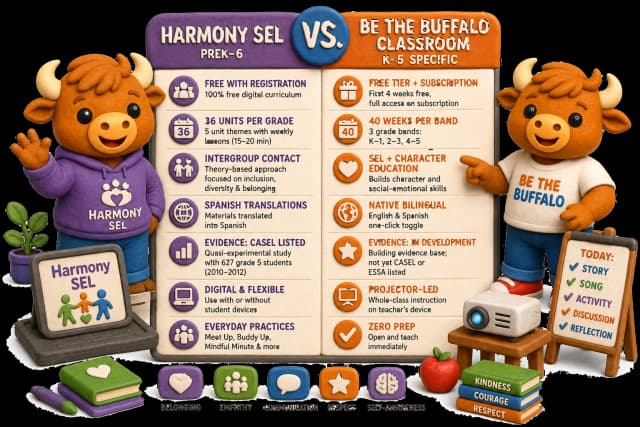
Harmony SEL is a free PreK-6 social-emotional learning curriculum offered by National University through Harmony Academy. It was rebuilt as Third Edition (rolled out 2022-2024) with grade-specific lessons designed to run 15-20 minutes. Its pedagogical foundation is intergroup contact theory, with explicit focus on relationship-building, cultural competence, and inclusive classroom community.[1][3]
Be The Buffalo Classroom is a K-5 specific SEL and character education curriculum with 40 weeks of projector-led whole-class content per grade band, native bilingual English and Spanish delivery, and a free tier covering the first four weeks.[8]
The comparison usually comes down to two questions. First, is free actually cheaper once you count teacher prep time? Second, do you want intergroup-contact-focused SEL (Harmony) or character-education-integrated SEL (Be The Buffalo)? These are the honest decision points, and the article below walks through both.
Key Takeaways
- •Harmony SEL is fully free with registration. Be The Buffalo has a free tier for the first four weeks and a paid subscription for the full 40-week curriculum.
- •Harmony's evidence base is CASEL-recognized but limited: one 2010-2012 quasi-experimental study of 627 grade 5 students in a suburban Southwest US district. CASEL lists evidence at grade 5 only, not full PreK-6.[3][7]
- •Harmony's pedagogical foundation is intergroup contact theory with explicit cultural competence framing. Be The Buffalo integrates character education with CASEL SEL competencies. These are genuinely different content approaches.
- •Both offer Spanish support, delivered differently. Harmony translates materials. Be The Buffalo delivers English and Spanish as parallel native modes.
- •Free curriculum is not zero cost. Teacher prep time is the actual cost. Whether Harmony is cheaper than Be The Buffalo depends on how much of that time you value.
What is Harmony SEL?
Harmony SEL is a PreK-6 SEL curriculum published by National University through Harmony Academy. The program originated at Arizona State University with funding from T. Denny Sanford (as Sanford Harmony) and moved to National University in 2020. The Third Edition rolled out beginning in 2022 with revised lesson structure.[1][2]
Structure
Five unit themes per grade level: being one's best self, valuing others, communicating with others, learning from others, and building community. Third Edition provides grade-specific content for each grade PreK-6. A pre-unit called “First 10 Days” provides community-building activities to begin the school year.
Weekly components
Beyond formal lessons, Harmony centers “Everyday Practices” designed to run 3-5 times per week: Meet Up (whole-class community meeting), Buddy Up (partner activities), Quick Connection Cards, and Mindful Minute. Formal lessons in Third Edition run 15-20 minutes each.
Delivery
Free digital resources accessed through the Harmony Online Learning Portal. Works on computer, iOS, and Android. Can be used with or without student devices. Includes storybooks, digital games, sing-along songs, printables, and lesson plans.
Language support
Spanish translated materials available. Not a native bilingual toggle; translation is a separate parallel resource.
Pedagogical foundation
Rooted in intergroup contact theory, which posits that structured, sustained contact between diverse groups reduces bias and improves relationships. Third Edition explicitly incorporates cultural competence, equity, and student voice as design priorities.[4]
Family and out-of-school components
Harmony at Home online toolkit, Home-School Connections for each unit, Harmony Game Room App, and Distance Learning Guide.
Professional learning
Free Inspire Teaching and Learning modules cover educator SEL and Harmony implementation. A paid Harmony Academy Certificate for Educators is available for structured professional development (four micro-credentials).[6]
Evidence
CASEL Select designation. The supporting evidence is one quasi-experimental study conducted in 2010-2012, published in 2017, of 627 fifth-grade students in a suburban school district in the Southwest United States. Study findings: greater classroom identification and school liking, higher GPA, and fewer teacher-reported aggressive behaviors compared to controls. CASEL lists Harmony with evidence of effectiveness at grade 5, not full PreK-6.[3][7]
Cost
Free with registration.
What is Be The Buffalo Classroom?
Be The Buffalo Classroom is a K-5 specific SEL and character education curriculum published by Mindwired Labs LLC.[8]
- •Structure: 40 weeks of content per grade band. Three elementary grade bands: K-1, 2-3, and 4-5.
- •Delivery: Projector-led whole class. Teacher opens the curriculum on their own device and projects the day's or week's content. No student accounts. No student devices required.
- •Content library: Weekly projector activities, illustrated stories (including choose-your-own-adventure formats for grades 4-5), original SEL songs, printables, and a 40-week lesson planner with CASEL color-coding. Safety modules cover topics such as lockdown response in age-appropriate format.
- •Pedagogical foundation: Integrates character education explicitly with CASEL SEL competencies. The buffalo metaphor centers resilience and running into difficulty rather than away from it.
- •Language support: English and Spanish delivered as parallel native modes through a single interface toggle.
- •Prep time: Advertised as zero.
- •Evidence: No published evaluation at this time. Not listed in the CASEL Program Guide or Evidence for ESSA. CASEL competency alignment documented.
- •Cost: Free tier covering the first four weeks of content. Full curriculum on subscription.
Direct Comparison
| Feature | Harmony SEL | Be The Buffalo |
|---|---|---|
| Grade band | PreK-6 | K-5 specific |
| Weekly instructional structure | 5 unit themes, grade-specific lessons 15-20 min each | 40 weeks per grade band |
| Grade organization | Per-grade (PreK, K, 1, 2, 3, 4, 5, 6) | Grade bands (K-1, 2-3, 4-5) |
| Delivery model | Digital portal, teacher-facing, flexible use | Projector-led whole class |
| Everyday practices | Meet Up, Buddy Up, Quick Connection Cards, Mindful Minute | Not structured this way |
| Pre-unit | First 10 Days | Not structured this way |
| Teacher prep required | Substantial (extensive resource navigation) | Advertised as zero |
| Training | Free on-demand modules; paid Certificate available | Not required |
| Student accounts required | No | No |
| Student devices required | No (portal accessed by teacher) | No |
| Spanish support | Translated materials | Native English/Spanish toggle |
| Additional languages | Not documented | English and Spanish only |
| Pedagogical foundation | Intergroup contact theory, cultural competence | Character education + CASEL SEL |
| CASEL Program Guide | Yes, CASEL Select, evidence at grade 5 | Not yet listed |
| Published evaluation | Yes (2010-2012 study, published 2017, 627 grade 5 students) | None yet |
| Family engagement tools | Harmony at Home, Game Room App, Home-School Connections | Printables for family use |
| Assessment toolkit | Not bundled | Not currently offered |
| MTSS Tier 2/3 | Not core to the product | Not currently offered |
| Character education | Not framed as character education | Explicit |
| Publisher | Harmony Academy (National University) | Mindwired Labs LLC |
| Founded | Originally as Sanford Harmony (~2008); Third Edition 2022 | 2024 |
| Cost | Free with registration | Free tier for 4 weeks; subscription for full curriculum |
The free question: is Harmony actually cheaper?
Any comparison article between a free program and a paid program that dodges this question is not useful.
Harmony is free. There is no subscription, no per-teacher license, no per-district contract. Any school, teacher, or counselor can register and access the full curriculum. This is a genuine advantage and the reason Harmony belongs in any K-5 SEL evaluation.
The unpaid cost is teacher time. Common Sense Education's review of Harmony SEL notes that the program “might feel overwhelming” at first and that “teachers will need to spend some time to figure out the best way to incorporate the lessons.” Harmony provides pacing guides, planning guides, and on-demand training to help, but the reviewer's conclusion is that “the level of detail and thought that went into building the curriculum, and filling gaps with supporting resources, is what sets Harmony SEL apart.” That level of resource depth is a feature, and it is also a prep-time cost.[5]
Be The Buffalo advertises zero teacher prep. Lessons are designed to be opened and taught without preparation, delivered as projector-led content.
The honest calculation for a school
- •If your teachers have time to explore, plan, and adapt from a rich resource library, Harmony's zero-dollar cost is likely a real net win.
- •If your teachers are already at capacity and need turn-key content that opens and teaches, a paid subscription that saves several hours of prep per week per teacher may cost less in effective time than a free program that requires navigation and adaptation.
The specific threshold depends on your local teacher hourly cost and how much prep time each program actually requires in your context. This is a decision worth doing the math on, not a decision to make on the sticker price alone.
Delivery model comparison
Both programs are flexible in delivery, and both work without required student devices. They differ in what the teacher is doing during a lesson.
Harmony SEL
Teacher accesses the Online Learning Portal and selects from lessons, storybooks, games, activities, or Everyday Practices. Weekly Everyday Practices (Meet Up, Buddy Up, Quick Connection Cards, Mindful Minute) run 3-5 times per week. Formal lessons run 15-20 minutes. Teacher facilitates in person; the portal provides materials, scripts, and supporting media.
Be The Buffalo
Teacher opens the curriculum on their device and projects it to the whole class. The projected content drives the lesson pacing; the teacher facilitates alongside it.
Practical difference: Harmony puts more instructional design decisions in the teacher's hands. Be The Buffalo makes those decisions in advance and gives the teacher a ready-to-project sequence. Neither is inherently better. Teachers who want to select, sequence, and customize from a rich library tend to prefer Harmony's model. Teachers who want turn-key delivery tend to prefer Be The Buffalo's.
Weekly structure and dosage
Harmony's Third Edition lessons are designed to run 15-20 minutes each. Combined with Everyday Practices at 3-5 times per week, total weekly dosage varies substantially by implementation choice. Harmony's own guidance notes flexibility: “as little as 10-20 minutes a day.”
Be The Buffalo provides 40 weeks of content per grade band. Weekly dosage varies by the specific content type used (projector activity, illustrated story, song, printable).
Direct comparison of lesson count is complicated by structural differences. Harmony organizes around units and Everyday Practices; Be The Buffalo organizes around weeks. A school committed to consistent weekly SEL instruction will likely find both usable, with the specific dosage decision made locally.
Bilingual support
Harmony provides Spanish translated materials. Content is authored in English and translated into Spanish for use with Spanish-speaking students and families.
Be The Buffalo delivers English and Spanish as parallel native modes through a single interface toggle. Spanish is designed as a first-class delivery mode, not a translation layer.
For classrooms with substantial Spanish-speaking populations that use both languages during instruction, the native toggle is functionally different from switching between English materials and Spanish translations. For classrooms where Spanish is primarily for family communication or occasional student support, translated materials serve well.
Evidence base
Harmony's evidence base is documented but narrow. Be The Buffalo's is not yet documented.
Harmony's supporting study is Miller, Kochel, and colleagues, conducted over the 2010-2012 school years and published in 2017. The study included 627 fifth-grade students in a suburban Southwest US school district. Findings: greater classroom identification and school liking, higher overall GPA, and fewer teacher-reported aggressive behaviors compared to controls, measured 26 weeks after baseline. CASEL Select designation is based on this study.[7]
Two contextual caveats worth naming:
- 1.Grade scope. The study is at grade 5 only. CASEL lists Harmony's evidence at grade 5, not the full PreK-6 range Harmony's product covers. Evidence for other grades is not established at the same tier.
- 2.Demographics. The study sample was drawn from a suburban school district with median household income $90,000-$99,000 and 56% white students. Generalizability to more racially and economically diverse populations, particularly Title I settings, is not established by this study alone. The Third Edition explicitly aims to broaden relevance for underserved populations, but Third Edition itself has not yet been evaluated in a published study.
- 3.Age of data. The study data is now over a decade old. Curriculum revisions since 2012 (including the full Third Edition rebuild) may improve outcomes or change them; the existing evidence base does not yet include Third Edition.
Be The Buffalo does not yet have a published evaluation. For districts that require CASEL-listed evidence, Harmony meets that bar at grade 5. Neither program meets an ESSA “Strong” evidence tier.
Pedagogical framework: intergroup contact versus character education
This is a real content difference and worth naming plainly.
Harmony: intergroup contact theory
The core idea: structured, sustained interaction between diverse groups (with equal status, cooperation toward shared goals, institutional support, and personal contact) reduces bias and improves relationships. Harmony's design centers relationship-building, cultural competence, equity, and student voice. Third Edition's explicit priorities include “enhancing cultural competence, equity, and student voices.”
Be The Buffalo: character education + SEL
Character education focuses on cultivating specific virtues (resilience, honesty, kindness, responsibility) through story, modeling, and practice. Be The Buffalo's name references the buffalo metaphor: buffalo turn into a storm and move through it rather than away from it. The curriculum centers resilience-forward character alongside social-emotional skill.
These are genuinely different content approaches. Some districts want intergroup-contact-focused SEL. Others want character-education-integrated SEL. Some want both. The choice is not about which framework is “better” but about which fits your community's stated priorities and instructional goals.
Do not assume this is politically neutral in the current environment. Depending on your state and district context, one framework may face more procurement scrutiny than the other. Verify your district's stated SEL priorities before assuming either is a safe default.
Which is right for your school?
How to run a fair comparison at your school
If you are actually choosing between Harmony and Be The Buffalo:
- Register for Harmony and preview the Online Learning Portal. Register for Be The Buffalo's free tier. Do both before deciding.
- Ask your teachers to preview one lesson from each program and estimate their weekly prep time under actual implementation.
- Multiply that prep time by teacher hourly cost and by the number of teachers implementing. Compare that number to the Be The Buffalo subscription cost. This is the actual cost comparison.
- Clarify what your district or school prioritizes: intergroup contact and cultural competence, or character education integrated with SEL. This is a real content decision, not a nice-to-have.
- If bilingual delivery matters, have a Spanish-speaking teacher or aide preview both bilingual models and confirm the delivery fit.
- If evidence tier matters for procurement, verify that Harmony's grade 5 evidence meets your district's stated bar. If it does not, both programs need supplementation.
What the research says
The overall SEL evidence base is well established. A 2011 meta-analysis by Durlak and colleagues, published in Child Development, reviewed 213 school-based SEL programs and found an 11-percentile-point academic achievement gain for students in SEL programs compared to controls. Follow-up meta-analyses have generally supported these findings.[9]
Program-level evidence varies substantially. Harmony has a CASEL Select designation supported by one quasi-experimental study at grade 5 in a suburban Southwest US district. Be The Buffalo does not yet have a published evaluation.
Implementation quality and dosage fidelity matter substantially. A curriculum with strong published evidence that teachers do not actually teach with fidelity will underperform a curriculum with weaker evidence that teachers use consistently. This is one place where prep-time-heavy programs and prep-time-light programs actually produce different real-world outcomes: teachers who cannot find time to prepare stop delivering.
Sources
- Harmony Academy (National University). harmony-academy.org
- Harmony SEL. harmonysel.org
- CASEL Program Guide. “Harmony SEL.” pg.casel.org/harmony-sel
- Harmony Academy. “Harmony SEL Third Edition Refresh Whitepaper.” harmonysel.org
- Common Sense Education. “Harmony SEL Review.” commonsense.org/education/reviews/harmony-sel
- National Center on Safe Supportive Learning Environments. “Harmony SEL On-Demand Training and Professional Learning Options.” safesupportivelearning.ed.gov
- Miller, C. F., Kochel, K. P., et al. (2017). Study of Harmony SEL effectiveness at grade 5, published 2017. Study conducted 2010-2012 school years.
- Be The Buffalo Classroom. bethebuffaloclassroom.com
- Durlak, J. A., Weissberg, R. P., Dymnicki, A. B., Taylor, R. D., & Schellinger, K. B. (2011). The impact of enhancing students' social and emotional learning: A meta-analysis of school-based universal interventions. Child Development, 82(1), 405–432. PubMed
What the Research Says
(and Doesn't Say)
The SEL evidence base supports curriculum investment generally, but program-level evidence varies substantially. This comparison involves one program with narrow evidence and one with none yet.
Harmony has CASEL Select designation based on one quasi-experimental study at grade 5 in a suburban district. Be The Buffalo has no published evaluation. Neither meets an ESSA 'Strong' evidence tier.
Research also shows:
- Harmony's evidence is real but narrow: one study, one grade level, one district demographic, and data from 2010-2012 predating the current Third Edition.
- The 2011 Durlak meta-analysis found an 11-percentile-point academic gain for students in SEL programs versus controls—this supports the category, not any specific program.
- Implementation fidelity may matter more than published evidence tier. A program teachers actually deliver consistently will outperform one they abandon due to prep burden.
Harmony's Third Edition has not yet been evaluated in a published study. Be The Buffalo is pre-evaluation.
This article compares two specific K-5 SEL products. Be The Buffalo publishes this article and is transparent about that relationship throughout.
Want to see how Be The Buffalo works?
Try the first four weeks free. No student accounts, no devices, no prep. Open and teach.
Sign Up Free