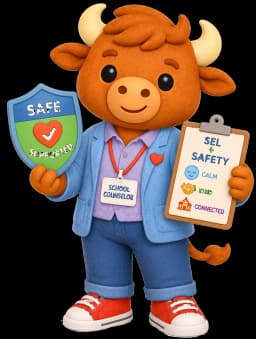
Most elementary schools run safety programs and SEL programs on parallel tracks. The safety coordinator handles drills. The counselor handles SEL lessons. The two rarely overlap in planning, instruction, or assessment. This separation is understandable from a scheduling perspective. It is also leaving measurable results on the table.
The research on this is converging from multiple directions. The largest meta-analysis of SEL programs ever conducted, a 2023 registered report analyzing 424 studies across 53 countries and over 575,000 students, found that the single largest effect of SEL programs was on students' perceptions of school safety and inclusion.[1] Not academic achievement. Not social skills. Safety. The domain most schools treat as a separate line item.
Meanwhile, the U.S. Secret Service, after decades of studying school violence, concluded that the most effective prevention is not physical security. It is school climate: cultures of safety, respect, trust, and emotional support that make students willing to report concerning behavior before it escalates.[2] That climate is exactly what well-implemented SEL programs build.
The two fields are solving the same problem from different ends. The schools getting the best outcomes in both have figured that out.
The Overlap Nobody Talks About
When you list the skills a student needs to stay safe at school and the skills a student develops through SEL instruction, the overlap is significant.
A lockdown drill asks a kindergartner to stop what they are doing, move to a specific location, stay quiet, stay still, and manage their fear. Every one of those actions requires self-regulation, the second CASEL competency.[3]
Reporting a classmate's threatening behavior requires social awareness (recognizing that something is wrong), relationship skills (trusting an adult enough to tell them), and responsible decision-making (weighing the social cost of reporting against the potential consequences of staying silent).[2]
Conflict resolution before it escalates to physical aggression requires self-awareness (recognizing your own anger), self-management (pausing before reacting), and relationship skills (communicating without escalation).[4]
The skills are the same. The context changes. A student who has practiced calming strategies in a Monday morning SEL lesson is better equipped to use those same strategies during a fire drill on Tuesday. A student who has practiced perspective-taking through a read-aloud discussion is more likely to notice when a peer is struggling and say something to a trusted adult.
What the Research Says
SEL Programs Improve Safety Outcomes Directly
The Cipriano et al. (2023) meta-analysis is the most comprehensive study of SEL effectiveness to date. It analyzed 424 experimental studies involving 252 distinct SEL programs and found statistically significant improvements across every measured domain: skills, attitudes, behaviors, peer relationships, school functioning, and academic achievement.[1]
But the largest effect size was in school climate and safety. Students who participated in SEL programs reported feeling safer at school, witnessing less violence and aggression, experiencing more supportive relationships with teachers, and perceiving school rules and policies as more fair.[1][5]
SEL program outcomes by domain
Cipriano et al. (2023) meta-analysis of 424 studies, 575,361 students
All domains showed statistically significant improvement vs. control. Relative bar lengths represent comparative effect magnitude across domains. Source: Child Development, 94(5), 1181-1204.
This finding was replicated in a 2024 U.S.-focused analysis of 90 studies and 47 discrete SEL programs, which confirmed that American students specifically showed increased perceptions of school climate and safety, along with reductions in externalizing behaviors and emotional distress.[6]
Safety-First Approaches Without SEL Produce Anxiety, Not Preparedness
The National Academies of Sciences, Engineering, and Medicine published a comprehensive report in 2025 on school active shooter drills. Their core finding: drills conducted without developmental and emotional preparation can increase anxiety, particularly in elementary students, without meaningfully improving response outcomes.[7]
A 2025 RAND Corporation survey of educators found that nearly a third of principals and teachers reported awareness of students experiencing trauma or heightened anxiety after lockdown drills, with elementary school leaders reporting this at higher rates than secondary.[8]
The Tennessee Department of Education addressed this directly by recommending that schools embed social-emotional competencies into daily instruction so that students already have coping skills before they participate in a drill.[9] The logic is straightforward: if students have never practiced calming strategies in low-stakes settings, a lockdown drill introduces multiple unfamiliar demands simultaneously in a high-stress context.
School Climate Prevents Violence. Physical Security Responds to It.
The Secret Service's National Threat Assessment Center (NTAC) has studied school violence prevention for over two decades. Their 2019 report, Protecting America's Schools, analyzed 41 incidents of targeted school violence and found that most attackers exhibited observable warning signs before the attack. In the majority of cases, other people, often classmates, were aware of concerning behavior beforehand.[2]
Their recommendation was not more metal detectors or surveillance cameras. It was to create school climates where students feel safe enough to report what they see. The report explicitly calls for schools to “create and promote a safe school climate built on a culture of safety, respect, trust, and emotional support” and to “encourage communication, intervene in conflicts and bullying, and empower students to share concerns.”[2]
A follow-up analysis of 67 averted school attacks confirmed this: more than two-thirds were stopped because a student noticed warning signs and told an adult.[10] The prerequisite for that report is a student who trusts adults, can articulate their concerns, and has been taught that speaking up is responsible rather than disloyal. Those are SEL competencies, not safety drill outcomes.
How Siloed Programs Fail
When safety and SEL operate independently, several predictable problems emerge.
Duplicated Instruction, Missed Connections
A safety program teaches students to “tell a trusted adult” when they see something concerning. An SEL program teaches students to identify emotions in others, build trusting relationships with adults, and practice responsible decision-making. These are the same skill chain. Taught separately, students hear the safety instruction as a rule to follow. Taught together, they develop the internal capacity to actually follow it.
Drills Without Emotional Scaffolding
A school that runs lockdown drills but has no SEL instruction is asking students to perform self-regulation under high stress without ever having practiced it under low stress. This is why drills produce anxiety in some students: the emotional demands of the drill exceed the coping skills students have been given.[7][8]
SEL Without Real-World Application
An SEL program that never connects its competencies to safety contexts misses one of the most concrete and relevant applications available. Self-management is abstract until a student practices it during a fire drill. Responsible decision-making is theoretical until a student has to decide whether to report a peer's concerning text message. Safety situations provide high-salience practice contexts that reinforce SEL learning.
Counselor Overload
In schools where the counselor owns both programs independently, the workload doubles without any efficiency gain. Integration means the same 15-minute morning lesson can address both an SEL competency and a safety objective simultaneously, rather than requiring two separate instructional blocks.
What Integration Looks Like in Practice
Integrating safety and SEL does not mean combining two separate curricula into one document. It means deliberately connecting the skills taught in SEL instruction to the contexts where students actually need them for safety.
Map Safety Skills to CASEL Competencies
Every school safety objective corresponds to one or more CASEL competencies. Making these connections explicit allows teachers to reinforce safety concepts during SEL instruction and SEL concepts during safety instruction.
Safety-to-CASEL competency mapping
CASEL competencies
Safety objectives
| Safety Objective | Primary CASEL Competency | Connection |
|---|---|---|
| Follow emergency procedures calmly | Self-Management | Students who have practiced calming strategies can regulate during drills |
| Report concerning behavior | Responsible Decision-Making + Relationship Skills | Requires trust in adults and the ability to weigh consequences |
| Resolve conflicts without aggression | Self-Awareness + Self-Management | Recognizing anger early and choosing a non-escalatory response |
| Recognize when a peer is in distress | Social Awareness | Perspective-taking and empathy skills transfer directly |
| Navigate online interactions safely | Responsible Decision-Making | Same framework applies to digital citizenship decisions |
| Follow bus and transportation safety rules | Self-Management | Impulse control and body awareness in unstructured settings |
Use SEL Lessons to Prepare for Drills
Rather than conducting a safety drill cold, use the SEL block in the days before a scheduled drill to teach or review the relevant competencies. If a lockdown drill is coming, spend the Monday SEL lesson on calming strategies. If a bus evacuation drill is scheduled, use the Wednesday lesson to practice following multi-step directions quickly and quietly.
This is not extra instruction. It is the same SEL lesson you would teach anyway, contextualized with a real application students will experience that week.
Debrief Drills Using SEL Language
After a drill, use SEL vocabulary in the debrief. Instead of “You did a good job being quiet,” try “You used your self-management skills to stay calm and follow directions, even when it felt uncomfortable. That is exactly what those skills are for.”
This reinforces both the safety behavior and the SEL competency, and it helps students see that the skills they practice in SEL lessons have practical applications beyond the classroom discussion.
Connect Character Education Themes to Safety Contexts
Courage is a character trait. Reporting a peer's threatening behavior requires courage. Responsibility is a character trait. Following safety procedures is an act of responsibility. Schools that teach character education can use safety contexts as concrete, age-appropriate examples of character in action.
Embed Safety Scenarios in SEL Activities
During an SEL lesson on responsible decision-making, include a scenario where a character sees a classmate writing something threatening. During a lesson on social awareness, discuss why some students might feel afraid during drills and how to support them. These scenarios do not need to be graphic or anxiety-inducing. They can be handled with the same age-appropriate, narrative-driven approach used for other SEL topics.
What to Avoid
Turning every SEL lesson into a safety lesson
Integration does not mean every SEL activity needs a safety angle. SEL covers a broad range of social and emotional competencies that extend far beyond school safety. The connection should be made where it is natural and relevant, not forced into every lesson.
Using safety scenarios that are too intense for the age group
For K-2 students, safety integration should use concrete, behavioral language and character-driven stories. “A character in our story had to decide whether to tell the teacher about something that worried them” is appropriate. Detailed descriptions of school violence are not, regardless of how much they might reinforce SEL concepts.[7][11]
Assuming safety drills teach SEL skills
A lockdown drill is a behavioral rehearsal, not an SEL lesson. It asks students to perform skills. It does not teach them. The teaching happens in the daily SEL instruction that builds the competencies students draw on during the drill. Drills without prior skill-building are performance tests for skills students may not have.[9]
Treating integration as a cost-cutting measure
The goal of integrating safety and SEL is better outcomes for students, not fewer instructional minutes for adults. Integration creates efficiency by connecting related instruction, but it should not be used to justify eliminating dedicated SEL time or reducing safety training for staff.
Skipping measurement
If your school integrates safety and SEL, track both sets of outcomes. Are students using SEL vocabulary during drill debriefs? Are office discipline referrals decreasing? Are students reporting concerning behavior more frequently? Are drill-related anxiety reports declining? Integrated programs should produce measurable improvements in both domains, not just feel like a more coherent approach.
A Note on the Research
The evidence supporting SEL's impact on safety outcomes is strong and growing. The Cipriano et al. (2023) meta-analysis is a registered report, meaning the research protocol was peer-reviewed and approved before data collection began, which substantially reduces the risk of cherry-picked findings.[1] The NTAC research is based on decades of case analysis of actual school violence incidents.[2] The RAND and National Academies work synthesizes practitioner surveys and developmental research.[7][8]
However, most of this research measures perceived safety (how safe students feel) rather than objective safety metrics (incident counts, threat assessments averted). The perceived safety data is robust and consistent, but schools should not assume that improved feelings of safety automatically translate to reduced incidents without also implementing operational safety measures. SEL is not a replacement for emergency procedures, physical security, or threat assessment protocols. It is the foundation that makes all of those measures more effective.
Final Thoughts
Schools do not need to choose between safety programs and SEL programs. They need to stop treating them as unrelated line items.
The research from every direction, from developmental psychology to the Secret Service, points to the same conclusion: the skills that make students safe at school are social-emotional skills. The climate that prevents violence is the climate that SEL programs build. The students who report warning signs are the students who trust adults, read social cues, and make responsible decisions under pressure.
When schools run safety and SEL as separate programs, they are solving two halves of the same problem with two separate teams who never compare notes. When they integrate them, both programs get better. Students who practice self-regulation in an SEL lesson perform better in safety drills. Students who practice responsible decision-making in SEL scenarios are more likely to report concerning behavior. Students who feel safe at school learn more effectively.
The question is not whether your school should have safety programs or SEL programs. The question is why they are still separate.
References
- [1]
Cipriano, C., Strambler, M. J., Naples, L. H., Ha, C., Kirk, M., Wood, M., Sehgal, K., Zieher, A. K., Eveleigh, A., McCarthy, M., Funaro, M., Ponnock, A., Chow, J. C., & Durlak, J. (2023). The state of evidence for social and emotional learning: A contemporary meta-analysis of universal school-based SEL interventions. Child Development, 94(5), 1181-1204.
https://doi.org/10.1111/cdev.13968 - [2]
U.S. Secret Service, National Threat Assessment Center. (2019). Protecting America's schools: A U.S. Secret Service analysis of targeted school violence.
https://www.secretservice.gov/protection/ntac - [3]
CASEL. (2024). Fundamentals of SEL.
https://casel.org/fundamentals-of-sel/ - [4]
Durlak, J. A., Weissberg, R. P., Dymnicki, A. B., Taylor, R. D., & Schellinger, K. B. (2011). The impact of enhancing students' social and emotional learning: A meta-analysis of school-based universal interventions. Child Development, 82(1), 405-432.
https://doi.org/10.1111/j.1467-8624.2010.01564.x - [5]
Yale School of Medicine. (2023). Research finds social and emotional learning produces significant benefits for students.
https://medicine.yale.edu/news-article/new-research-published-in-child-development-confirms-social-and-emotional-learning-significantly-improves-student-academic-performance-well-being-and-perceptions-of-school-safety/ - [6]
Cipriano, C., Naples, L. H., et al. (2024). A systematic review and meta-analysis of the effects of universal school-based SEL programs in the United States: Considerations for marginalized students. Social and Emotional Learning: Research, Practice, and Policy, 3, 100032.
https://www.sciencedirect.com/science/article/pii/S2773233924000032 - [7]
National Academies of Sciences, Engineering, and Medicine. (2025). School active shooter drills: Mitigating risks to mental, emotional, and behavioral health. Washington, DC: The National Academies Press.
https://www.nationalacademies.org/read/29105/chapter/8 - [8]
RAND Corporation. (2025). Are active shooter drills in K-12 schools aligned with best practices? Insights from recent surveys of educators.
https://www.rand.org/pubs/research_reports/RRA3930-7.html - [9]
Tennessee Department of Education. (n.d.). Tips for conducting trauma-informed drills.
https://www.tn.gov/content/dam/tn/education/safety/save-act/Trauma_Informed_Drills.pdf - [10]
U.S. Secret Service, National Threat Assessment Center. (2021). Averting targeted school violence: A U.S. Secret Service analysis of plots against schools.
https://www.secretservice.gov/protection/ntac - [11]
National Association of School Psychologists. (2018). Mitigating psychological effects of lockdowns.
https://www.nasponline.org/resources-and-publications/resources-and-podcasts/school-safety-and-crisis/systems-level-prevention/mitigating-psychological-effects-of-lockdowns
Build the Skills That Keep Students Safe
Be The Buffalo teaches self-regulation, emotional vocabulary, and responsible decision-making through daily K-5 lessons. No student devices. No prep. The same skills that make safety drills less scary and school climate stronger.
Sign Up FreeRelated Resources
Teaching School Safety Without Causing Fear
How to prepare K-5 students for emergency drills using age-appropriate, trauma-informed approaches
Character Education vs. SEL: What's the Difference?
Where they overlap, where they diverge, and why your school probably needs both
SEL Activities for K-5 Classrooms
Practical, classroom-ready SEL activities aligned to CASEL standards