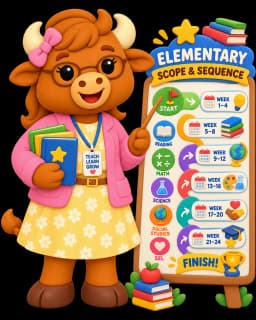
How to build a K-5 SEL scope and sequence that covers all five CASEL competencies, progresses logically from internal skills to external application, and gives teachers a clear weekly roadmap from September to June.
A scope and sequence is one of the first things an administrator asks to see when evaluating curriculum. It is also one of the most revealing documents a program can provide. It answers two questions that matter more than any marketing claim: What do students actually learn? And in what order?
For SEL curriculum specifically, the order is not incidental. It is instructional. Teaching social awareness before self-awareness is like teaching multiplication before counting. Teaching conflict resolution before students have practiced emotional regulation gives them a strategy they lack the internal capacity to execute. The sequence is the pedagogy.[1]
Yet many elementary SEL programs treat the scope and sequence as an afterthought: a list of topics organized by month or unit with no clear rationale for why one comes before another. This guide covers what an effective elementary SEL scope and sequence looks like, what principles should drive the ordering, how to evaluate whether a program's sequence will actually work for your students, and what a 40-week yearlong plan looks like in practice.
What “Scope and Sequence” Means for SEL
Scope
The scope defines what a curriculum covers. For SEL, this means which competencies, skills, and topics are included across the full program. A comprehensive scope addresses all five CASEL competencies:
A scope that covers only two or three competencies is incomplete. A scope that lists all five but devotes 80% of lessons to self-management and relationship skills while barely touching responsible decision-making is unbalanced.[1]
Sequence
The sequence defines the order in which skills and topics are taught. An effective sequence is not arbitrary. It follows developmental logic: foundational skills come first, and more complex skills build on them. It also follows psychological logic: internal skills (knowing yourself) precede external skills (navigating others), which precede integrative skills (making decisions that consider both).[2]
The Sequencing Principles That Matter
Principle 1: Intrapersonal Before Interpersonal
The most consistent finding from SEL implementation research is that programs teaching intrapersonal skills (self-awareness, self-management) before interpersonal skills (social awareness, relationship skills) produce better outcomes across all measured domains.[2] A student who cannot identify their own anger will struggle to recognize it in someone else. The first quarter of any SEL scope and sequence should emphasize self-awareness and self-management.
Principle 2: Simple to Complex Within Each Competency
Within each CASEL competency, skills exist on a complexity gradient. Self-awareness starts with basic emotion identification (“I feel sad”) and progresses to understanding how thoughts influence feelings and behavior. An effective scope and sequence returns to each competency multiple times across the year, each time at a higher level of complexity.[3]
Principle 3: Interleave, Don't Isolate
Organizing a scope and sequence by competency in strict blocks is clean on paper but disconnected from reality. A conflict at recess requires self-awareness, self-management, social awareness, relationship skills, and responsible decision-making simultaneously. Effective sequences introduce self-awareness and self-management first but weave in social awareness and relationship skills within the first few weeks.[1]
Principle 4: Revisit and Deepen
A scope and sequence that lists “empathy” once in week 12 and never returns to it is not building a skill. It is introducing a vocabulary word. A sequence that introduces empathy in week 5, applies it to peer relationships in week 14, connects it to digital interactions in week 22, and revisits it in ethical decision-making in week 34 is building genuine competence.[3]
Principle 5: Match the Calendar
A well-designed scope and sequence anticipates the emotional rhythms of the school year: community building in September, deeper skill work October through December, reset and goal-setting in January, complex application February through April, and review, celebration, and transition support in May and June.
What a 40-Week Scope and Sequence Looks Like
A 40-week structure maps to the standard school year and provides enough instructional time to cover all five CASEL competencies with depth, repetition, and progressive complexity.
Quarter 1: Building the Foundation (Weeks 1-10)
| Week | Topic | Primary CASEL Competency | Why Here |
|---|---|---|---|
| 1 | Growth mindset | Self-Awareness | Establishes the belief framework that makes all other learning possible |
| 2 | Resiliency | Self-Management | Builds on growth mindset with strategies for bouncing back |
| 3 | Kindness | Relationship Skills | Early interpersonal skill; low complexity, high engagement |
| 4 | Self-control | Self-Management | Core regulation skill needed for everything that follows |
| 5 | Empathy | Social Awareness | First perspective-taking skill; builds on self-awareness from weeks 1-2 |
| 6 | Courage | Self-Management | Deepens self-management with higher-stakes application |
| 7 | Teamwork | Relationship Skills | Applies self-management and empathy in collaborative context |
| 8 | Honesty | Responsible Decision-Making | First ethical reasoning topic; requires self-awareness and courage |
| 9 | Gratitude | Self-Awareness | Deepens self-awareness with positive emotion identification |
| 10 | Problem-solving | Responsible Decision-Making | Integrates multiple competencies into a decision-making process |
The sequence does not march through CASEL competencies one at a time. It leads with self-awareness and self-management but introduces relationship skills and social awareness early. By week 8, responsible decision-making enters with a topic (honesty) that requires the self-awareness, courage, and empathy taught in previous weeks.
Quarter 2: Expanding Social Skills (Weeks 11-20)
The second quarter shifts emphasis toward interpersonal competencies while continuing to reinforce internal skills. Topics include respect, responsibility, conflict resolution, active listening, patience, fairness, communication, and friendship skills.
Each week connects to prior learning. A lesson on conflict resolution in week 14 should explicitly reference the self-control strategies from week 4 and the empathy skills from week 5: “We learned how to notice our own feelings. We learned how to see things from someone else's perspective. Today we put those together to solve a disagreement.”
Quarter 3: Application and Complexity (Weeks 21-30)
The third quarter introduces more complex topics that require students to integrate multiple competencies: digital citizenship, peer pressure, bullying prevention, leadership, and ethical dilemmas. These are placed later because they require the full toolkit.
This quarter is also where safety topics integrate naturally. Bus safety, internet safety, and emergency preparedness all require the self-management, responsible decision-making, and courage skills taught earlier in the year.
Quarter 4: Integration and Transition (Weeks 31-40)
The final quarter reviews earlier topics at deeper levels of complexity, applies skills to real end-of-year challenges (transitions, goodbyes, anxiety about next year), and celebrates growth.
The last weeks should include explicit reflection on growth. Students who can articulate “In September I used to get angry and shut down, and now I take three breaths and try a different strategy” are demonstrating self-awareness about their own development—the meta-skill that makes all other SEL learning transferable.
How to Evaluate a Program's Scope and Sequence
When reviewing curriculum, ask these questions about the scope and sequence:
Does it cover all five CASEL competencies?
Count the lessons. If 25 of 30 lessons address self-management and relationship skills while the remaining competencies share 5, the scope is unbalanced.[1]
Is the sequencing rationale clear?
Can you identify why topic A comes before topic B? If the sequence appears random or is organized solely by month, there may not be developmental logic driving the order.
Does it build progressively?
Look at how the same competency is addressed in week 5 versus week 25. If the treatment is identical in depth and complexity, the curriculum is not progressing. A flat scope and sequence produces initial engagement that fades as content becomes repetitive.
Does it interleave competencies?
A scope and sequence that addresses self-awareness in weeks 1-8 and never returns to it is not interleaving. Look for programs where each competency appears multiple times across the year, in increasingly complex applications.
Is it grade-differentiated?
The scope and sequence for kindergarteners should look different from the one for fifth graders. A program that provides one scope and sequence for all of “elementary” is not developmentally appropriate.[3]
Scope and Sequence vs. Pacing Guide
These terms are sometimes used interchangeably, but they serve different functions. A scope and sequence defines what is taught and in what order—it is a curriculum design document reflecting instructional logic. A pacing guide defines when each lesson is taught and how long it takes—it is a scheduling document mapping the scope and sequence to your school's specific calendar.
Both are necessary. The best programs provide both: a clear scope and sequence explaining the developmental logic, and a flexible pacing guide that accounts for holidays, testing windows, and the inevitable disruptions of a real school year.
Building Your Own Scope and Sequence (If You Must)
Some schools assemble SEL instruction from multiple sources rather than adopting a single curriculum. If your school takes this approach, you need to build a scope and sequence intentionally.
Step 1: Map the CASEL competencies to your school year
Allocate approximate weeks to each competency, front-loading self-awareness and self-management. Aim for coverage of all five competencies by mid-year.
Step 2: Select or create lessons for each week
Every week needs a specific lesson, not a vague topic. “Empathy” is a topic. “Read a story, discuss how the character felt, partner share about a time students felt like an outsider” is a lesson.
Step 3: Check for progression
Review the full sequence. Does complexity increase? Do later lessons reference earlier ones? Can you draw a line from the self-awareness lessons in September to the responsible decision-making lessons in April?
Step 4: Differentiate by grade
Whatever scope and sequence you build for second grade will need modification for kindergarten and fifth grade. The topics may be similar, but the vocabulary, instructional strategies, and expected depth should change.
This process is time-intensive, which is why most schools that attempt it eventually adopt a structured curriculum that provides a ready-made scope and sequence with the sequencing logic, grade differentiation, and lesson materials already designed.
Bilingual Scope and Sequence Considerations
Emotional vocabulary is among the most culturally and linguistically specific content in any curriculum. The Spanish word “coraje” can mean both courage and anger depending on context. The concept of “vergüenza” (shame) carries cultural weight that “shame” in English does not fully capture.
A scope and sequence designed for bilingual settings should introduce emotional vocabulary in both languages simultaneously, allow students to process and discuss in whichever language feels most natural, and use bilingual materials that were written bilingually rather than translated after the fact.[6]
Final Thoughts
A scope and sequence is the skeleton of an SEL curriculum. Without it, lessons are disconnected activities. With it, they become a coherent developmental journey that builds genuine social-emotional competence across the school year.
The principles are consistent across the research: start with internal skills, build toward external skills, interleave competencies rather than isolating them, revisit topics at increasing levels of complexity, match the emotional rhythm of the school calendar, and sustain instruction for 30 to 40 weeks.[1][2][3]
When evaluating programs, the scope and sequence tells you more about instructional quality than any marketing material. Ask to see it. Read it carefully. The order is the instruction.
References
- [1]
Durlak, J. A., Weissberg, R. P., Dymnicki, A. B., Taylor, R. D., & Schellinger, K. B. (2011). The impact of enhancing students' social and emotional learning: A meta-analysis of school-based universal interventions. Child Development, 82(1), 405-432.
https://doi.org/10.1111/j.1467-8624.2010.01564.x - [2]
Cipriano, C., Strambler, M. J., Naples, L. H., et al. (2023). The state of evidence for social and emotional learning: A contemporary meta-analysis of universal school-based SEL interventions. Child Development, 94(5), 1181-1204.
https://doi.org/10.1111/cdev.13968 - [3]
Cipriano, C., Naples, L. H., et al. (2024). A systematic review and meta-analysis of the effects of universal school-based SEL programs in the United States. Social and Emotional Learning: Research, Practice, and Policy, 3, 100032.
https://www.sciencedirect.com/science/article/pii/S2773233924000032 - [4]
Taylor, R. D., Oberle, E., Durlak, J. A., & Weissberg, R. P. (2017). Promoting positive youth development through school-based social and emotional learning interventions: A meta-analysis of follow-up effects. Child Development, 88(4), 1156-1171.
https://doi.org/10.1111/cdev.12864 - [5]
CASEL. (2025). CASEL Program Guide.
https://pg.casel.org/ - [6]
Colorin Colorado. (n.d.). Research and reports on bilingual literacy and English language learners.
https://www.colorincolorado.org/research-reports
See the Full 40-Week Scope and Sequence
Be The Buffalo provides 40 weeks of sequenced, CASEL-aligned K-5 SEL curriculum. Each week builds on the last, covering all five competencies with interactive projector activities, original songs, read-aloud stories, printable worksheets, discussion prompts, and teacher guides. Bilingual. No student accounts. No prep.
Sign Up FreeRelated Resources
Weekly SEL Lessons for Elementary Teachers
A simple yearlong approach to teaching social-emotional skills in K-5
SEL Curriculum for Elementary Schools
What SEL curriculum looks like in K-5 and what makes it effective
SEL by Grade Level: K-5 Guide
What students actually need at each developmental stage for effective SEL instruction