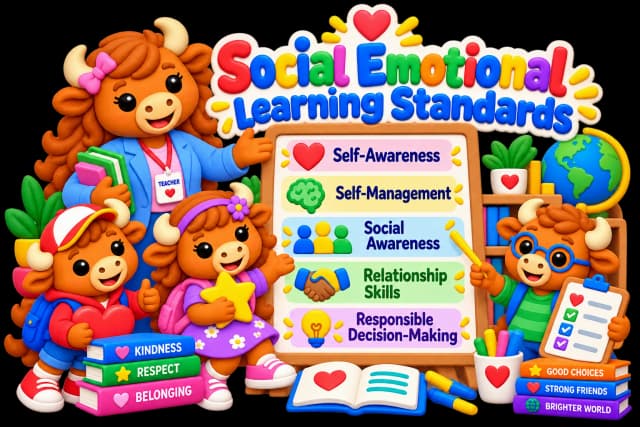
If you have been asked to make sure your SEL instruction “aligns to standards,” the first question is often: which standards? There are no national SEL standards in the United States. Instead, there is a patchwork of state standards, competencies, benchmarks, and guidance documents, many built on the same framework but with different names, structures, and levels of requirement.
This guide explains what social emotional learning standards are, how many states have them, the different ways states approach SEL, what standards typically look like for K–5, and how to align a curriculum. It also links to our detailed guides for every state, the District of Columbia, and Puerto Rico.
What Are Social Emotional Learning Standards?
SEL standards (also called competencies, benchmarks, goals, or indicators) describe the social and emotional skills students should develop at each grade level or grade band. They usually cover skills like recognizing emotions, managing behavior, understanding others, building relationships, and making responsible decisions.
Most state SEL standards share a common structure:
Broad goals or competencies: The big skill areas, such as self-awareness or relationship skills.
Standards: More specific statements under each goal.
Benchmarks or indicators: What the skill looks like at a particular grade band, such as K–2 or 3–5.
For example, Illinois, one of the first states to adopt K–12 SEL standards, organizes 10 learning standards under three goals.[1] See Illinois SEL requirements.
Are There National SEL Standards?
No. There are no federal or national SEL standards, and SEL standards are not part of the Common Core.
The closest thing to a national reference is the CASEL framework, developed by the Collaborative for Academic, Social, and Emotional Learning. It defines five core competencies: self-awareness, self-management, social awareness, relationship skills, and responsible decision-making.[2] Many states built their standards on these five competencies. The CASEL framework is not a mandate. It is a widely used reference. Programs built on these competencies have the strongest research base.[6][7]
How Many States Have SEL Standards?
states with K–12 SEL competencies
states with preschool SEL competencies
Source: CASEL 2022 state scan[3]
It is from 2022. State policy has changed since then. Our individual state guides have more current, state-specific detail.
Counts vary by source. Other organizations count differently depending on whether they include guidance documents, health standards, or character education.
“Adopted” usually does not mean “mandated.” In most states, SEL standards are voluntary guidance, not requirements every school must teach.
Five Ways States Approach SEL
States differ less in whether they address social-emotional skills than in how. Most fall into one or more of these approaches.
Standalone K–12 SEL standards
Dedicated SEL standards or competencies across grades.
Examples: Illinois, Michigan, New York, Mississippi
SEL combined with character development
SEL and character education in a single set of standards.
Examples: Kansas, Tennessee
SEL within health or wellness standards
Social-emotional skills through health education or whole-child wellness.
Examples: Various states
Character education or other terminology
Similar skills under names like character education, citizenship, or life skills.
Examples: Florida, Texas
Guidance, frameworks, or local control
Guidance documents or toolkits without formal standards.
Examples: Oregon and others
Standalone K–12 SEL standards
- Illinois adopted K–12 SEL standards following its 2003 Children’s Mental Health Act.[1]
- Michigan adopted early childhood through grade 12 SEL competencies in 2017.[5]
- New York released SEL benchmarks in 2018.[5]
- Mississippi adopted K–12 SEL standards in 2021.
See Michigan, New York, and Mississippi.
SEL combined with character development
Kansas adopted Social, Emotional, and Character Development (SECD) model standards in 2012, revised in 2018.[5] See Kansas SEL requirements.
Because the terminology varies so much, a state without “SEL standards” may still expect schools to teach many of the same skills under a different name. See character education vs. SEL.
What SEL Standards Typically Look Like in K–5
Specific wording varies by state, but most elementary benchmarks follow a similar progression:
| Competency | K–2 (typical) | 3–5 (typical) |
|---|---|---|
| Self-Awareness | Name basic emotions; identify likes and strengths | Describe a range of emotions and causes; recognize strengths and areas for growth |
| Self-Management | Use a simple strategy to calm down; follow routines | Use several strategies to manage stress; set and track simple goals |
| Social Awareness | Recognize how others feel from facial expressions; show care | Describe others’ perspectives; recognize similarities and differences |
| Relationship Skills | Take turns, share, use kind words; ask for help | Cooperate in groups; resolve conflicts using steps; listen actively |
| Responsible Decision-Making | Identify problems and simple choices; follow safety rules | Consider consequences; use problem-solving steps; take responsibility |
For more on how SEL develops across grades, see SEL by grade level.
What SEL Standards Mean for Teachers and Schools
Most standards are guidance, not mandates
In most states, schools are not required to teach to SEL standards the way they are required to teach academic standards. Check your state guide for specifics.
Some states attach requirements
In some states, SEL is tied to school improvement plans, health education requirements, or surveys. These vary widely.
Districts often set their own expectations
Even in states without formal SEL standards, many districts adopt their own SEL frameworks or require a specific curriculum.
Standards shape curriculum decisions
When districts adopt an SEL program, they often look for documented alignment to their state’s standards or to the CASEL framework.
How to Align an SEL Curriculum to State Standards
Find your state’s current document
Start with your state education agency’s website, or see our state guide below.
Identify the structure
List the goals or competencies and the benchmarks for the grades you teach.
Map your curriculum’s scope and sequence
For each lesson or unit, note which competency and benchmark it addresses.
Look for gaps
Check whether every competency is covered across the year.
Check grade-band fit
A lesson aligned to a 3–5 benchmark may be too advanced for kindergarten.
Document it
A crosswalk table (lesson, competency, state benchmark) is useful for administrators and grants.
Revisit annually
State documents change. Confirm you are working from the current version.
See elementary SEL scope and sequence and how to choose an SEL curriculum.
State-by-State SEL Requirements
Each guide below covers that state’s SEL standards or guidance, related requirements, terminology, and what it means for elementary classrooms.
Northeast
Midwest
South
West
U.S. Territories
What to Avoid
Assuming your state has no expectations
Even states without “SEL standards” often address the same skills through health, character education, or other requirements.
Relying on outdated documents
State SEL guidance has changed frequently in recent years. Always confirm the current version.
Treating alignment as a checkbox
A curriculum that lists standards next to each lesson is not necessarily teaching those skills well.
Ignoring local context
Terminology matters in some communities. Many schools teach the same skills under names like character education or life skills.
Covering only easy competencies
Feelings and kindness lessons are common. Responsible decision-making and social awareness are often underrepresented.
Final Thoughts
There are no national SEL standards, but most states provide some form of guidance for teaching social and emotional skills, whether through standalone SEL standards, combined SEL and character standards, health education, or other frameworks. Most of these documents share the same core ideas, often built on the five CASEL competencies, even when the names differ.
For teachers and schools, the practical steps are the same everywhere: find your state’s current guidance, map what you teach to it, and make sure every competency gets real instruction across the year.
Sources
- Illinois State Board of Education. Social/Emotional Learning (SEL) standards. isbe.net/sel
- CASEL. What is SEL? (The CASEL 5). casel.org
- CASEL. SEL policy at the state level (2022 State Scan). casel.org
- Positive Action. (2025). SEL standards. positiveaction.net
- CASEL. Frameworks, competencies, standards, and guidelines. State Resource Center. casel.org
- Durlak, J. A., et al. (2011). SEL meta-analysis. Child Development, 82(1), 405–432. DOI
- Cipriano, C., et al. (2023). SEL meta-analysis. Child Development, 94(5), 1181–1204. DOI
A K–5 Curriculum Built on All Five CASEL Competencies
Be The Buffalo’s 40-week K–5 curriculum is organized around the five CASEL competencies, with every week color-coded by competency in the lesson planner, so alignment to state standards built on CASEL is easier to document. Projector activities, original songs, stories, and printables in three grade bands, in English and Spanish. No student devices. No prep. The first four weeks are free.
Sign Up Free