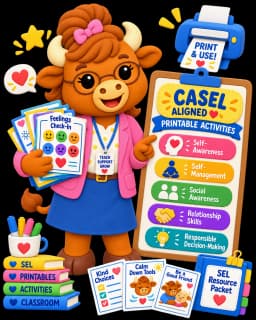
There's a difference between a printable that mentions CASEL on the cover and one that's actually designed around a specific competency. Most “CASEL-aligned” printables floating around online are emotion wheels and feelings charts that vaguely gesture at self-awareness without teaching anything actionable. Alignment means the activity targets a named competency, practices a specific skill within that competency, and gives students something to do besides color.
This guide covers what genuine CASEL alignment looks like in a printable activity, includes free examples you can use today, and explains how to evaluate whether the printable resources you're already using are actually doing what they claim.
What CASEL Alignment Actually Means for Printable Activities
The CASEL framework defines five core competencies: self-awareness, self-management, social awareness, relationship skills, and responsible decision-making.[1] When a printable activity is aligned to this framework, it should do three things.
First, it should target a specific competency, not all five at once.
A single worksheet that claims to address self-awareness, empathy, decision-making, and communication is almost certainly addressing none of them with any depth. Focused activities produce better skill development than broad ones.[2]
Second, the activity should practice the skill, not just define it.
A printable that says “Self-management means controlling your emotions” and asks students to copy the definition is assessment at best and busywork at worst. A CASEL-aligned printable gives students a structured experience: matching challenges to outcomes, sorting scenarios by strategy, or working through a decision-making framework with a real situation.
Third, it should be developmentally appropriate within the K-5 range.
Self-management looks different for a kindergartener (learning to take a deep breath when frustrated) than for a fifth grader (choosing between competing priorities when both feel urgent). A printable that uses the same language and scenarios for all elementary grades is not differentiated, regardless of what the label says.
Free CASEL-Aligned Activities

Storm & Sunshine Cards
Storm & Sunshine Cards
Help students identify challenges and discover positive outcomes. Perfect for building resilience and perspective-taking.
Opens in new tab · Customize grade · Print instantly

The Invisible Crew
The Invisible Crew
Discover the hidden helpers who make everyday scenes possible. A gratitude activity your whole class will love.
Opens in new tab · Choose grade · Any device
Free CASEL-Aligned Printable: Storm & Sunshine Cards
Competency
Self-Management
Skills
Resiliency, Coping
Format
Cut & Sort
Grades
K-1, 2-3, 4-5
Storm & Sunshine Cards are a printable activity where students work with two types of cards. Storm cards name specific challenges elementary students face: getting a bad grade, being left out by friends, making a mistake in front of others. Sunshine cards name the growth that can come from those experiences: learning to ask for help, discovering hidden strengths, becoming more patient.
The activity asks students to match storms to sunshine outcomes, which requires them to reframe a negative experience as a potential source of growth. That reframing process is the skill being practiced, and it maps directly to CASEL's self-management competency, specifically the sub-skills of coping with stress and self-motivation.[1]
The sorting mat provides structure: students place storm cards on one side, sunshine cards on the other, and write a reflection connecting them. Blank cards let students create storms and sunshine from their own experience, which moves the activity from generic to personal.
Grade differentiation: Available for K-1, 2-3, and 4-5. Younger grades use simpler language and more concrete scenarios. Older grades introduce more nuanced challenges and reflective prompts.
Bilingual: Available in English and Spanish with a language toggle.
Free CASEL-Aligned Interactive Activity: The Invisible Crew
Competency
Social Awareness
Skills
Gratitude, Perspective
Format
Projector Activity
Delivery
Whole Class
The Invisible Crew isn't a printable, but it's worth including here because it demonstrates what CASEL alignment looks like in a different format and because it targets a competency (social awareness) that printables often handle poorly.
Social awareness activities frequently reduce to “how would this person feel?” worksheets. The Invisible Crew takes a different approach: students look at an everyday scene and identify the people who made it possible but aren't visible. This builds the specific social awareness sub-skill of recognizing the contributions and perspectives of others, which is harder to practice on paper but natural in a visual, interactive format.[1]
This is a projector-led activity. No student devices needed. No printing either. Toggle between English and Spanish mid-lesson.
How to Evaluate CASEL Alignment in Any Printable
If you're pulling SEL printables from Teachers Pay Teachers, Pinterest, or district resource libraries, here's how to quickly assess whether they're genuinely CASEL-aligned or just labeled that way.
Does it name a specific competency and sub-skill?
“Aligned to CASEL” is not specific enough. Look for language like “targets self-awareness: identifying emotions” or “practices relationship skills: communication and active listening.” If the printable doesn't specify which competency and which skill within that competency, the alignment is likely superficial.
Does the student do something with the skill, or just identify it?
A worksheet that asks “Circle the picture that shows self-management” is a recall exercise. An activity that asks students to sort scenarios into “strategies I could use” and “strategies that wouldn't help” requires application. The distinction matters because CASEL's implementation guidance emphasizes active, experiential practice over passive recognition.[2]
Is there a way to connect the activity to real experience?
The strongest CASEL-aligned activities include a bridge between the structured activity and the student's own life. Storm & Sunshine Cards do this with blank cards and a reflection prompt. Activities that stay entirely hypothetical miss the transfer step that makes the skill stick.
Is it differentiated by developmental level?
CASEL's framework is organized around developmental progression.[1] A kindergartener and a fifth grader are not working on the same version of self-management. If a printable uses identical language, scenarios, and complexity for the full K-5 range, it's not meaningfully aligned.
CASEL Competencies and What Printable Activities Can (and Can't) Do
Not every CASEL competency is equally well-served by printable formats. Here's an honest assessment.
Self-awareness
Works well in print. Emotion identification, strengths recognition, and self-reflection are internal processes that translate naturally to journaling, sorting, and matching activities.
Self-management
Works well in print when the activity practices a strategy (like reframing in Storm & Sunshine Cards) rather than just naming strategies. Printables that list coping skills without having students apply them are closer to reference sheets than activities.
Social awareness
Harder in print. Recognizing others' emotions and perspectives benefits from visual and interactive formats. The Invisible Crew works better as a projected scene than it would as a static worksheet, which is why it's not a printable.
Relationship skills
Weakest fit for printables because the skills are inherently interpersonal. A printable can prompt a partner discussion or structure a collaborative task, but the skill practice happens in the interaction, not on the page.
Responsible decision-making
Works reasonably well in print through scenario-based activities where students evaluate options and consequences. The key is using scenarios that are genuinely ambiguous, not ones with obvious right answers.
For a deeper look at activities across all five competencies, see our guide to SEL activities for K-5 classrooms.
Building From Printables to a Full CASEL-Aligned Curriculum
Printables are useful. They're portable, require no technology, and give students a tangible artifact from the lesson. But they're one delivery format, and a stack of printables is not a curriculum.
A CASEL-aligned curriculum sequences skill instruction across the school year, progressing from foundational competencies (self-awareness) to more complex ones (responsible decision-making). It uses multiple formats: discussion, interactive activities, songs, stories, and yes, printables, each chosen because it fits the skill being taught. And it provides enough structure that teachers don't have to design the progression themselves.[2]
Be The Buffalo's full curriculum covers 40 weeks of K-5 instruction across all five CASEL competencies. Every week includes a projector activity, a printable, an original song, and a classroom challenge. Everything is bilingual (English/Spanish) and requires no training. The free activities on this page are representative of the quality and approach used throughout.
For guidance on evaluating full SEL curriculum options, see how to choose an SEL curriculum for elementary school or our scope and sequence guide.
Frequently Asked Questions
What does “CASEL-aligned” actually mean?
It means the activity is designed around one or more of the five competencies defined by the Collaborative for Academic, Social, and Emotional Learning: self-awareness, self-management, social awareness, relationship skills, and responsible decision-making. Genuine alignment means the activity targets a specific skill within a competency, not just that it's loosely related to emotions or behavior. See our full guide to the CASEL framework.
Are these printables free to use in my classroom?
Yes. No account, no email, no trial expiration. Print as many copies as you need.
Can I use these alongside a different SEL curriculum?
Yes. These activities supplement any CASEL-aligned program. If your school uses Second Step, Ruler, PATHS, or another curriculum, Storm & Sunshine Cards can serve as a review activity, an extension, or a substitute when you need variety within the same competency.
How do I know which CASEL competency to focus on?
Start with what your students need most. If you're seeing frequent emotional outbursts or frustration, self-management is the priority. If students struggle with peer conflicts, relationship skills and social awareness are where to focus. Our SEL by grade level guide breaks down developmental expectations by competency and grade band.
Do these work for students with disabilities or neurodivergent learners?
The printable format is inherently flexible: students can work at their own pace, revisit cards, and use the blank cards to customize the activity. The visual and tactile components (cutting, sorting, matching) support multiple learning modalities. For a more in-depth look, see our guide on SEL curriculum for neurodivergent elementary students.
Sources
- CASEL. What Is the CASEL Framework? https://casel.org/fundamentals-of-sel/what-is-the-casel-framework/
- Learning Policy Institute. The Evidence Base for Social and Emotional Learning. https://learningpolicyinstitute.org/product/evidence-social-emotional-learning-schools-report
40 Weeks of CASEL-Aligned K-5 Instruction
Be The Buffalo covers all five CASEL competencies across a full school year. Every week includes a projector activity, a printable, an original song, and a classroom challenge. Bilingual. No student devices. No prep.
Sign Up Free