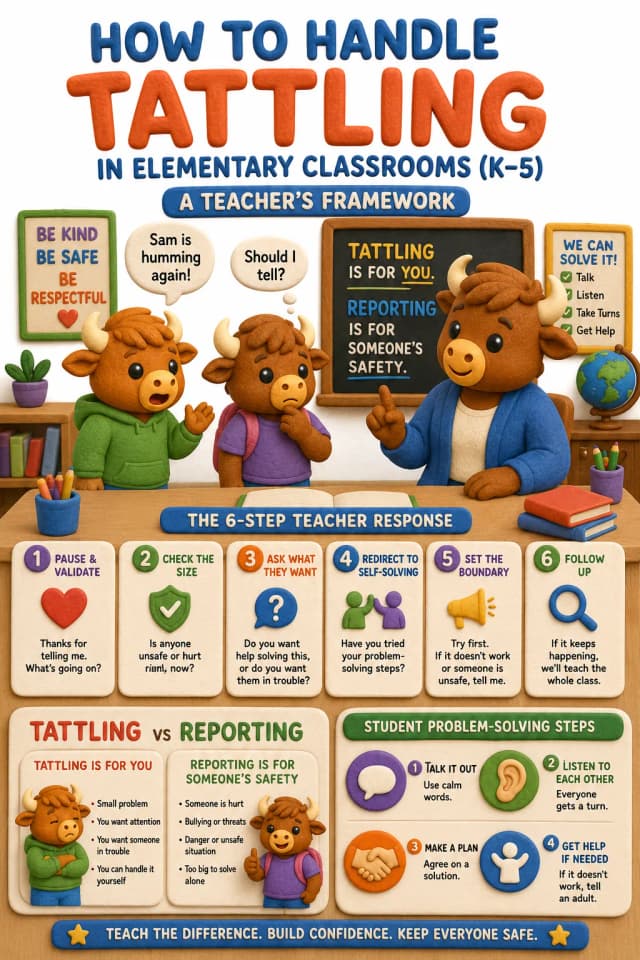
A kindergartener approaches you six times in one morning: “Sam is humming again.” A third grader whispers behind her hand at recess: “Riley cut in line for the swings.” A fifth grader lingers after class: “You should know that Jordan copied off Marcus's math paper, but don't tell them I told you.”
None of these are the same problem. The kindergartener is enforcing a rule they just learned. The third grader is navigating peer status. The fifth grader is holding two loyalties at once. All three moments look like tattling, and all three deserve a different response.
Handling tattling badly is one of the most common ways elementary teachers accidentally suppress safety reporting. The reflex “stop tattling” is easy to say and, said too often, teaches students that telling an adult is bad, full stop. That message costs schools bullying reports, injury reports, and disclosures of adult harm. The pedagogically correct approach is to teach students the distinction between tattling and reporting, give them a repeatable process for handling small problems themselves, and preserve the pathway for real reports to reach adults.
Why tattling is not just a discipline problem
Research on children's tattling since the early 2000s has consistently found that tattling is developmentally normal and reflects moral development, not misbehavior. In a foundational study, Ingram and Bering (2010) observed preschool tattling and found that children tattle to enforce moral norms they have just internalized, not primarily to get peers in trouble. Fifty-six percent of children in their harm condition tattled, compared to 6% in the control condition. The behavior tracks with what the child understands about right and wrong.[1]
The developmental shift happens inside the K-5 grade band. Loke, Heyman, Forgie, McCarthy, and Lee (2011) studied children ages 6-11 and found that younger children (grades K-2) evaluated reporting as appropriate for both minor and major transgressions. Older children (grades 3-5) reserved reporting for major transgressions only. Somewhere between ages 7 and 9, students begin to weigh peer culture against moral obligation. This is the transition that produces the fifth grader's “don't tell them I told you.”[2]
More recent work by Berry and colleagues (2024) documented what they called the Whistleblowers' Dilemma in children as young as four. When children evaluated a peer who reported a friend's transgression, they consistently judged the reporter as morally good but as a bad friend. The tradeoff between being a good person and being a good friend is not something students learn in middle school; they are already reasoning about it in early elementary.[3]
The instructional implication: teaching students the difference between tattling and reporting is not about suppressing tattling behavior. It is about giving students better categories for a distinction they are already trying to make.
The core distinction: tattling versus reporting
Every scalable approach to this problem uses the same underlying framework. The Momentous Institute, Responsive Classroom, and most school counselor curricula converge on the same two definitions.[6][7]
Tattling
Telling an adult about a small problem the student could handle themselves, or telling to get someone in trouble, get attention, or get their own way. The problem is not urgent and no one is unsafe.
Reporting
Telling an adult about something unsafe, harmful, or too big for the student to solve alone. The problem is urgent, or the student's safety or someone else's safety is at stake.
The distinction rests on two questions: who is the report for, and what is the size of the problem. Tattling is for the teller. Reporting is for the person at risk.
The six-step teacher response
When a student approaches you with what sounds like tattling, run the same sequence. Consistency across weeks is what moves students from telling to self-solving.
Pause and validate the approach
Do not shut the student down before you know what they came to say. “Thanks for telling me. What's going on?” This first step matters because it preserves the pathway for actual reporting. Students who get shut down for tattling learn to keep quiet about reporting too.
Ask the size-of-the-problem question
“Is anyone unsafe or hurt right now?” This is the safety check. If yes, treat it as a report. If no, continue.
Ask what the student wants
“Do you want help solving this, or do you want them to be in trouble?” This question surfaces the student's motive without shaming them. Kindergarteners often answer honestly: “I want them to be in trouble.” That is the moment to teach.
Redirect to self-solving
“This sounds like something you can handle. Have you tried any of your problem-solving steps yet?” Point them to the two or three strategies you have already taught. Do not solve it for them.
Set the reporting boundary explicitly
“If you try and it does not work, or if anyone is unsafe, that is when you come find me. That is reporting, and I want you to do that.” Naming the distinction out loud, in the moment, is what teaches it.
Follow up
If the same problem returns, that is your signal to teach the whole class the specific strategy the student is missing, not to punish the tattling. Most repeat tattling is a skill gap, not a defiance issue.
The student decision framework
Students need a simple checklist they can run in their own heads before approaching an adult. Four questions work across grade bands:
Is anyone unsafe or hurt?
Is this a big problem or a small problem?
Have I tried to solve it myself?
Do I need help, or do I want them in trouble?
If the answer to question one is yes, they report immediately. If the answer to question one is no, they walk through the other three. If they still need adult help after trying, they report. If they only want the peer in trouble, they handle it themselves or let it go.
Post this list somewhere students can see it during independent work time. Reference it out loud when students approach. “Let's run through the four questions.”
What tattling looks like by grade band
The teacher response does not change much across grades. The student behavior and the coaching emphasis do.
Kindergarten and First Grade
Tattling is frequent, developmentally normal, and mostly about rule-enforcement. Students are learning what the classroom rules are and testing them by reporting violations. Expect high volume.
Coaching emphasis: Name the rule the student is enforcing, validate the awareness, and redirect to the size-of-the-problem question. Do not punish. This is when students learn that adults take reporting seriously, which is the foundation you need later when a real safety issue arises.
Second and Third Grade
The developmental shift Loke and colleagues documented begins here. Students start to notice peer reactions and begin the internal tradeoff between “tell the adult” and “keep my social standing.” Tattling volume typically drops.[2]
Coaching emphasis: Teach the four-question framework explicitly, model it during class meetings, and start distinguishing tattling from reporting by name. This is the grade band where the vocabulary itself does the most work.
Fourth and Fifth Grade
The Whistleblowers' Dilemma is fully in play. Students who report peer transgressions face social costs. The risk shifts from too much tattling to too little reporting. Bullying, exclusion, and adult-boundary violations are more likely to go unreported.[3]
Coaching emphasis: Explicitly name that reporting real problems is a mark of good judgment, not disloyalty, and preserve confidential pathways (a note in a folder, a private word after class, a designated adult who is not the classroom teacher). Do not assume that a quiet class is a class without problems to report.
Classroom activities and scripts
The Tattling vs Reporting Sort
Give students a set of scenario cards. Each card describes a situation. Students sort them into two piles: this is tattling, or this is reporting. Discuss disagreements as a class. Use scenarios that include gray-area cases (a student took a marker that was not theirs; a student said something mean at recess; a student is climbing on the bookshelf; a student showed another student an inappropriate video on a phone). Gray-area scenarios do more instructional work than obvious ones.
The Bug and a Wish Script
For minor peer conflicts that students should handle themselves, teach a repeatable sentence stem: “It bugs me when you _____. I wish you would _____.” This gives K-3 students a tool they can use before considering whether to approach an adult.
The Size of the Problem Visual
Post a chart in the classroom that maps problem sizes to responses. Small problems (annoyance, minor rule-breaking): use words, ignore, or walk away. Medium problems (repeated bothering, hurt feelings, minor property conflicts): use words, then get an adult if needed. Big problems (unsafe, someone hurt, bullying): report immediately.
The Class Meeting Parking Lot
During class meetings, invite students to share non-urgent concerns that came up during the week. This teaches students that most tattling can wait, and that some concerns are better raised in a group setting. Concerns that cannot wait until the meeting are, by definition, reports.
The Private Reporting Channel
For grades 4-5, offer a way to report that does not require peer visibility. A folder on your desk where students can drop a note, a designated end-of-day check-in, or an email address are all standard options. The point is to remove the social cost of reporting.
How this maps to CASEL competencies
The tattling and reporting distinction touches four of the five CASEL SEL competencies directly.[8]
Self-Management
Regulating the impulse to tell an adult about small problems. Pausing to run the four-question framework before acting.
Social Awareness
Recognizing when a peer's behavior affects others, understanding what counts as a rule violation, and reading whether a situation is urgent.
Relationship Skills
Handling small conflicts directly with peers rather than routing them through an adult. Balancing loyalty and moral responsibility in the older grades.
Responsible Decision-Making
Evaluating the size of a problem and choosing an appropriate response. Knowing when to involve an adult and when not to.
Weekly SEL instruction that names these competencies out loud, in the context of tattling scenarios, is what makes the skill transfer.
What to avoid
Five common approaches that either fail or actively cause harm.
“Are you tattling or reporting?” said as a challenge
When this becomes the automatic first response, students hear a threat and learn to keep quiet. Ask the question if you genuinely do not know, not as a rhetorical shutdown.
Punishing tattling
Tattling is developmentally normal in K-2 and reflects a skill gap in K-5 more broadly. Punishing it teaches students that telling adults is bad, which suppresses real reporting. The correct response is teaching, not consequences.
“Work it out yourselves” applied universally
This works for size-small and size-medium problems. Applied to bullying, safety issues, or power imbalances, it leaves the harmed student without recourse. The teacher's judgment call about problem size cannot be delegated to a universal script.
Ignoring tattling entirely
It will not go away. K-1 students will keep tattling until they get either a redirect or a response. Ignoring reads as endorsement of the underlying behavior the student is reporting.
Encouraging all reporting to avoid missing anything
This is the mirror-image failure. Students who report every dropped pencil overwhelm the adult response system, lose peer standing, and eventually stop discriminating. Both under-reporting and over-reporting are failures. The pedagogical goal is calibrated reporting, not maximal reporting.
Measuring progress
You will not have clean data on this. Tattling is not the kind of behavior that fits well into an observation rubric. Watch for these signals across a semester:
- •Tattling frequency in K-1 declines as rule internalization stabilizes. Not to zero, but noticeably.
- •Students in grades 2-3 begin to use the words tattling and reporting spontaneously, and self-correct mid-approach (“Wait, this is small, I can handle it”).
- •Students in grades 4-5 use the private reporting channel for serious concerns you would not have heard otherwise. If nothing ever comes through the private channel, something is off.
- •Repeat tattling from the same students drops when you teach the specific problem-solving skill they were missing (turn-taking, verbal disagreement, using words instead of grabbing).
- •Class meetings feature genuine problem-solving discussions instead of a lineup of complaints.
If none of these signals show up over a semester, the framework is not being applied consistently. Consistency across weeks and across teachers in the same building is what makes it work.
Sources
- Ingram, G. P., & Bering, J. M. (2010). Children's tattling: The reporting of everyday norm violations in preschool settings. Child Development, 81(3), 945-957.
- Loke, I. C., Heyman, G. D., Forgie, J., McCarthy, A., & Lee, K. (2011). Children's moral evaluations of reporting the transgressions of peers: Age differences in evaluations of tattling. Developmental Psychology, 47(6), 1757-1762.
- Berry, D., Ronfard, S., et al. (2024). Good person, but bad friend: Children's developing evaluations of tattling. Journal of Experimental Child Psychology.
- Friman, P. C., Woods, D. W., Freeman, K. A., Gilman, R., Short, M., McGrath, A. M., & Handwerk, M. L. (2004). Relationships between tattling, likeability, and social classification. Behavior Modification, 28(3), 331-348.
- Kennedy-Moore, E. (2018). Why Kids Tattle and What to Do About It. Psychology Today.
- Momentous Institute. Tattling vs. Reporting: A Free Lesson Plan.
- Responsive Classroom. A Conflict Resolution Protocol for Elementary Classrooms.
- CASEL. Framework for Systemic Social and Emotional Learning. casel.org
What the Research Says
(and Doesn't Say)
Research on children's tattling has grown substantially since 2010, with studies documenting the developmental trajectory of reporting behavior across the elementary years.
The core finding is consistent: tattling reflects moral development and is not misbehavior. Suppressing tattling suppresses safety reporting. Teaching the distinction between tattling and reporting preserves the reporting pathway while building self-regulation.
Research also shows:
- Ingram and Bering (2010) found 56% of children tattled in a harm condition compared to 6% in controls—children tattle to enforce moral norms they have internalized.
- Loke et al. (2011) documented a developmental shift between ages 7-9: younger children approved reporting for all transgressions, older children reserved it for major ones.
- Berry et al. (2024) documented the Whistleblowers' Dilemma in children as young as four: reporters are judged as morally good but as bad friends.
The distinction between tattling and reporting maps to CASEL's self-management and responsible decision-making competencies, and weekly instruction accelerates the developmental shift.
This article is published by Be The Buffalo, a K-5 SEL and character education curriculum. The research cited is independent of Be The Buffalo.
Want to see how Be The Buffalo works?
Try the first four weeks free. No student accounts, no devices, no prep. Open and teach.
Sign Up Free