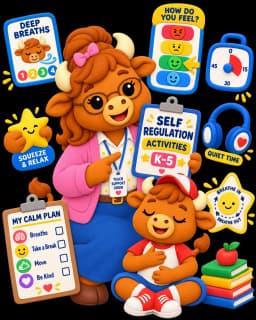
How to teach self-regulation as a learnable skill, not a behavioral expectation, with classroom activities that build the internal capacity students need to manage frustration, follow through on tasks, and recover from setbacks.
Self-regulation is not obedience. This distinction matters because confusing the two produces instruction that looks like compliance training rather than skill building.
Obedience is doing what an adult says because the adult said it. Self-regulation is the internal capacity to manage your own emotions, thoughts, and behavior in pursuit of a goal, even when the environment makes that difficult.[1] A student who sits quietly because the teacher is watching is being obedient. A student who notices their frustration rising during a math problem, takes three breaths, and tries a different approach is self-regulating. The first behavior disappears when the teacher turns away. The second one persists because the student owns it.
Self-regulation maps to self-management, the second CASEL competency, and it is arguably the most practically consequential skill in the entire SEL framework. A student who can self-regulate can persist through difficulty, delay gratification, manage transitions, participate in group instruction, recover from disappointment, and maintain focus when the classroom is noisy, unstructured, or boring.[1][2] A student who cannot self-regulate experiences each of those situations as a crisis.
The research is unambiguous: self-regulation is teachable, it improves with practice, and it predicts academic achievement, social competence, and long-term wellbeing more reliably than IQ.[2][3] The question is not whether to teach it. It is how to teach it in ways that build genuine internal capacity rather than just external compliance.
What Self-Regulation Actually Is
Self-regulation operates through three interconnected capacities, all supported by the brain's executive function system.[1]
Emotional Regulation
The ability to manage the intensity and duration of emotional responses. Not suppressing emotions. Not pretending they do not exist. Managing them: recognizing what you are feeling, understanding why, and choosing a response that is proportional to the situation.
A kindergartner who screams when they cannot have a turn is experiencing a real emotion (frustration) at an intensity that exceeds the situation. Emotional regulation does not mean the child should not feel frustrated. It means building the capacity to feel frustrated without screaming.
Cognitive Regulation
The ability to direct and sustain attention, hold information in working memory, and shift between tasks or strategies when needed. This is the executive function dimension of self-regulation: the capacity to think before acting, remember instructions across a delay, and adjust your approach when the first strategy does not work.[1]
A third grader who gets stuck on a math problem and immediately gives up is experiencing a cognitive regulation gap. The strategy “try something different” requires the executive function to step back from the current approach, generate an alternative, and redirect effort. That capacity is trainable.
Behavioral Regulation
The ability to control impulses, follow rules, and manage your body in accordance with the situation. Sitting still during a read-aloud, raising your hand instead of shouting out, walking in the hallway, keeping your hands to yourself during a line.
These behaviors are not instinctive for elementary students. They require active impulse inhibition, which is one of the most effortful cognitive tasks the developing brain performs.[1] A student who shouts out the answer is not choosing to be disruptive. Their impulse arrived faster than their inhibition. Self-regulation instruction builds the inhibition side of that equation.
Why Self-Regulation Is Hard for Elementary Students
The Brain Is Still Under Construction
The prefrontal cortex, the brain region responsible for executive function, impulse control, and emotional regulation, is one of the last areas to fully mature. It continues developing through adolescence and into early adulthood.[1][4]
This has a direct instructional implication: expecting students to self-regulate consistently without having been taught specific strategies is expecting them to perform a task their brain is not yet wired to do automatically. Self-regulation is not a choice students make. It is a capacity students build, gradually, with instruction and practice.
Stress and Dysregulation Are Contagious
A dysregulated student affects the entire classroom. When one child is screaming, crying, or acting out, other students' nervous systems respond: stress hormones increase, attention shifts from the task to the disruption, and the emotional temperature of the room rises.[5] This is not a character flaw. It is neurobiology. Humans are wired to respond to emotional distress in their environment.
This means self-regulation instruction is not just for the students who struggle most visibly. It benefits every student by creating a classroom where fewer students are dysregulated at any given time, which reduces the stress load on everyone.
The Gap Between Knowing and Doing
Most elementary students can tell you what they should do when they are angry (“take a deep breath,” “count to ten,” “walk away”). Far fewer can actually do it in the moment. The gap between knowing a strategy and being able to deploy it under emotional pressure is the central challenge of self-regulation instruction.[3]
This gap closes through practice. Repeated, low-stakes practice of calming strategies during calm moments builds the neural pathways that make those strategies accessible during high-stress moments. A student who has practiced deep breathing 50 times during SEL lessons is more likely to use it during a recess conflict than a student who heard about it once on a poster.
Self-Regulation Activities by Category
Breathing and Body-Based Strategies
Breathing exercises are the most portable, evidence-based self-regulation tool available. Deep, slow breathing activates the parasympathetic nervous system, which counteracts the fight-or-flight response and reduces cortisol, heart rate, and emotional intensity.[6] Research has demonstrated that even brief breathing exercises significantly reduce children's cortisol levels and self-reported stress.[7]
4-4-4 Breathing (All grades)
Breathe in for 4 counts, hold for 4 counts, breathe out for 4 counts. Simple enough for kindergartners, effective enough for adults. Practice daily, not just during crises.
Balloon Breathing (K-2)
Students put their hands on their belly. Breathe in slowly and feel the belly inflate like a balloon. Breathe out slowly and feel it deflate. The tactile feedback makes the breathing concrete and observable.
Five-Finger Breathing (All grades)
Students hold up one hand and use the index finger of the other hand to trace up and down each finger. Breathe in while tracing up, breathe out while tracing down. The physical movement provides a focus point that prevents the mind from returning to the stressor.
Progressive Muscle Relaxation (Grades 2-5)
Students tense a muscle group (squeeze fists, scrunch shoulders, curl toes) for 5 seconds, then release. The contrast between tension and release teaches the body the difference between a stressed state and a calm state.
Movement Breaks (All grades)
Structured movement (10 jumping jacks, a silent stretch sequence, a walk to the water fountain) provides a physical outlet for accumulated energy and a reset point between activities. These are not rewards for good behavior. They are regulation tools built into the schedule.
Emotional Identification Tools
Students cannot regulate what they cannot name. Building emotional vocabulary is the prerequisite for every other self-regulation strategy.
Emotion Check-Ins (All grades)
Start the day with a brief check-in. For K-1: “Show me with your face how you are feeling right now.” For grades 2-5: “On a scale of 1 to 5, how are you feeling? If you are below a 3, what strategy might help you move up?” This takes 60 seconds and provides real-time data on who might need support.
Feelings Thermometer (K-3)
A visual scale from 1 (calm) to 5 (out of control) with color coding and matching facial expressions. Students learn to identify where they are on the thermometer and practice strategies that bring them down one or two levels. The goal is never to jump from 5 to 1 instantly. It is to move down one level at a time.
Emotion Vocabulary Expansion (All grades)
During read-alouds and classroom discussions, consistently name emotions with precision. Not “he was upset” but “he was embarrassed because everyone was watching.” The more specific the vocabulary, the more accurately students can identify their own states.
Cognitive Strategies
These strategies teach students to manage their thinking, not just their feelings.
Positive Self-Talk (Grades 2-5)
Teach students to notice negative self-talk (“I can't do this,” “I'm so stupid”) and replace it with accurate, constructive alternatives (“This is hard, but I can try a different approach,” “I haven't figured it out yet”). This connects directly to growth mindset instruction.
Stop, Think, Act (All grades)
A three-step process for any situation where impulse and good judgment point in different directions. Stop: pause before acting. Think: consider what will happen if you follow your first impulse versus an alternative. Act: choose the option that aligns with what you actually want to happen. For K-1, simplify to “Stop and Think.”
Problem-Size Assessment (Grades 2-5)
Teach students to categorize problems as small (I dropped my pencil), medium (my partner won't share the materials), or large (someone got hurt). The appropriate emotional response should match the problem size. A student who reacts to a small problem with a large-problem emotional response is mis-calibrating.
Environmental Supports
The classroom itself can be designed to support self-regulation.
Calming Corner
A designated space in the classroom where students can go to regulate when they feel overwhelmed. Stock it with visual strategy cards, breathing guides, sensory tools (stress balls, textured objects), and a timer. The calming corner is not a punishment. It is a self-regulation tool that students learn to use independently.
Introduce it during an SEL lesson, model how to use it, and practice. “When you feel yourself getting to a 4 or 5 on the feelings thermometer, you can go to the calming corner, try a strategy, and come back when you are ready.”
Visual Schedules and Transition Warnings
Transitions are peak dysregulation moments for many students, especially those with ADHD or other neurodevelopmental differences. Visual schedules showing what comes next and verbal warnings before transitions (“We have 2 minutes before we switch to math”) reduce the executive function demand and give students time to prepare.
Noise Level Indicators
A visual meter showing the expected noise level for the current activity (silent work, partner voices, group discussion, celebration) gives students an external reference point for behavioral regulation. It is easier to regulate your volume when you can see the target.
Self-Regulation by Grade Band
Co-Regulation First
Young children are still developing the capacity for independent self-regulation. They learn to regulate through co-regulation: managing their emotions with the support of a trusted adult who models calm, names the emotion, and provides a strategy.[5]
At this level, the teacher's role is not to tell students to calm down. It is to calm down with them. “I can see that you're really frustrated right now. Let's take some breaths together. In... out... in... out... How does that feel?”
Effective K-1 strategies: breathing with physical cues (balloon breathing, finger breathing), movement breaks, songs that teach calming strategies, visual emotion charts, teacher modeling of self-talk. The goal is familiarity with the vocabulary, the strategies, and the concept that feelings can be managed.
Building Independence
Students at this age can begin using strategies independently when they have been explicitly taught and have practiced repeatedly. They can identify their emotions with more precision, select a strategy from a menu of options, and evaluate whether it worked.
Effective strategies: the feelings thermometer, Stop-Think-Act, the calming corner used independently, positive self-talk with sentence frames, problem-size assessment, partner check-ins. The teacher's role shifts from co-regulator to coach.
Metacognition and Transfer
Upper elementary students can engage in metacognitive self-regulation: thinking about their own thinking and regulation patterns. They can identify which strategies work best for them personally, recognize their own triggers and patterns, and plan ahead for situations they know will be challenging.
Effective strategies: personalized strategy menus, pre-planning for difficult situations, self-reflection journals, peer-to-peer regulation support, analysis of self-regulation in characters during read-alouds.
At this level, connect self-regulation explicitly to academic performance: “When you noticed you were stuck and decided to try a different approach instead of giving up, you were self-regulating. That skill is what makes learning possible.”
Self-Regulation and School Safety
Self-regulation is the skill that makes every safety procedure work. A lockdown drill asks students to stop what they are doing, move to a specific location, stay quiet, stay still, and manage their fear. Every one of those actions requires self-regulation.[8]
Students who have practiced calming strategies during low-stakes SEL instruction are better equipped to use those same strategies during high-stakes safety situations. Research on school drills confirms that drills conducted without prior emotional preparation can increase anxiety rather than reduce it, particularly in elementary students.
Self-regulation is also the skill that prevents conflicts from escalating to the point where they become safety incidents. A student who can pause before reacting (Stop), consider the consequences (Think), and choose a non-aggressive response (Act) is de-escalating in real time. That is conflict resolution built on self-regulation infrastructure.
What to Avoid
Treating self-regulation as a behavioral expectation rather than a taught skill
“Calm down” is not instruction. “Let's use our breathing strategy: in for 4, hold for 4, out for 4” is instruction. Students who are told to calm down without being taught how are receiving a demand without a tool.
Punishing dysregulation
A student who loses control of their emotions is experiencing a skills gap, not making a behavioral choice. Punishing the outburst does not build the skill. It adds shame to an already overwhelming emotional experience, which makes future regulation harder, not easier.
Teaching strategies only during crises
If students only encounter calming strategies when they are already upset, they associate those strategies with being in trouble. Calming strategies should be practiced daily during neutral moments so they become familiar, automatic tools.
Over-relying on a single strategy
Deep breathing works for many students but not all. Some students regulate better through movement, some through sensory input, some through verbal processing, some through drawing. Teach a menu of strategies and help students identify which ones work for them personally.
Expecting immediate mastery
Self-regulation develops over years, not weeks. A student who learned a breathing strategy in September will still have dysregulated moments in March. Look for progress (fewer incidents, faster recovery, more independent use) rather than perfection.
Ignoring the teacher's own regulation
Students learn self-regulation partly through observation. A teacher who responds to disruptions with visible frustration, raised voice, or punitive reactions is modeling dysregulation. “I'm feeling frustrated right now, so I'm going to take a breath before I respond” is one of the most powerful self-regulation lessons a teacher can deliver.
Measuring Self-Regulation Growth
Frequency and Intensity
Track how often individual students or the class as a whole experiences dysregulated episodes over time. A decrease in frequency, intensity, or duration indicates growing regulation capacity.
Recovery Time
How long does it take a student to return to baseline after an emotional disruption? With effective instruction, recovery time should shorten as students build faster access to their regulation strategies.
Independent Strategy Use
Are students using calming strategies without teacher prompting? Are they going to the calming corner independently? Are they choosing strategies that work for them? Independent use is the clearest indicator.
Transfer to Academics
Are students applying self-regulation during academic challenges? When a math problem is difficult, do they persist, try a different approach, or ask for help rather than shutting down?
Language
Listen for self-regulation language in students' natural speech: “I need a minute,” “I'm going to take some breaths,” “This is a small problem, I don't need a big reaction.” When regulation vocabulary appears spontaneously, the instruction is working.
Final Thoughts
Self-regulation is the infrastructure that makes everything else in school possible. A student who can manage their emotions can participate in instruction. A student who can control their impulses can collaborate with peers. A student who can direct their attention can learn. A student who can persist through difficulty can grow.
None of this happens by telling students to try harder, pay attention, or calm down. It happens through explicit instruction in specific strategies, daily practice during calm moments, consistent teacher modeling, environmental supports that reduce regulatory demand, and patient, sustained effort across the school year.[1][2][3]
The goal is not a quiet classroom. The goal is a classroom full of students who have the internal tools to manage whatever they are feeling and keep moving forward. Sometimes that looks quiet. Sometimes it looks like a student walking to the calming corner, taking five breaths, and walking back ready to try again. That walk is the skill.
References
- Blair, C., & Razza, R. P. (2007). Relating effortful control, executive function, and false belief understanding to emerging math and literacy ability in kindergarten. Child Development, 78(2), 647-663. https://doi.org/10.1111/j.1467-8624.2007.01019.x
- Durlak, J. A., Weissberg, R. P., Dymnicki, A. B., Taylor, R. D., & Schellinger, K. B. (2011). The impact of enhancing students' social and emotional learning: A meta-analysis of school-based universal interventions. Child Development, 82(1), 405-432. https://doi.org/10.1111/j.1467-8624.2010.01564.x
- Rosário, P., et al. (2023). A self-regulation intervention conducted by class teachers: Impact on elementary students' basic psychological needs and classroom engagement. Frontiers in Psychology, 14. https://www.frontiersin.org/journals/psychology/articles/10.3389/fpsyg.2023.1220536/full
- Edutopia. (2025). An effective protocol for student conflict resolution. https://www.edutopia.org/article/conflict-resolution-students-protocol/
- Education Endowment Foundation. (2026). Self-regulation and executive function. https://educationendowmentfoundation.org.uk/early-years/evidence-store/self-regulation-and-executive-function
- Mendes, P., & Ferreira, M. (2023). Deep breathing and mindfulness: Simple techniques to promote students' self-regulation and well-being from the inside out. In Positive Psychology and Positive Education in Asia (pp. 327-349). Springer. https://link.springer.com/chapter/10.1007/978-981-99-5571-8_17
- Gaertner, K. (2021). Taking a few deep breaths significantly reduces children's cortisol levels. ERIC. https://files.eric.ed.gov/fulltext/ED661504.pdf
- U.S. Secret Service, National Threat Assessment Center. (2019). Protecting America's schools: A U.S. Secret Service analysis of targeted school violence. https://www.secretservice.gov/protection/ntac
- Cipriano, C., Strambler, M. J., Naples, L. H., et al. (2023). The state of evidence for social and emotional learning: A contemporary meta-analysis of universal school-based SEL interventions. Child Development, 94(5), 1181-1204. https://doi.org/10.1111/cdev.13968
Build Self-Regulation Into Every Week
Be The Buffalo teaches self-regulation through interactive projector activities, calming strategy practice, character-driven stories, original songs, and structured discussion across a 40-week scope and sequence. Bilingual. No student devices. No prep.
Sign Up FreeRelated Resources
Teaching Growth Mindset in Elementary School
How to teach students that their brains can grow and change through effort and strategy.
Teaching Perseverance to Elementary Students
How to build the capacity to keep going when things get hard, without glorifying struggle.
Goal Setting for Elementary Students
How to teach K-5 students to set, track, and achieve goals that build self-efficacy and self-management skills.