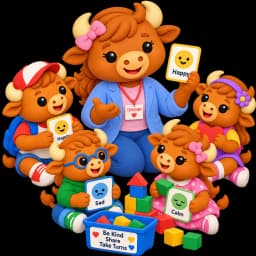
Kindergarten is the first year many children spend six or seven hours a day in a room with twenty other people their age. They are asked to wait in line, share a single box of scissors, raise a hand before speaking, recover from a tumble at recess, and say goodbye to a parent at the door. Most of that is social-emotional work, and most of it happens before anyone opens a phonics book.
That is why kindergarten SEL is not a smaller version of fifth-grade SEL. It needs to be shorter, more physical, more musical, more repetitive, and built around what five-year-olds can actually do.
This guide covers what the research says, what kindergarten brains are ready for, what a kindergarten SEL curriculum should teach, and how to evaluate a program before you commit to it.
What the Research Says About Kindergarten SEL
Kindergarten Social Skills Predict Later Outcomes
The most cited study on this topic followed 753 children from kindergarten into early adulthood. Kindergarten teachers rated each child's prosocial skills, such as cooperating with peers, resolving problems without being told, listening to others, and sharing. Researchers then tracked education, employment, criminal justice involvement, substance use, and mental health about 19 years later.[1]
Impact of Kindergarten Social Competence on Adult Outcomes
Per one-point increase on kindergarten social competence scale
One caution matters here: this was a correlational study. It shows that kindergarten social skills predict later outcomes. It does not prove that teaching those skills in kindergarten causes the later outcomes, because family environment, temperament, and many other factors are in the mix. The study is a strong argument that kindergarten social competence matters. It is not, on its own, proof that any particular program will change a child's life trajectory.
SEL Programs Produce Measurable Gains
The causal evidence comes from intervention research. A 2011 meta-analysis of 213 school-based SEL programs involving more than 270,000 students found that participants showed an 11-percentile-point gain in academic achievement compared with controls, along with better social-emotional skills, fewer conduct problems, and lower emotional distress.[2] A 2023 meta-analysis of 424 studies with more than 575,000 students confirmed improvements across skills, attitudes, behavior, and academics.[3]
SEL Intervention Research at a Glance
Kindergarten-Specific Trials
A smaller body of research looks at kindergarten and the early grades specifically:
INSIGHTS into Children's Temperament
Delivered in kindergarten and first grade, tested in a randomized trial. A follow-up found that students were less likely to have received special education services by the end of fifth grade, with the effect concentrated among low-income students.[4]
MindUP
A mindfulness-based SEL program evaluated with young elementary students in Ontario, associated with reductions in behavior problems and improvements in adaptive skills and executive functioning.[5]
These are encouraging results, but the early-grades evidence base is thinner than the evidence for SEL in general. Anyone claiming a single kindergarten program is proven to transform outcomes is overstating what the research shows.
The Kindergarten Brain
A good kindergarten SEL curriculum is built around developmental reality, not around a scaled-down version of an older-grade program.
What Five- and Six-Year-Olds Are Ready For
Perspective-Taking
Just Coming Online
Theory of mind develops ages 3-6. Fragile when upset or tired.
Developmental readiness
Self-Regulation
Still Borrowed
Relies on co-regulation with a calm adult. Independent use is inconsistent.
Developmental readiness
Sustained Attention
10-15 Minutes
Focused attention on teacher-led activity. Less at end of day or post-recess.
Developmental readiness
Emotional Vocabulary
The Bottleneck
"Happy, sad, mad" — most experiences get sorted into just three bins.
Developmental readiness
Perspective-Taking Is Just Coming Online
Theory of mind, the understanding that other people have thoughts and beliefs different from your own, develops largely between ages 3 and 6.[6] Many kindergartners can now understand that a friend might feel differently than they do, but the skill is fragile. It breaks down when they are upset, tired, or highly invested in the outcome (which describes most disputes over the red crayon).
Implication: Kindergarten empathy instruction should be concrete and immediate. “How do you think Sam felt when the tower fell?” works. Abstract discussions of fairness or other people's experiences generally do not.
Regulation Is Still Borrowed
Five-year-olds rely heavily on co-regulation: an adult's calm voice, steady presence, and predictable routines help them settle. Independent self-regulation is emerging but inconsistent.
Implication: Kindergarten SEL should teach a small number of calming strategies and practice them when children are calm, so the strategies are available when they are not. The teacher is part of the intervention.
Attention Spans Are Short
Most kindergartners can sustain focused attention on a teacher-led activity for roughly 10 to 15 minutes, less at the end of the day or after recess.
Implication: Lessons that run 30 to 45 minutes are poorly matched to kindergarten. Short, frequent sessions work better than long weekly blocks.
Vocabulary Is the Bottleneck
A child who only has “happy,” “sad,” and “mad” will put almost every experience into one of those three bins. Frustration, disappointment, embarrassment, and nervousness all come out as “mad” or “sad,” and the child cannot ask for the right kind of help.
Implication: Emotional vocabulary is one of the highest-value things a kindergarten SEL curriculum can teach. Every new word gives a child a more precise way to describe what is happening inside them.
Learning Is Concrete, Physical, and Repetitive
Kindergartners learn through movement, songs, stories, play, and repetition. They will happily hear the same song twenty times and are often more engaged the twentieth time than the first.
Implication: Repetition is a feature, not a flaw. A kindergarten SEL program should reuse songs, characters, and routines across many weeks.
What a Kindergarten SEL Curriculum Should Teach
Mapped loosely to the CASEL competencies, these are the skill areas that matter most at this age.
Emotional Vocabulary
Start with core feelings (happy, sad, mad, scared) and expand through the year to words like frustrated, proud, nervous, disappointed, excited, lonely, and calm. Use faces, pictures, and characters.
Body Clues
Children often notice the body before they can name the emotion: a hot face, tight fists, a fast heartbeat, a tummy that feels funny. Teaching kindergartners to notice these clues gives them an early warning system.
One or Two Calming Strategies
Kindergartners do not need ten strategies. They need one or two they have practiced many times: a specific breathing exercise, counting slowly, squeezing hands and letting go. Depth beats variety.
Sharing, Turn-Taking, and Waiting
These are the daily friction points of kindergarten. Explicitly teach what waiting looks like, what to say when you want a turn, and what to do when the answer is "not yet."
Making and Keeping Friends
How to ask to join a game, how to invite someone in, what to do when someone says no, and how to be a good friend when someone is sad.
Simple Problem Solving
A short, repeatable script works best: stop, say the problem, think of one or two ideas, try one. Kindergartners can learn a simple routine with practice.
Asking for Help
Many kindergartners do not yet know that asking for help is allowed, or how to do it. Teach the words ("Can you help me?"), who to ask, and when.
Routines and Transitions
Separation at drop-off, cleanup time, moving from recess back to the classroom, and the end of a favorite activity are all emotionally loaded for five-year-olds.
How Kindergarten SEL Should Look Day to Day
Short, Frequent, and Predictable
Ten to fifteen minutes a day, several days a week, builds more skill than one long weekly lesson. A consistent time slot, such as morning meeting or the period right after recess, helps children know what to expect.
Story- and Character-Driven
Kindergartners learn about emotions more easily through a character than through direct instruction about themselves. A recurring character who gets frustrated, makes mistakes, and figures things out gives children a safe distance to talk about hard feelings. See our guide to SEL read-alouds for elementary classrooms for how to structure story-based SEL.
Musical
Songs make SEL language stick. A calming strategy set to a simple tune is far more likely to be remembered on the playground.
Physical
Acting out emotions, freeze-and-breathe games, and role-play match how kindergartners learn.
Shared, Not Device-Based
A projector-based approach keeps everyone looking at the same thing and talking to each other.
Bilingual Where It Fits
For dual-language classrooms or classrooms with Spanish-speaking families, teaching emotional vocabulary in both languages helps children connect SEL concepts to the language they use at home. Many children find it easier to describe a feeling in their home language first. Our guide to bilingual SEL curriculum covers this in more depth.
A Sample 10-Week Kindergarten SEL Sequence
Adjust the order to match what is happening in your classroom
Feelings have names
Sort feeling faces into happy, sad, mad, scared
Body clues
Point to where you feel mad or nervous in your body
A calming breath
Practice one breathing strategy with a song, daily
Growth mindset and the word "yet"
Turn "I can't" into "I can't yet"
Making mistakes
Story about a character who makes a mistake and tries again
Kindness
Notice and name kind acts in the classroom
Sharing and taking turns
Role-play asking for a turn and waiting
Being a friend
Practice inviting someone to play
Solving small problems
Learn a simple stop, say, think, try routine
Asking for help
Practice what to say and who to ask
Related topic guides: growth mindset activities, kindness activities, emotional regulation for K-5, and problem solving for K-5.
Kindergarten vs. First Grade
Where the line moves
| Dimension | Kindergarten | First Grade |
|---|---|---|
| Focus | Emotion naming, body awareness, routines, separation | Complex emotion words, early perspective-taking |
| Instruction Style | Whole-group, teacher-led | More partner work, longer discussions |
| Key Tools | Songs, movement, visuals | Talk, partner practice, stories |
| Social Skills | Basic turn-taking, sharing | “Why might she feel that way?” |
For a broader view across grades, see SEL by grade level.
Questions to Ask Before Choosing a Kindergarten SEL Curriculum
How long is each lesson?
If lessons run longer than 15 to 20 minutes, the program was probably not designed for kindergarten.
Was the kindergarten content written for kindergarten?
Some programs reuse upper-grade material with simpler wording. Look for developmentally specific content.
Does it use songs, stories, and movement?
These are the primary ways five-year-olds learn.
How much teacher prep does it require?
Kindergarten teachers are already managing a high-demand classroom. A program that needs an hour of prep per lesson will not be used consistently.
Does it require devices or student accounts?
For kindergarten, a teacher-led, projector-based format is usually more practical.
Is it available in Spanish?
If you serve Spanish-speaking families, check whether the Spanish materials are full versions or partial translations.
Does it align with CASEL or your state standards?
Check whether your state has early-grades SEL standards.
Does it include family connections?
Kindergarten families are often eager to reinforce what is learned at school. Take-home materials help.
Does it cover a full year?
A curriculum with a clear scope and sequence is easier to sustain than a collection of standalone activities.
For a fuller evaluation framework, see how to choose an SEL curriculum and our state SEL requirements hub.
What to Avoid
Lessons That Are Too Long
A 40-minute SEL lesson in kindergarten will lose most of the room by minute 15. Shorter and more frequent is better.
Too Many Strategies at Once
Introducing six calming strategies in one month means children master none of them. Pick one or two and practice them until they are automatic.
Abstract Discussions
"What does respect mean?" is a hard question for a five-year-old. "What can we do when a friend is talking?" is answerable.
Using SEL Only After Something Goes Wrong
If SEL lessons only appear after a meltdown or a fight, children learn to associate them with being in trouble. Teach skills proactively, when everyone is calm.
Expecting Adult-Level Regulation
Kindergartners will still cry, grab, and yell sometimes, even after weeks of instruction. Progress looks like faster recovery and more frequent use of words, not the disappearance of big feelings.
Shaming or Public Correction
Clip charts and public behavior systems can undercut the emotional safety that SEL depends on. Private redirection and coaching work better.
Ignoring Families
Kindergarten is a transition year for parents too. Sharing the songs, vocabulary, and calming strategies at home multiplies the effect of classroom instruction.
Measuring Progress in Kindergarten SEL
Most classroom teachers can track meaningful progress with simple observation
Observable Growth Indicators Over Time
Illustrative targets for a well-implemented kindergarten SEL program over one school year
Emotional Vocabulary
Are children using more feeling words, and more specific ones, over time?
A child who moves from "mad" to "frustrated" is showing real growth.
Recovery Time
How long does it take a child to settle after a big feeling?
Shorter recovery is one of the clearest signs of developing regulation.
Strategy Use
Do children use a taught calming strategy without being reminded?
Do they reference songs or characters during real moments?
Peer Conflicts
Are disputes over materials and turns becoming less frequent or easier to resolve?
Help-Seeking
Are children asking for help with words rather than through crying, withdrawing, or acting out?
Transitions
Are drop-off, cleanup, and post-recess transitions getting smoother?
Final Thoughts
Kindergarten SEL does not need to be complicated. Five-year-olds need words for their feelings, a couple of practiced ways to calm down, simple scripts for sharing and solving problems, and an adult who models all of it consistently. The research suggests these skills are connected to outcomes well beyond kindergarten, though the strongest long-term findings are correlational and should be described that way.
The best kindergarten SEL curriculum is the one a teacher can actually deliver every week: short, musical, story-based, and built for the way five-year-olds learn.
Small skills, practiced daily, are what kindergarten SEL is made of.
References
- [1]
Jones, D. E., Greenberg, M., & Crowley, M. (2015). Early social-emotional functioning and public health: The relationship between kindergarten social competence and future wellness. American Journal of Public Health, 105(11), 2283-2290.
https://doi.org/10.2105/AJPH.2015.302630 - [2]
Durlak, J. A., Weissberg, R. P., Dymnicki, A. B., Taylor, R. D., & Schellinger, K. B. (2011). The impact of enhancing students' social and emotional learning: A meta-analysis of school-based universal interventions. Child Development, 82(1), 405-432.
https://doi.org/10.1111/j.1467-8624.2010.01564.x - [3]
Cipriano, C., Strambler, M. J., Naples, L. H., et al. (2023). The state of evidence for social and emotional learning: A contemporary meta-analysis of universal school-based SEL interventions. Child Development, 94(5), 1181-1204.
https://doi.org/10.1111/cdev.13968 - [4]
McCormick, M. P., Neuhaus, R., Horn, E. P., O'Connor, E. E., White, H. I., Harding, S., Cappella, E., & McClowry, S. (2019). Long-term effects of social-emotional learning on receipt of special education and grade retention: Evidence from a randomized trial of INSIGHTS. AERA Open, 5(3).
https://doaj.org/article/9f5f212bc79f4be3aa9742d582338609 - [5]
Crooks, C. V., Bax, K., Delaney, A., Kim, H., & Shokoohi, M. (2020). Impact of MindUP among young children: Improvements in behavioral problems, adaptive skills, and executive functioning. Mindfulness, 11, 2433-2444.
https://doi.org/10.1007/s12671-020-01460-0 - [6]
Wellman, H. M., Cross, D., & Watson, J. (2001). Meta-analysis of theory-of-mind development: The truth about false belief. Child Development, 72(3), 655-684.
https://doi.org/10.1111/1467-8624.00304
SEL Built for Kindergarten
Be The Buffalo's K-1 band was written for five- and six-year-olds, not adapted from older grades. Short projector activities, original songs, stories with Benny and Bella the buffalo, printables, and teacher guides are part of a 40-week CASEL-aligned scope and sequence. Bilingual. No student devices. No prep.
Sign Up FreeRelated Resources
SEL by Grade Level
How SEL skills and instruction shift from kindergarten through fifth grade
Emotional Regulation for K-5 Elementary Students
Calming strategies and co-regulation approaches that start in kindergarten
SEL Read-Alouds for Elementary Classrooms
How to use picture books to teach feelings, friendship, and problem solving