🧭
Character Education Alone
Student can define “perseverance” but cannot regulate the frustration that makes them want to quit.
Vocabulary without capacity
🔧
SEL Alone
Student can regulate frustration but has no framework for why persistence matters.
Skill without a compass
🧭 + 🔧
Both Together
Student regulates frustration because they understand that persistence matters — and has the tools to continue.
Compass AND capacity
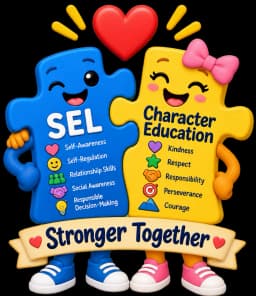
The separation of character education and social-emotional learning into distinct programs, distinct budgets, distinct professional development tracks, and distinct political identities is one of the most counterproductive structural decisions in elementary education.
The research does not support it. The classroom does not need it. The students do not benefit from it. And the only people it serves are those who find it easier to market, legislate, or argue about two simple categories than to grapple with one integrated reality.
The Research Never Separated Them
Berkowitz & Bier (2007) used a “broad definition of character education to include related positive youth development programs such as socioemotional learning.”[1]
Brown et al. (2023) defined character as “a complex multidimensional psychological construct encompassing moral, intellectual, self-regulatory, and civic functioning.”[2]
Self-regulatory = self-management. Civic = social awareness + responsible decision-making.
Fenn et al. (2026): “SEL competencies provide the regulatory, cognitive foundations” while “character education extends the impact of SEL by shaping adolescents' moral compass.”[3]
The research community treats these as overlapping constructs that reinforce each other. It is the education market and the political system that insist on separating them.
How They Actually Work Together
Character Education answers the “what” and “why”
Names the traits: kindness, respect, responsibility, courage, perseverance, fairness, compassion.
“What should I do? Why does it matter? What kind of person do I want to be?”
SEL answers the “how”
Teaches the skills: regulation, conflict resolution, perspective-taking, decision-making, goal-setting.
“How do I manage my emotions? How do I resolve conflict? How do I persist?”
Together they answer “now what”
A student who has learned kindness matters (character) AND how to recognize when someone is hurting (self-awareness), manage discomfort (self-management), take the other's perspective (social awareness), and respond with words that help (relationship skills) has both the compass and the capacity.
The Integrated Response Is Always Stronger
| Situation | Character Alone | SEL Alone | Both Together |
|---|---|---|---|
| Classmate is excluded | Knows exclusion is wrong | Recognizes the excluded child's emotions | Knows it's wrong, sees the pain, manages social anxiety, and acts to include |
| Hard math problem | Knows perseverance is valued | Can regulate frustration | Regulates frustration because they understand persistence matters |
| Disagreement about rules | Knows fairness matters | Knows conflict resolution steps | Applies resolution steps because they value fairness and have skills |
| Finds money that isn't theirs | Knows honesty is important | Can evaluate consequences | Returns it because they value honesty and can reason through the decision |
Why We Separated Them Anyway
Political convenience
“Character education” is safer in conservative communities. “SEL” is safer in progressive ones. Alabama mandates 24 character traits. Delaware mandates five CASEL competencies. Both describe the same student behaviors.
The difference is not pedagogical. It is rhetorical.
Market segmentation
A school that views them as separate will purchase two products. A vendor that sells “character education” to conservative districts and “SEL” to progressive ones can serve both markets. The separation is good for sales. It is not good for instruction.
Organizational inertia
The character committee selects a character program. The SEL committee selects an SEL program. Both run during the same school day, using different vocabulary and materials to teach the same student the same skills. The org chart created the duplication and perpetuates it.
What the Split Costs
🧠
Fragmented student experience
“Respect” on Monday, “social awareness” on Wednesday — same concept, two vocabularies. Students experience it as two things to remember, reducing depth.
⏱️
Doubled instructional time
Two programs spending twice the time to achieve what one integrated program could deliver. In elementary, every minute is contested.
🗣️
Inconsistent language
Teachers default to whichever vocabulary they're comfortable with. Consistency across the building breaks down.[4]
🌊
Political vulnerability
Programs labeled purely “SEL” or purely “character ed” are vulnerable to political shifts. Integrated language is resilient to shifts in either direction.
What Integration Looks Like
An integrated program does not teach character on Monday and SEL on Wednesday. It teaches both simultaneously because they are both present in every meaningful learning moment.
Example: A Lesson on Perseverance
One lesson. Both constructs. No duplication.
Example: A Lesson on Kindness
One lesson. Both constructs. Complete instruction.
What to Look For in a Program That Does Both
Does it name character traits AND teach the underlying skills?
A program that names "respect" without teaching perspective-taking and communication is vocabulary, not education. Both should be present in the same lesson.
Does it use consistent language across traits and skills?
Students should not need to translate between two frameworks. When a program uses one set of terms for character and a different set for SEL, the integration is superficial.
Does it provide a single scope and sequence?
An integrated program has one plan for the year. A program with separate tracks has repackaged two programs into one purchase — that is bundling, not integration.
Does it satisfy both character and SEL mandates?
Address the character traits statutes name (honesty, respect, self-control, perseverance) while covering the CASEL competencies that health education standards require.
Does it produce behavior change, not just knowledge?
Higher quality implementation produces greater student outcomes. A program that teaches the trait, the skill, and provides structured practice is more likely to change behavior.
The Research Supports Integration
Both meta-analyses of character education and meta-analyses of SEL report improvements in the same domains: prosocial behavior, reduced behavioral problems, improved attitudes, and academic achievement.[2][5][6]
+11%
Academic achievement gain from SEL programs (Durlak 2011)[5]
213
SEL programs meta-analyzed confirming positive effects[5]
214
Character ed studies showing significant positive effect (Brown 2023)[2]
Programs producing the strongest outcomes share common features: sequenced, active, focused, and explicit. They name what they teach. They provide practice. They build skills progressively. These features belong to good instruction — not to character education or SEL exclusively.
The Path Forward
The separation was never supported by research, never demanded by the classroom, and never experienced by the student as two distinct needs. It was a product of political labeling, market segmentation, and organizational convenience.
One program that:
- → Names the trait and teaches the skill
- → Provides one scope and sequence covering all five CASEL competencies
- → Addresses character traits that state mandates require
- → Uses one vocabulary shared by teachers, students, and parents
- → Produces both the moral framework and the functional skills in one investment of time
The student does not need two programs. The student needs one good one.
References
- Berkowitz, M. W., & Bier, M. C. (2007). What Works in Character Education. Journal of Character Education, 5(1), 29-48. emerald.com
- Brown, M., McGrath, R. E., Bier, M. C., Johnson, K., & Berkowitz, M. W. (2023). A comprehensive meta-analysis of character education programs. Journal of Moral Education, 52(2), 119-138. doi.org
- Fenn, N. S., et al. (2026). A multi-site cluster randomized trial of CharacterStrong's Secondary Curriculum. Social and Emotional Learning: Research, Practice, and Policy. sciencedirect.com
- Berkowitz, M. W. (2012). Understanding Effective Character Education. researchgate.net
- Durlak, J. A., et al. (2011). The impact of enhancing students' social and emotional learning. Child Development, 82(1), 405-432. doi.org
- Cipriano, C., et al. (2023). The state of evidence for social and emotional learning. Child Development, 94(5), 1181-1204. doi.org
One Program. Both Constructs. No Duplication.
Be The Buffalo integrates character education and SEL in every lesson. Each week names the trait, teaches the underlying skills, and provides structured practice — all within a single 40-week scope and sequence. No separate programs. No parallel vocabularies. No doubled instructional time.
Sign Up FreeRelated Resources
Best Character Education Curriculum
What to look for in a K-5 character education program that combines traits with social-emotional skills.
SEL Curriculum for Elementary Schools
How to evaluate and choose a CASEL-aligned SEL curriculum for K-5 schools.
What Is CASEL?
The five competencies that define social-emotional learning and how they connect to character education.
SEL Scope and Sequence
How to build a year-long plan that integrates character traits and social-emotional skills.