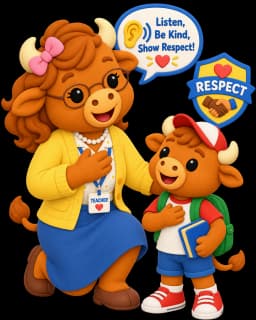
“Be respectful.” It is on every classroom rules poster in America. It is the most frequently cited behavioral expectation in elementary schools. It is also one of the least effectively taught, because most schools treat respect as a rule to enforce rather than a skill to develop.
A student who sits quietly because the teacher demands respect is not respecting the teacher. They are complying with the teacher. Compliance looks like respect from the outside, but it does not produce the internal understanding, the genuine regard for another person's dignity, that real respect requires. When the authority figure leaves the room, compliance leaves with them. Respect stays.
Teaching respect means helping students understand that every person has value, that other people's experiences and feelings matter even when they differ from your own, and that specific behaviors communicate this understanding.[1]
Respect connects to multiple CASEL competencies: social awareness (recognizing others' worth), relationship skills (communicating with honor), self-awareness (understanding your own value), and responsible decision-making (choosing respect when it is hard).
What Respect Actually Means in a Classroom
The Four Directions of Classroom Respect
A school that teaches only one direction is teaching compliance, not respect
Student → Teacher
Following instructions, listening during lessons, communicating disagreement appropriately rather than defiantly
Teacher → Student
Speaking with patience, acknowledging feelings, not using sarcasm or public humiliation, respecting time and autonomy
Student → Student
Listening when peers speak, not mocking or excluding, treating differences as variation rather than deficiency
Student → Self
Recognizing own worth, not accepting mistreatment as normal, advocating for own needs, treating own body with care
Respect Is Not Agreement
You can respect a classmate's right to their opinion while disagreeing with it. You can respect a teacher's authority while privately questioning a decision. Conflating respect with agreement produces students who suppress genuine disagreement or treat any disagreement as disrespect. Both undermine honest communication.
Respect Is Specific and Observable
“Be respectful” is vague. Respectful behavior is specific:
- •Waiting for someone to finish speaking
- •Using someone's preferred name correctly
- •Keeping hands and body to yourself
- •Cleaning up after yourself in shared spaces
- •Making room for someone to join a group
- •Disagreeing with an idea without attacking the person
- •Asking before touching someone's belongings
- •Listening to understand, not just to respond
Why Respect Matters for Learning
What Research Shows About Respectful Classrooms
Measured outcomes from classroom climate and respect research
The mechanism is straightforward: students who feel respected feel safe. Students who feel safe are willing to take risks (answering questions, trying hard problems, sharing ideas). Students who take risks learn more.[2]
The U.S. Secret Service has consistently recommended that schools build climates of “safety, respect, trust, and emotional support” as the primary strategy for preventing targeted violence.[4] The chain from respect to safety is direct and documented.
Respect Instruction by Grade Band
From concrete behaviors to moral reasoning
| Dimension | K-1 | Grades 2-3 | Grades 4-5 |
|---|---|---|---|
| Focus | Concrete behaviors | Respect across difference | Nuance and moral reasoning |
| Key Distinction | Respectful vs. disrespectful | Respect ≠ sameness | Respect ≠ agreement |
| Challenge | Being kind to friends | Respecting people who differ | Respect under peer pressure |
| Example Activity | Sorting respectful/disrespectful | Structured disagreement | Upstander scenarios |
| Includes Self-Respect | Body safety basics | Boundaries awareness | Advocating for own needs |
K-1: Concrete Behaviors and Clear Expectations
Respectful vs. Disrespectful Sorting
Present pairs of behaviors (listening vs. interrupting, asking vs. grabbing, including vs. excluding). Students sort them. This builds recognition before production.
Modeling and Practice
Act out scenarios with puppets. One character does something disrespectful. Ask: “Was that respectful? What could the character do instead?” Then act out the respectful alternative.
Respectful Listening Practice
Teach specific behaviors: eyes on speaker, body still, mouth quiet, thinking about what they say. Practice with partner activities.
Songs and Stories
Songs that name respectful behaviors and read-alouds featuring characters who learn to treat others with respect embed the concept through narrative and melody.
Taking Care of Shared Spaces
Cleaning up, pushing in chairs, putting supplies back. Frame explicitly as respect: “You are showing respect for our classroom and for the people who will use this space next.”
Grades 2-3: Expanding to Respect Across Difference
Respect for Different Ideas
Practice structured disagreement. One student shares an opinion. Another disagrees respectfully. The class evaluates what made the disagreement respectful.
Respect for Names
Teach students to learn and use correct names, including pronunciation. “Your name is part of who you are. Using it correctly shows I see you as a person.”
Respect for Different Abilities
Discuss what it means to respect classmates who learn, move, or communicate differently. Connect to empathy and neurodiversity.
Respect for Boundaries
Teach that respect includes honoring physical and emotional boundaries. “If someone says stop, you stop” encodes a complex respect concept in a simple rule.
Noticing Disrespect
Teach students to identify disrespectful behavior in stories before asking them to identify it in real life. Build the analytical skill needed for self-awareness.
Grades 4-5: Nuance and Moral Reasoning
Upper elementary students are ready for the harder dimensions: respecting people you disagree with, respecting people who have been disrespectful to you, and understanding that respect does not mean accepting mistreatment.
Respect vs. Fear
Genuine respect comes from recognizing competence, fairness, or care—not from fearing power. Help students evaluate when authority deserves respect versus demands compliance.
Respecting People You Disagree With
Use ethical dilemma discussions. “You can say ‘I disagree because...’ without saying ‘That's stupid.’” This is the foundation of civil discourse.
Respect and Peer Pressure
“Your friends are making fun of a classmate's accent. What do you do?” Connect to upstander training: standing up for someone being disrespected is one of the hardest acts of respect.
Self-Respect
“If someone is treating you in a way that doesn't feel right, that is important information. You deserve to be treated with respect, and you can ask for it.”
Digital Respect
“How would this text message feel if you received it? Would you say this to the person's face?” Connect to internet safety instruction.
Building a Respect Culture
The Teacher Sets the Floor
The level of respect in a classroom cannot exceed the level the teacher models. A teacher who speaks with patience, uses names, says please and thank you, admits mistakes, and treats every contribution as worthy is building respect through daily behavior.[3]
Name It in Real Time
When you see respectful behavior, name it: “I noticed you waited until she finished speaking. That was really respectful.” When you see disrespect, name that too without shaming: “That comment sounded disrespectful. What could you say instead?”
Create Agreements, Not Rules
A rule says “Be respectful.” An agreement says “We listen when someone is speaking. We use kind words. We include everyone.” Agreements are specific, student-generated, and owned by the community.
Repair Rather Than Punish
When disrespect occurs, use restorative practices: “What did you say? How do you think it made her feel? What could you do to make it right?” This builds empathy and responsible decision-making.
Connecting Respect to Your SEL Curriculum
Understanding your own worth and recognizing when your behavior is disrespectful
Choosing a respectful response even when frustrated, angry, or impatient
Recognizing that others have different perspectives that deserve acknowledgment
Communicating in ways that honor the other person, resolving conflicts without attacks
Choosing respectful behavior when disrespect would be easier, more popular, or more immediately satisfying
In a well-sequenced scope and sequence, respect instruction appears after foundational self-awareness and emotional regulation skills are established. A student cannot choose a respectful response when emotionally overwhelmed.
What to Avoid
Demanding Respect Without Modeling It
Students will not respect a teacher who does not respect them. If you use sarcasm, dismiss feelings, or speak to them in ways you wouldn't speak to a colleague, no instruction will produce genuine respect.
Equating Respect With Silence
A student who asks a challenging question is being intellectually respectful. A student who disagrees calmly is being conversationally respectful. Respect is not silence—it is thoughtful engagement.
Teaching Respect as One-Way
If respect only flows from students to adults, students learn respect is something the powerful demand. This is compliance, not respect. Mutual respect is the standard that produces culture change.
Using “Respect” as a Catch-All
A student out of their seat is not necessarily disrespectful. Reserve respect language for situations that genuinely involve the treatment of another person, not every off-task behavior.
Final Thoughts
Respect is not a rule to enforce. It is a culture to build. It starts with the teacher modeling mutual regard in every interaction. It deepens through instruction that makes respectful behavior specific, observable, and practicable. It expands through activities that challenge students to respect people who are different, people they disagree with, and themselves.
The research is clear: classrooms where students and teachers treat each other with genuine respect produce better academic outcomes, stronger relationships, less bullying, and greater wellbeing.[2][3]
Teach respect in all four directions. Model it first. Name it when you see it. Repair it when it breaks. And remember that the most powerful respect lesson you will ever teach is how you treat the most difficult student in your room on your worst day.
References
- [1]
Lickona, T. (1991). Educating for character: How our schools can teach respect and responsibility. New York: Bantam Books.
https://archive.org/details/educatingforchar0000lick - [2]
Wang, M.-T., Degol, J. L., Amemiya, J., Parr, A., & Guo, J. (2020). Classroom climate and children's academic and psychological wellbeing: A systematic review and meta-analysis. Developmental Review, 57, 100912.
https://www.sciencedirect.com/science/article/abs/pii/S0273229720300186 - [3]
Jennings, P. A., & Greenberg, M. T. (2009). The prosocial classroom: Teacher social and emotional competence in relation to student and classroom outcomes. Review of Educational Research, 79(1), 491-525.
https://doi.org/10.3102/0034654308325693 - [4]
U.S. Secret Service, National Threat Assessment Center. (2019). Protecting America's schools: A U.S. Secret Service analysis of targeted school violence.
https://www.secretservice.gov/protection/ntac - [5]
OECD. (n.d.). Respect: OECD Learning Compass 2030.
https://www.oecd.org/content/dam/oecd/en/topics/policy-issues/future-of-education-and-skills/learning-compass-constructs/Respect.pdf - [6]
Escartí, A., Llopis-Goig, R., & Wright, P. M. (2019). Implementation of a model-based programme to promote personal and social responsibility. International Journal of Environmental Research and Public Health, 16(22), 4259.
https://www.ncbi.nlm.nih.gov/pmc/articles/PMC6862051/ - [7]
Durlak, J. A., Weissberg, R. P., Dymnicki, A. B., Taylor, R. D., & Schellinger, K. B. (2011). The impact of enhancing students' social and emotional learning: A meta-analysis of school-based universal interventions. Child Development, 82(1), 405-432.
https://doi.org/10.1111/j.1467-8624.2010.01564.x
Build a Culture of Respect Every Week
Be The Buffalo teaches respect through interactive projector activities, character-driven stories, original songs, printable worksheets, and structured discussion prompts as part of a 40-week CASEL-aligned scope and sequence. Bilingual. No student devices. No prep.
Sign Up FreeRelated Resources
Kindness Activities for Elementary Students
How to teach kindness as a practicable skill that builds prosocial behavior and peer acceptance
Empathy Lessons for Elementary Students
How to teach perspective-taking, emotional understanding, and compassion in K-5
Best Character Education Curriculum for Elementary Schools
What to look for in a K-5 character education program that works