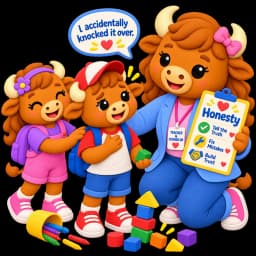
Stories about the positive consequences of telling the truth promote honest behavior. Stories about the negative consequences of lying do not.[1]
✗ The Boy Who Cried Wolf
Teaches that getting caught is dangerous. Does not make children more honest.[1][2]
✓ George Washington & the Cherry Tree
Truth → pride, not punishment. Measurably promotes honest behavior in subsequent conditions.[1][2]
This finding has been replicated across multiple studies, age groups, and cultural contexts: children become more honest when they see honesty rewarded, not when they see lying punished.[2][3] The default approach — warning children about what happens when you lie — is less effective than the alternative: showing children what happens when you tell the truth.
What Honesty Actually Requires
Honesty is not the absence of lying. It is the active choice to tell the truth when the truth is harder. That choice requires five capacities:
Recognizing the moment
Noticing you are in a situation where honesty is relevant
Managing the fear
Regulating the impulse to protect yourself through deception
Understanding the impact
Knowing that honesty builds trust and dishonesty damages it
Choosing the harder path
Deciding long-term trustworthiness is worth short-term discomfort
Communicating effectively
Saying hard things in ways that are clear, considerate, and constructive
Teaching “be honest” addresses none of these. Teaching the capacities produces honesty as an outcome.
How Honesty Develops
Rules and consequences
Honesty is a rule: you should tell the truth. Motivated by fear of getting caught and desire for approval. The child tells the truth because they are supposed to, not because they understand why it matters relationally.[4]
Emerging relational understanding
Children begin to understand that honesty affects relationships. They feel guilty about lying, not just afraid of getting caught. Stories featuring guilt after lying promote honesty at this age but not in preschoolers.[3][5]
Nuanced reasoning
Wrestling with complexity: when truth might hurt feelings, when honesty conflicts with loyalty, when partial truths are tempting. The simplistic “always tell the truth” breaks down. The child needs guidance on navigating complexity, not just following a rule.
Teaching Through Stories That Work
Lead with positive consequences[1][2][3]
Use stories where honesty leads to understanding, relief, or strengthened relationships during weekly SEL instruction.
“The character told the truth about breaking the vase. The parent was upset about the vase but proud of the honesty. The relationship got stronger. What would have happened if the character had lied?”
Positive consequence first, then the counterfactual. The child sees what honesty produces before considering what dishonesty costs.
Use realistic characters[2]
A story about a child who tells the truth is more effective than a story about a rabbit who tells the truth. When the primary goal is promoting honest behavior, realistic honesty dilemmas are the stronger tool.
Discuss, don't just read
"Why was it hard to tell the truth?"
"What was the character afraid of?"
"What happened to the relationship after?"
"Have you been in a situation like this?"
These questions move the lesson from passive reception to active moral reasoning.
Building a Classroom Where Honesty Is Easier Than Lying
Make truth-telling safe
The single most important structural condition. If telling the truth consistently leads to better outcomes than lying, the child learns honesty pays.
“Thank you for telling me the truth. I know that was hard. Now let's talk about what happened and figure out how to fix it.”
The “thank you” must come before the consequence. Honesty is acknowledged before behavior is addressed.
Model honesty yourself
“I made an error on the schedule. Math was supposed to be at 10:00. I'm sorry for the confusion.”
“I said we'd have extra recess and I forgot. That was my mistake. We'll do it tomorrow.”
The adult choosing honesty when they could have avoided it is the most powerful honesty lesson available.
Create a repair-oriented culture
Repair-based
Breaking a marker → help tape it or contribute to replacement. Manageable cost → more likely to tell truth.
Punishment-based
Breaking a marker → lose recess. Disproportionate cost → more likely to lie.[4]
Repair-oriented responses align discipline with honesty instruction: we tell the truth, and when truth reveals a problem, we fix it together.
Teach the concept of trust
“When you tell the truth, even when it is hard, people learn they can believe you. That is trust. When you lie, even once, people are not sure if they can believe you next time. Trust is hard to build and easy to break.”
Use promise-making strategically[2]
“Before I ask what happened, I want you to promise me you will tell the truth. Can you do that?”
The promise creates a self-imposed commitment. Do not overuse — deploy when the situation is significant.
The Harder Conversations
When honesty hurts someone's feelings
“Do you like my drawing?” — this is where “always tell the truth” collapses. Honest and cruel is cruelty. Kindness without honesty is flattery. The goal is both.
“You can be honest and kind at the same time. If you don't like their drawing, you can say 'I like how hard you worked on it' or 'tell me about what you drew.' You don't have to lie, and you don't have to be mean.”
When honesty means getting a friend in trouble
The loyalty conflict is real. Do not dismiss it — acknowledge it as real and teach the child to navigate it.
“If your friend did something that could get them in trouble, telling the truth is how we help them learn from it. Hiding it doesn't help them. It just delays the consequence.”
When the child has been punished for honesty before
Some children lie because experience taught them honesty is dangerous. Rebuilding trust takes time and consistent experience. One positive experience is not enough. Ten might be. Twenty might be. The pattern has to overwrite previous learning, and patterns take time.
What to Avoid
✗ Honesty traps
“I left the candy out to see if you'd take it.” Build trust by extending it, not testing it.
✗ Disproportionate praise
“I'm SO proud of you!” with excessive emotion implies honesty is exceptional. Calm acknowledgment normalizes it.
✗ Slogans as curriculum
“Honesty is the best policy” is a bumper sticker, not an instructional program. A slogan without a strategy.
The Full Skill Set
Self-awareness
"I notice I want to lie right now because I'm afraid."
Self-management
"I can manage the fear and choose to tell the truth."
Social awareness
"If I lie, the person I lie to can't trust me."
Relationship skills
"I can say hard things in a kind way."
Decision-making
"Telling the truth now is hard, but it produces a better outcome."
The Character Connection
Honesty appears in more state character education mandates than almost any other trait (Alabama, South Carolina, Iowa, Florida).[6] A program that integrates character with SEL teaches honesty as both a value (why truth matters) and a skill (how to tell the truth when it is hard).
Value without skill: knows honesty matters but can't manage the fear, social pressure, or complexity
Both together: can tell the truth and understands why — even when it is hard
The Bigger Picture
The most honest children are not the most obedient. They are the children who have been taught that truth-telling is safe, that mistakes are survivable, that trust is worth building, and that the adults in their lives will respond to honesty with problem-solving rather than punishment.
Tell the stories where honesty is rewarded. Build the classroom where truth-telling is safe. Model your own mistakes openly. Acknowledge the honesty before you address the behavior. Teach the skills that make honesty possible even when it is hard.
The child who can do all of that is not just honest. They are trustworthy. And trustworthy is what every parent, teacher, employer, and community needs more of.
References
- Lee, K., Talwar, V., et al. (2014). Can classic moral stories promote honesty in children? Psychological Science, 25(8), 1630-1636. doi.org
- Behavioral Sciences. (2025). The Influence of Different Types of Moral Stories on Honest Behaviour in Children. Behav. Sci., 15(2), 178. pmc.ncbi.nlm.nih.gov
- ScienceDirect. (2025). Emotional elements matter: Stories about guilt over lying promote honesty in early elementary children. sciencedirect.com
- AJOUP. (2025). Understanding the Development of Honesty in Early Childhood. AJOUP, 2(9). scientificbulletin.com
- Talwar, V., & Lee, K. (2008). Social and Cognitive Correlates of Children's Lying Behavior. Child Development, 79(4), 866-881. researchgate.net
- Code of Alabama §16-6B-2(h); South Carolina Code §59-17-135; Iowa Code §256.18A; Florida Statutes §1003.42.
Build the Full Skill Set Behind Honesty
Be The Buffalo teaches honesty, self-regulation, empathy, and trust-building through weekly 15-minute lessons. Stories where honesty is rewarded. A culture where truth-telling is safe. The skills that make honesty possible even when it is hard.
Sign Up FreeRelated Resources
How to Handle Lying
The reactive companion: what to do when a child lies, and why punishment increases lying rather than reducing it.
Teaching Responsibility
Building accountability as a skill that makes honesty actionable.
Self-Regulation Activities
Building the impulse control that allows children to choose truth over self-protection.
SEL and Character Education
Why honesty requires both the character value and the social-emotional skill set.