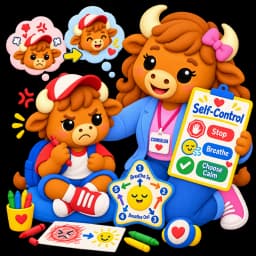
Three students. Three failures of self-control. Three different underlying mechanisms.
The blurting student
Could not inhibit an impulse
The grabbing student
Could not delay a desire
The crumpling student
Could not manage an emotion
All get called “poor self-control” but involve different processes, develop on different timelines, and respond to different interventions.
What Self-Control Actually Is
The ability to regulate impulses, emotions, and attention in the service of a goal. Two systems are involved:[1][2]
The “Hot” System (Reactive)
Fast, emotional, automatic. Produces the urge to blurt, grab, hit, cry, or quit. Operates below conscious awareness. Does not consult the future — reacts to now.
The “Cool” System (Regulatory)
Slower, cognitive, deliberate. Evaluates the impulse, considers consequences, chooses a response. Involves executive functions: inhibitory control, working memory, cognitive flexibility.
Self-control happens when the cool system catches the hot system before it acts. In children, the cool system is still developing — the hot system wins more often than adults expect.[1]
Three Components of Self-Control
Impulse control: Stopping yourself
Inhibiting an automatic response. Not blurting the answer. Not grabbing the toy. Not pushing past someone. The most visible component because its failures are the most disruptive.
Emotional regulation: Managing how you feel
Modulating intensity and duration of emotional responses. Not melting down when you lose. Not shutting down when overwhelmed. The component most connected to SEL.
Attentional control: Focusing on what matters
Directing and sustaining attention while ignoring distractions. The least visible component — failures look like disengagement, not disruption. The child staring out the window is losing learning time.
Why Self-Control Is Hard for Children
The brain is under construction
The prefrontal cortex is among the last regions to mature. The hot system is faster and stronger at every age in childhood. The child is not choosing defiance — their system is genuinely less capable.
Self-control is depletable
It fluctuates across the day and emotional states. Strong self-control in math may leave less for recess. The same child can look self-controlled in one context and impulsive in another.
Some children start the day depleted
A child who navigated a chaotic morning has already used significant capacity before the first lesson. Expecting uniform self-control from unequal starting conditions is expecting equal output from unequal inputs.
What Self-Control Is Not
✗ Not obedience
The obedient child sits still because the teacher is watching. The self-controlled child sits still because it serves a goal they care about. Remove the gaze and only one stays.
✗ Not suppression
The goal is not a child who feels nothing. The goal is a child who feels everything and can choose their response.
✗ Not uniform
Strong in academic settings, weak in social ones (or vice versa). Self-control develops unevenly across domains.
How to Teach Each Component
Teaching impulse control
The pause
“When you feel the urge to call out, put your hand up instead. The hand is the pause.” Practice with games: Simon Says, Red Light Green Light.
Stop-Think-Choose
Stop (recognize impulse). Think (what happens if I act? if I wait?). Choose (response that serves the goal). Role-play during SEL lessons.
Reduce the demand
Standing desk, wobble cushion, permission to move. Reducing demand in one domain frees resources for another.
Teaching emotional regulation
Name the emotion first
“I'm frustrated” creates a gap between feeling and action. Emotional identification is step one.
Specific calming strategies
4-4-4 breathing. Progressive muscle relaxation. Grounding (five things you see). Count backward from ten. Practice during calm moments.
Emotion-behavior separation
“It is okay to feel angry. It is not okay to throw things. The feeling is always allowed. The behavior has limits.”
Teaching attentional control
Break tasks into smaller units
Can't sustain 20 minutes? Try four 5-minute segments. Same work, different attentional demand.
Visual anchors
Checklists, timers, step-by-step instructions. External structure supports internal attention.
Reduce distractions
Seat away from traffic. Minimize clutter. Environmental adjustments that reduce the attentional demand.
Teach the refocus
“When your mind wanders, bring it back. That is not failure. That is what focusing looks like. The skill is noticing and returning.”
Building Self-Control Across the School Day
Set the intention
"Today we practice patience. I'll be looking for it." A specific target, not vague "be self-controlled."
Practice hardest moments
"Push in chair, walk to door, line up without touching or talking. Body control, voice control, space respect."
Scaffold the demand
Weak attention → shorter segments. Weak impulse control → structured turns. Weak regulation → warnings before challenges.
Reflect on practice
"When was self-control hardest? When did you succeed? What strategy helped?" Builds metacognition.
What to Avoid
✗ Punishing without teaching
Consequence without instruction produces suppression, not self-control. Teach the stop-and-think protocol, not just "don't do that."
✗ Expecting uniform self-control
Different neurological maturity, temperaments, home environments, and mornings. Equal output from unequal inputs is unreasonable.
✗ Treating it as a moral quality
"You should know better" produces shame, which depletes the self-control resources the child needs. Frame it as a skill gap, not a character judgment.
✗ Ignoring environmental demands
A loud, chaotic classroom demands more self-control. Sometimes the best intervention is a calmer environment.
What Self-Control Teaches
Self-awareness
Recognizing the impulse before acting. Noticing the emotion before it drives behavior. Catching the wandering mind
Self-management
The entire competency is built on self-control. Managing emotions, impulses, attention, behavior
Social awareness
The blurt interrupts. The grab takes from someone. Self-control in a shared space is an act of consideration
Relationship skills
Waiting your turn. Not saying the hurtful thing. Managing frustration during conflict rather than escalating
Decision-making
Pausing to think. Evaluating consequences. Selecting the response that serves the long-term goal
The Research That Matters Most[3]
The Dunedin study (Moffitt et al., 2011) followed 1,000 children from birth to age 32. Childhood self-control predicted health, wealth, and public safety outcomes across a gradient — after controlling for intelligence and socioeconomic status.
Critically: children who improved their self-control over childhood had better outcomes than their baseline predicted. Self-control is not fixed. Improvement counts.
The Character Connection
Self-control is named in multiple state mandates (Alabama, South Carolina) under names including self-control, self-discipline, and self-management.[5] A program that integrates character with SEL teaches it as both a value (why managing impulses matters) and a skill (how to stop, think, and choose).
The Bigger Picture
The child who cannot stop calling out is not showing you a character flaw. They are showing you a developing brain doing the best it can with a regulatory system still under construction. The blurt is not defiance. The grab is not greed. The meltdown is not a choice.
Teach the pause. Name the emotion. Practice the strategies. Scaffold the demand. Reduce the environmental load. And do it with the understanding that the child who struggles most today may benefit most from learning it — because improvement counts.
Self-control is not about being still. It is about being able to choose. Teach the choice.
References
- Scientific Reports. (2014). Development of self-control in children aged 3 to 9: Perspective from a dual-systems model. nature.com
- Frontiers in Psychology. (2025). Time-course effects of cognitively engaging physical activity on executive function and self-control. ncbi.nlm.nih.gov
- Moffitt, T. E., et al. (2011). A gradient of childhood self-control predicts health, wealth, and public safety. PNAS, 108(7), 2693-2698. doi.org
- Nature Human Behaviour. (2022). Teaching self-regulation. nature.com
- Code of Alabama §16-6B-2(h); South Carolina Code §59-17-135.
Build All Three Components of Self-Control
Be The Buffalo teaches impulse control, emotional regulation, and attentional focus through weekly 15-minute lessons. Not suppression — the ability to choose. Build the cool system that makes self-control possible.
Sign Up FreeRelated Resources
Emotional Regulation Activities
Building the emotional component of self-control.
Self-Regulation Activities
Practical strategies for building the regulatory system.
Teaching Patience
The specific self-control skill of delayed gratification.
Teaching Kids to Lose Gracefully
Self-control under the pressure of competitive frustration.