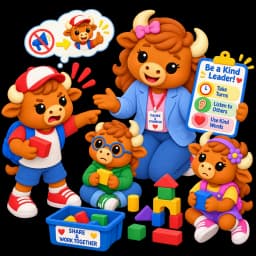
Leadership vs. Dominance
Leadership ✓
- • Guidance toward a shared goal
- • Influence, not control
- • Group follows because the idea is good
- • Produces collaboration
“Let's build a castle — I'll start the wall and you can work on the tower.”
Dominance ✗
- • Power through coercion or control
- • Dictation, not invitation
- • Group follows out of fear
- • Produces compliance
“We're building a castle. I'm in charge. Do what I say.”
Same project. Same organizational impulse. Different social mechanism. Different outcome for everyone.[1]
Hierarchical classrooms where power is concentrated in a few students show higher bullying and more persistent victimization. Egalitarian classrooms show lower aggression.[2][3]
Why Children Are Bossy
Managing anxiety
Controlling the play is their strategy for managing unpredictability. Being bossy feels safer than being flexible.
Want connection but only know how to direct
"Do it this way" is the only language they have for "I have an idea and I want us to do it together." Skills gap, not character flaw.
Replicating authority patterns
Applying the only template they have for how groups work: one person gives orders, others comply.
Developmentally egocentric (K-2)
May not fully understand others have different ideas or preferences. Not overriding — just not registering.
More skilled and frustrated
Can see how it should go. Watching peers do it "wrong" produces genuine frustration. Bossiness is an attempt to correct.
What Not to Do
✗ "Stop being bossy"
Labels the child without teaching an alternative. The label sticks. The behavior continues.
✗ "Let others have a turn"
Too vague. A turn at what? May be interpreted as "be passive," which feels intolerable to the organizing child.
✗ "They're just a natural leader"
Normalizes dominance. The other children don't experience it as leadership — they experience it as dictatorship.
✗ Punish the initiative
Initiative, organizational thinking, and confidence are valuable. The goal is to add collaboration, not eliminate the energy.
What to Do Instead
Teach the difference between proposing and commanding
Command
"Do it this way"
Proposal
"What if we tried it this way?"
Command
"You have to be the goalie"
Proposal
"Would you want to be goalie, or somewhere else?"
Command
"I'm the leader"
Proposal
"Can I share an idea?"
Command
"That's wrong"
Proposal
"I have a different idea. Can I show you?"
Same influence, collaborative channel. The child who proposes a good idea and gets agreement achieves the same outcome — while preserving everyone's dignity.
Teach negotiation and compromise
“You want to play tag and Sam wants basketball. What works for both? Tag for 10 minutes then basketball? A game that combines running and a ball?”
The bossy child thinks in binaries: my way or nothing. Negotiation and compromise are skills — practice them during low-stakes moments.
Build perspective-taking
"How do you think Jayden felt when you told him he was doing it wrong?"
"When you picked the game without asking, did everyone get to share their idea?"
"If someone told you exactly how to draw your picture, how would that feel?"
These questions build the social awareness the bossy child's focus on outcomes has bypassed.
Assign leadership roles with specific expectations
“You're team captain today. That means you organize who does what, but you ask each person what they want to do before you assign anything. A good captain listens first and decides second.”
Channels organizational energy into a legitimate role while teaching collaborative behaviors.
Create structures that distribute power
Assign interdependent roles: recorder, materials manager, reporter, timekeeper. When every student has a defined role, no single student can take over. Cooperative learning structures with role rotation ensure every child practices both leading and following.[4]
Work with the child privately
“I notice you often tell other people what to do. I think that comes from having really good ideas and wanting things to work out well. That is a strength. The problem is that when you tell people what to do without asking what they think, they stop wanting to work with you. I want to help you share your ideas in a way that makes people want to follow them.”
Validates strengths, names the problem honestly, explains the social consequence, offers a pathway.
Teach them to notice others' ideas
“Before you share your idea, ask each person for theirs first. Listen to all three. Then share yours. After everyone has shared, the group decides together.”
Forces the child to do the thing they skip: attend to other perspectives before asserting their own.
What About the Other Children?
Teach assertiveness
"I don't agree. Can we try something different?"
"I want a turn to decide too."
"That's your idea. I have a different one. Can we talk about both?"
Practice during SEL instruction. Assertiveness prevents children from becoming permanent followers.
Validate their experience
“Your ideas matter. Even if someone else talks louder or faster, your idea is just as important. In this classroom, everyone's ideas count.”
Build their confidence through leadership opportunities
Give quieter children assigned roles, small group leadership, presenting to the class. When those usually directed get practice directing, the power dynamic becomes more fluid.
The Classroom Culture Piece
Bossy behavior thrives where social power is concentrated. It diminishes where power is distributed and collaboration is explicitly valued.
Model collaborative language yourself
“I'm thinking we could do this two ways. Let me hear what you think. Raise your hand for option A. Now B. Most of you want B, so let's do that.”
Praise collaborative behavior specifically
“Your group had three different ideas and combined them into one plan. That is great teamwork.”
“I saw you ask everyone what they thought before starting. That is leadership.”
Teach collaboration during SEL instruction
A structured SEL curriculum that teaches cooperation, communication, conflict resolution, and respect provides the foundation that makes individual interventions more effective.
What This Teaches
Self-awareness
Recognizing how their behavior affects others; noticing the difference between willing and coerced following
Self-management
Managing the impulse to take over; pausing to create space for others
Social awareness
Attending to others' ideas and preferences instead of overriding them
Relationship skills
Proposing instead of commanding, negotiating instead of dictating, collaborating instead of controlling
Responsible decision-making
Understanding that the best outcome is one the group owns together
The Long View
The bossy child has something many quieter children do not: the willingness to step forward, organize a group, and drive toward a goal. In the right form, it becomes the leadership teams, organizations, and communities need.
In the wrong form, it becomes the coworker who steamrolls meetings, the manager who doesn't listen, the partner who makes every decision unilaterally.
Do not silence the bossy child. Teach them. The energy is the raw material. Collaboration is what you build with it.
References
- Shin, M. S., et al. (2004). Leadership and social dominance in young children. Cited in Springer (2024). springer.com
- Garandeau, C. F., & Rodkin, P. C. (2011). Classroom social hierarchy and aggression. Cited in Frontiers (2026). frontiersin.org
- Ahn, H. J., & Rodkin, P. C. (2014). Hierarchical and egalitarian classroom structures. Cited in ScienceDirect (2024). sciencedirect.com
- Fisher-Grafy, H., et al. (2025). From “Me” to “We.” Study of 594 fourth- and fifth-graders. ncbi.nlm.nih.gov
Build Collaborative Leadership Skills
Be The Buffalo teaches teamwork, negotiation, perspective-taking, and respect in weekly 15-minute lessons. When the bossy moment surfaces, the teacher has a shared vocabulary — and the bossy child has the collaborative skills to use their energy well.
Sign Up FreeRelated Resources
Teamwork Activities
Cooperative activities that build the collaboration bossy behavior lacks.
Conflict Resolution Activities
Teaching negotiation and compromise as alternatives to control.
Empathy Lessons
Building the perspective-taking bossy children need to understand their impact.
How to Handle Cliques
When bossy behavior becomes group-level social control.