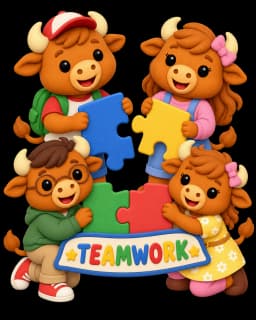
Four students are assigned a group project. One does all the work. One argues about every decision. One sits silently and contributes nothing. One announces that group projects are stupid and asks if they can work alone.
The teacher sees this and concludes that these students are “bad at teamwork.” But the students were never taught teamwork. They were taught content and then placed in a group with the instruction to “work together.” That is like handing four students instruments and telling them to play a song.
Teamwork is a relationship skill (the fourth CASEL competency) that requires explicit instruction in: communication, role clarity, shared decision-making, conflict resolution, accountability, and the ability to subordinate personal preference to group goals.[1][2]
Group Work vs. Teamwork Instruction
Group Work Only
- •Students placed together
- •Assumes skills already exist
- •One dominates, one withdraws
- •Frustration, not learning
- •No debrief or reflection
Teamwork Instruction
- •Skills taught explicitly first
- •Practiced in low-stakes activities
- •Clear roles and accountability
- •Applied in academic tasks
- •Debriefed every time
The Six Skills That Make Teamwork Work
Each skill must be taught explicitly before expecting it in group contexts
Communication
Stating ideas clearly, listening to understand, building on others' ideas, disagreeing without attacking.[2]
Role Clarity
Every member knows their responsibility. Roles rotate so everyone practices every function.
Shared Decisions
Round-robin input, consensus checks, and distinguishing between group decisions and individual decisions.
Conflict Management
Respectful disagreement as a skill: “I see it differently because...” not “That's dumb.”
Accountability
Every student can articulate what they contributed. The group can confirm or challenge that account.
Reflection
“What went well? What was difficult? What would we do differently?” The most-skipped step of cooperative learning.[1]
Teamwork Progression by Grade Band
From turn-taking to complex collaboration
| Dimension | K-1 | Grades 2-3 | Grades 4-5 |
|---|---|---|---|
| Group Size | Pairs | Trios or fours | 4-5 students |
| Duration | Single session (5-15 min) | 1-2 sessions | Multi-day projects |
| Key Skill | Turn-taking and sharing | Roles and jigsaw tasks | Leadership and feedback |
| Decisions | Teacher-guided | Group with protocols | Team contracts |
| Sample Activity | Partner drawing | Jigsaw research | Cross-curricular project |
K-1: Learning to Work With Others
Young students are still developing the basic social skills that teamwork requires: taking turns, sharing materials, listening to a peer, and accepting that their idea might not be chosen.
Partner Drawing
Two students share one piece of paper and one set of crayons. They must create a single picture together. The constraints force sharing, communication, and negotiation. Debrief: “What was hard about sharing?”
Building Challenges
Give pairs or trios blocks, cups, or craft materials and a challenge: build the tallest tower in 3 minutes. The shared goal creates collaboration. The time pressure reveals teamwork patterns.
Turn-Taking Games
Structured games where each student contributes in sequence: one block to the tower, one word in a group story, one puzzle piece. Teaches the most basic teamwork skill: waiting your turn and contributing when it comes.
Clean-Up Teams
Assign pairs to clean up specific areas. The task is concrete, the outcome visible, and the teamwork simple: divide the area, work together, finish together.
Grades 2-3: Structured Collaboration
Students can handle more complex collaborative tasks with defined roles and explicit teamwork expectations.
Jigsaw Activities
Divide content into parts. Each member learns one part and teaches it to the group. This creates positive interdependence: the group cannot succeed unless every member does their part.[1]
Team Challenges With Roles
Present a problem with assigned roles: facilitator, recorder, materials manager, presenter. Rotate roles across activities so every student practices each one.
Think-Pair-Share Plus
Standard think-pair-share with an added step: after sharing, the pair must agree on a combined answer incorporating both perspectives. Teaches synthesis—integrating someone else's idea with your own.
Teamwork Self-Assessment
After group activities, each student rates the team: Did we listen? Did everyone contribute? Did we disagree respectfully? Builds metacognitive awareness of collaboration quality.
Grades 4-5: Complex Collaboration and Leadership
Upper elementary students are ready for longer projects, shared leadership, peer feedback, and sustained teamwork dynamics.
Multi-Day Group Projects
Projects spanning several days require planning, labor division, time management, and integration of individual contributions. These surface challenges brief activities cannot: what happens when someone falls behind, how to adjust plans.
Rotating Leadership
Within a single project, rotate the facilitator role daily. Each student practices leading and following, building flexibility and empathy for each role's challenges.
Team Contracts
Before major projects, teams create written agreements: what each person will do, how decisions get made, what to do if someone isn't contributing, how to resolve disagreements.
Peer Feedback Protocols
Teach structured feedback: “One thing our team did well was... One thing we could improve is... A specific suggestion I have is...” Communication skills that extend far beyond the classroom.
Connecting Teamwork to the SEL Framework
Teamwork is the applied version of nearly every CASEL competency:
Recognizing your strengths and when you're dominating or withdrawing.
Managing frustration when teammates disagree. Staying on task. Controlling the impulse to take over.
Noticing when a teammate is struggling. Understanding different working styles.
Communicating clearly, listening actively, resolving disagreements, including everyone.
Doing your part, meeting deadlines, making choices that serve the group.
What to Avoid
Group Work Without Teamwork Skills
Placing students in groups without teaching the component skills is like assigning an essay without teaching writing. Students with social skills carry the group; others flounder.
Permanent Ability-Based Grouping
Reinforces fixed mindset and denies diverse perspectives. Heterogeneous groups produce better outcomes for all students when teamwork is well-structured.[1]
Grading Product Without Process
If only the final poster matters, students learn teamwork is about deliverables, not collaboration. Assess both quality and teamwork process.
Ignoring Free Riders
When one student does nothing and the group compensates, every student learns: free riding works. Address participation imbalances directly and constructively.
Groups Too Large
K-2: pairs. Grades 2-3: trios or fours. Grades 4-5: four to five max. Larger groups increase complexity and reduce accountability. When in doubt, go smaller.
Skipping the Debrief
Post-activity reflection is where teamwork learning happens. Without it, students repeat the same patterns. With it, they develop awareness and improvement strategies.
Final Thoughts
Teamwork is not something students should already know how to do. The first grader who grabs all the blocks, the third grader who does all the work herself, and the fifth grader who refuses to compromise are not demonstrating character flaws. They are demonstrating the current boundary of a skill that has not yet been taught.
The fix is not to avoid group work. It is to teach the skills that make group work productive: communication, role clarity, shared decision-making, respectful disagreement, individual accountability, and group reflection. Teach these explicitly. Practice in low-stakes activities. Apply in academic tasks. Debrief every time.
A student who finishes elementary school knowing how to listen to a teammate, contribute their part, handle disagreement without shutting down, and reflect on what they would do differently has a skill that will matter in every classroom, every workplace, and every relationship they enter for the rest of their life. That is worth teaching.
References
- [1]
Johnson, D. W., & Johnson, R. T. (2009). An educational psychology success story: Social interdependence theory and cooperative learning. Educational Researcher, 38(5), 365-379.
https://doi.org/10.3102/0013189X09339057 - [2]
Mendo-Lázaro, S., et al. (2018). Cooperative team learning and the development of social skills in higher education. Frontiers in Psychology, 9, 1536.
https://www.ncbi.nlm.nih.gov/pmc/articles/PMC6113388/ - [3]
Jurnal Ilmiah Sekolah Dasar. (2026). The effectiveness of social-emotional learning (SEL) on collaboration and teamwork skills among elementary school students.
https://doi.org/10.23887/jisd.v10i1.106756 - [4]
U.S. Secret Service, National Threat Assessment Center. (2019). Protecting America's schools: A U.S. Secret Service analysis of targeted school violence.
https://www.secretservice.gov/protection/ntac - [5]
Durlak, J. A., Weissberg, R. P., Dymnicki, A. B., Taylor, R. D., & Schellinger, K. B. (2011). The impact of enhancing students' social and emotional learning. Child Development, 82(1), 405-432.
https://doi.org/10.1111/j.1467-8624.2010.01564.x - [6]
van Keer, H., & Verhaeghe, J. P. (2020). Young children working together: Cooperative learning effects on group work of children in Grade 1 of primary education. Learning and Instruction.
https://www.sciencedirect.com/science/article/pii/S0959475219305419 - [7]
Gillies, R. M. (2016). Cooperative learning: Review of research and practice. Australian Journal of Teacher Education, 41(3), 39-54.
https://files.eric.ed.gov/fulltext/EJ1096789.pdf
Practice Teamwork Every Week
Be The Buffalo teaches teamwork through interactive projector activities, collaborative class challenges, character-driven stories, original songs, and structured discussion prompts as part of a 40-week CASEL-aligned scope and sequence. Bilingual. No student devices. No prep.
Sign Up FreeRelated Resources
Conflict Resolution Activities for Elementary Students
Practical strategies for recess disputes, classroom disagreements, and everyday peer conflicts
Teaching Responsibility to Elementary Students
How to build personal, social, and academic responsibility in K-5
Teaching Respect to Elementary Students
How to build mutual respect as a multi-directional social skill in K-5