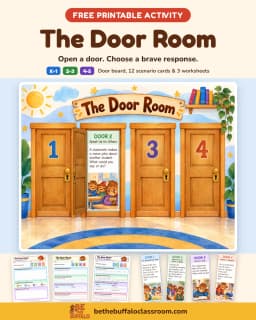
What Is The Door Room?
A student sees someone being excluded but does not say anything. Another student makes a mistake but lets someone else take the blame. A third wants to try something new but is too afraid of what others will think. These moments happen every day — and what students need is not a lecture about courage. They need practice making brave choices before the pressure is real.
The Door Room gives students that practice. It is a hands-on, interactive display with four numbered doors. Behind each door is a real-life courage scenario. Students open a door, read the situation, discuss what choices exist, and reflect on the wisest next step. Each door represents a different kind of courage: trying something new, speaking up, asking for help, and admitting a mistake. It builds responsible decision-making, social awareness, and the ability to consider consequences before acting.
What's Included
1
Door Room Board
Landscape display with 4 door frames — attach numbered door flaps with tape
12
Scenario Cards
4 cards per grade band (K-1, 2-3, 4-5) — each card matches a door theme
3
Reflection Worksheets
Differentiated by grade: draw (K-1), compare choices (2-3), analyze consequences (4-5)
The 4 Doors of Courage
Each door represents a different kind of courage students face every day. The scenarios behind each door grow in complexity across grade bands — but the core courage theme stays the same.
🚪 Door 1
Try Something New
Stepping into the unknown — joining a game, volunteering, leading a group. The fear of judgment or failure is real, and courage means trying anyway.
🚪 Door 2
Speak Up
Using your voice when it matters — standing up for someone, calling out what is wrong, or saying what you feel even when it is uncomfortable.
🚪 Door 3
Ask for Help
Admitting you do not know or cannot do it alone. Asking for help is not weakness — it is one of the bravest things a student can do.
🚪 Door 4
Admit a Mistake
Owning what you did, especially when no one is making you. Taking responsibility instead of hiding, blaming, or staying silent.
Scenario Cards by Grade Band
Each grade band has four scenario cards — one for each door. The situations are real, age-appropriate, and designed to spark genuine discussion about what courage looks like in everyday life.
Simple, Concrete Scenarios
Scenarios use simple language and focus on everyday situations young students encounter at school.
Door 1 · Try Something New
“Some kids are playing a game at recess. You want to join, but you feel shy. What could you do?”
Door 2 · Speak Up
“Someone keeps cutting in front of you in line. You feel upset. What could you say?”
Door 3 · Ask for Help
“You don't understand the directions, and everyone else has started. What could you do?”
Door 4 · Admit a Mistake
“You accidentally knock over a box of crayons. They spill everywhere. What could you do?”
Social Awareness Scenarios
Scenarios involve interpersonal dynamics, peer pressure, and taking responsibility in social situations.
Door 1 · Try Something New
“Your teacher asks for a volunteer to demonstrate something new, but you feel nervous. What could you do?”
Door 2 · Speak Up for Others
“A classmate makes a mean joke about another student. What could you say or do?”
Door 3 · Ask for Help
“The assignment feels tricky, and you are confused. What could you do?”
Door 4 · Admit a Mistake
“You bent a book that a friend let you borrow. What could you do?”
Complex Moral Reasoning
Scenarios require weighing consequences, considering multiple perspectives, and making courageous choices under social pressure.
Door 1 · Lead the Group
“You are asked to lead a group, but you are worried people might judge you. What could you do?”
Door 2 · Speak Up for What Is Right
“Friends are excluding someone on purpose, and they expect you to go along with it. What could you do?”
Door 3 · Ask for Help
“You are struggling with something important, but you do not want to look incapable. What could you do?”
Door 4 · Own Your Mistake
“Someone else is getting blamed for a mistake that you made. What could you do?”
The 3 Reflection Worksheets
Each grade band has its own reflection worksheet. The thinking deepens as students grow — from drawing to comparing choices to analyzing consequences. Every worksheet asks students to circle the door they opened and connect back to the scenario.
My Courage Reflection
Draw what happened behind your door — students illustrate the scenario in their own way.
Circle a feeling — Happy, Worried, Sad, or Upset. Builds basic emotional vocabulary.
Draw a brave next step — what would YOU do? Connects courage to action.
Think, Choose & Explain
Describe the challenge in your own words — retelling builds comprehension.
How might the character feel? Why? — Look for clues in the situation.
Compare two choices — Choice A and Choice B. What would YOU choose, and why?
Courage & Consequences
Describe the challenge — what makes this situation difficult?
Who might be affected, and how? — Consider more than one person or point of view.
Compare two choices and their outcomes — what could you do, and what might happen next?
What is the wisest next step? Explain why. — Consider courage, responsibility, kindness, and safety.
How to Use It
Setup (One Time)
Print & prepare — print the landscape board, numbered doors, and one grade-band card sheet. Laminate for repeated use.
Cut out the pieces — cut the four numbered doors and four scenario cards along the guides.
Place scenario cards — match cards 1-4 to the four door frames. Use removable tape to hold each card in place.
Make doors into flaps — cover each card with its numbered door. Tape ONLY one side as a hinge so it opens like a flap.
Display & reuse — display on a table, wall, or easel. Swap scenario cards to switch grade bands.
The Four Steps
1. Choose
Invite a student, pair, or group to pick Door 1, 2, 3, or 4. The mystery builds engagement — they do not know what is behind the door until they open it.
2. Reveal
Open the flap and read the courage scenario aloud together. Give students a moment to absorb the situation before jumping to answers.
3. Discuss
Ask: How might someone feel? What choices exist? What would be safe and kind? Encourage multiple perspectives — there is no single “right” answer.
4. Reflect
Students circle their door number and complete the matching reflection worksheet. One door per round is enough. Go deep, not wide.
Ways to Use It
Morning Meeting
Open one door each morning. Read the scenario, discuss as a class, and set a courage intention for the day. Builds a shared language around brave choices.
Small Group / Counseling
Each student picks a door, reads the scenario, and the group discusses together. Low-stakes practice for real-life courage. Perfect for conflict resolution groups.
Whole-Class Lesson
Introduce all four courage themes. Open each door and compare: What kind of courage does each one require? Which feels hardest? Why?
Partner Discussion
Pairs pick a door, read the scenario together, and each complete a reflection worksheet. Then share: Did you choose the same response or different ones?
After a Conflict
Use a related scenario to process what happened without making it personal. “This character faced something similar. What do you think they should do?”
Home Use
Parents can use the board at dinner or bedtime. “Pick a door and tell me what you would do.” Opens conversations about courage that lectures never will.
Why It Works
Scenarios are safer than real life
When a student faces a real courage moment, the pressure is on and emotions are high. The Door Room lets students rehearse brave responses in a low-stakes setting. When the real moment comes, they have already practiced thinking it through.
The mystery drives engagement
Students do not know what is behind the door until they open it. That element of surprise creates genuine curiosity — they want to see the scenario. The physical act of opening a flap makes it tangible and memorable.
Courage is not one thing
The four doors show students that courage takes many forms. Speaking up is courage. Asking for help is courage. Admitting a mistake is courage. Trying something new is courage. Students who think “I'm not brave” discover that they already are — in ways they had not recognized.
CASEL-aligned skills
Maps directly to CASEL competencies: responsible decision-making (weighing choices and consequences), self-awareness (recognizing emotions), social awareness (considering how choices affect others), and relationship skills (speaking up, admitting mistakes).
CASEL Connections
Each door theme maps to specific courage and SEL skills:
Door Theme
Courage Skill
CASEL Competency
What Students Practice
Door 1: Try Something New
Initiative, risk-taking
Self-awareness
Recognizing fear, choosing to act anyway
Door 2: Speak Up
Advocacy, assertiveness
Social awareness + Relationship skills
Using voice for self and others
Door 3: Ask for Help
Self-advocacy, vulnerability
Responsible decision-making
Recognizing limits, seeking support
Door 4: Admit a Mistake
Accountability, integrity
Responsible decision-making + Self-awareness
Owning actions, making amends
Download The Door Room
Completely free. Print it, cut it, tape the doors, and start helping students practice courage — trying something new, speaking up, asking for help, and owning mistakes. For classrooms, counseling offices, small groups, and homes.
Download Free PDFWant More Like This?
The Door Room is one free sample from Be The Buffalo — a full 40-week CASEL-aligned curriculum with interactive projector activities, character-driven stories, original songs, printable worksheets, and structured discussion prompts. Bilingual. No student devices. No prep.
Sign Up FreeRelated Resources
My Emotional Weather Station
An emotion weather wheel, 12 coping strategy cards, and a Think-Try-Reflect check-in sheet for K-5.
Choices Vending Machine
10 self-regulation strategies packaged as vending machine snacks, plus 30 scenario cards across K-5 grade bands.
Conflict Resolution Activities
Teach students to navigate disagreements, communicate needs, and find solutions together.
Kindness Activities for Elementary
Build a culture of kindness with activities that go beyond random acts to intentional practice.