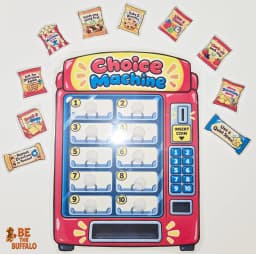
What Is the Choices Vending Machine?
A student cannot focus. Their body is wiggly, their desk is a mess, and the teacher just gave four-step directions they cannot remember. What they need is not a reminder to “pay attention.” What they need is a strategy — and the ability to choose the right one for the situation.
The Choices Vending Machine is a hands-on classroom activity that teaches students to identify what is getting in the way of their focus and then select a concrete strategy to address it. Like a real vending machine, each slot holds a different “snack” — but instead of chips and candy, the options are self-regulation strategies like Take 5 Breaths, Use a Timer, and Move Distractions Away.
What's Included
1
Vending Machine Display
Full-color poster with 10 numbered slots for strategy snack bags
10
Strategy Snack Bags
Cut-out strategies designed as snack packages — attach with velcro or magnets
30
Choice Cash Cards
Scenario cards across K-1, 2-3, and 4-5 grade bands
The 10 Strategies
Each strategy is packaged as a snack bag that students can physically pick from the machine. Every strategy targets a specific self-regulation and focus challenge.
Finish One Thing First
Task initiation
Take a Movement Break
Body regulation
Use a Timer
Time management
Take 5 Breaths
Emotional regulation
Ask for Directions Again
Help-seeking
Check Off Each Step
Working memory
Break It Into Steps
Task management
Move Distractions Away
Inhibitory control
Repeat Directions to Yourself
Self-talk
Use a Quiet Space
Sensory regulation
Choice Cash: Real Scenarios by Grade Band
Each Choice Cash card describes a real classroom situation that students recognize immediately. The student reads their scenario, “inserts” their dollar into the machine, selects a strategy, and explains why they chose it.
Concrete, Body-Based Scenarios
Scenarios use simple language and focus on sensory and body experiences young students recognize.
“Your body feels wiggly and it is getting hard to listen.”
“You look at your worksheet and there are lots of problems. You do not know where to start.”
“Your teacher gives you two directions. You do the first one, but cannot remember what comes next.”
“Your desk has crayons, papers, toys, and books all over it. You are having trouble paying attention.”
Multi-Step Challenges
Scenarios introduce multi-step instructions, sustained work periods, and emotional responses to academic demands.
“Your teacher gives you an assignment with six things to complete. Looking at all of it at once makes you want to give up.”
“You have been working on the same math problem for several minutes. You are starting to feel angry and cannot think clearly.”
“You are trying to write, but you keep noticing students talking, supplies on your desk, and people walking around.”
“You finish the worksheet but cannot remember what comes next.”
Complex Self-Management
Scenarios require metacognition: recognizing patterns, managing multi-task demands, and navigating social distractions.
“You have a project due at the end of the week. It has several parts, and every time you think about starting, it feels overwhelming.”
“You start one assignment, switch to another, check something else, then go back. At the end of class, three things almost finished, nothing completed.”
“Your friends keep whispering and joking near you during independent work, and you are having trouble staying focused.”
“You have tried a problem several times and still cannot figure it out. Your shoulders are getting tight and you feel like crumpling your paper.”
How to Use It
Setup (One Time)
Download the free PDF and print all pages in color.
Cut out the vending machine, 10 strategy snack bags, and Choice Cash cards.
Laminate everything for durability (recommended).
Attach strategy snack bags to the machine with velcro dots or magnets.
Ways to Use It
Whole-Class Lesson
Introduce the machine and strategies. Read a scenario aloud. Students discuss which strategy they would choose and why. Build shared vocabulary.
Small Group / Counseling
Each student draws a Choice Cash card, reads the scenario, picks a strategy, and explains their reasoning. Practice self-regulation in a low-stakes setting.
Morning Meeting
Start the day with a scenario. Students share strategies. Sets the tone for using tools when challenges arise throughout the day.
Independent Station
Place the machine at a center or calm-down corner. Students can independently browse strategies when they need one. Self-serve focus support.
Role-Play / Partner Work
Pairs act out scenarios, then one student “buys” a strategy and demonstrates using it. Kinesthetic learning that builds muscle memory for real situations.
Home Use
Parents can use the machine during homework time. “You seem frustrated. Want to pick something from the machine?” Works at kitchen tables and in homeschool settings.
Why It Works
Choice builds ownership
Students are not told which strategy to use — they choose one. That autonomy converts compliance into self-management. When a student picks their own strategy, they are more likely to use it when they actually need it.
Scenarios make it real
Every Choice Cash card describes a situation students have actually been in. “Your desk is covered in stuff and you can't focus” is not hypothetical — it happened this morning. Recognition drives engagement.
The machine makes it fun
The vending machine metaphor is instantly engaging. Students want to “buy” a snack. The game mechanic (insert dollar, select strategy) creates a memorable routine they can reference later: “What would you pick from the machine right now?”
CASEL-aligned skills
Maps directly to CASEL competencies: self-management (choosing strategies), self-awareness (recognizing when you need help), and responsible decision-making (evaluating which tool fits the situation).
CASEL Connections
Each strategy in the Choices Vending Machine maps to specific executive function and SEL skills:
Strategy
Executive Function
CASEL Competency
When to Use
Finish One Thing First
Task initiation, inhibitory control
Self-management
Jumping between tasks
Take a Movement Break
Sensory regulation
Self-management
Wiggly body, hard to sit still
Use a Timer
Time management, sustained attention
Self-management
Losing track of time
Take 5 Breaths
Emotional regulation
Self-awareness
Feeling frustrated or overwhelmed
Ask for Directions Again
Help-seeking, working memory
Responsible decision-making
Missed or forgot instructions
Check Off Each Step
Working memory, organization
Self-management
Multi-step tasks
Break It Into Steps
Planning, task management
Self-management
Feeling overwhelmed by big tasks
Move Distractions Away
Inhibitory control, selective attention
Self-management
Too many things competing for attention
Repeat Directions to Yourself
Working memory, self-talk
Self-awareness
Forgetting what to do next
Use a Quiet Space
Sensory regulation, emotional regulation
Self-awareness
Overstimulated, need to reset
Download the Choices Vending Machine
Completely free. Print it, cut it, laminate it, and start teaching self-regulation strategies tomorrow. Works in classrooms, counseling offices, small groups, and at home.
Download Free PDFWant More Like This?
The Choices Vending Machine is one free sample from Be The Buffalo — a full 40-week CASEL-aligned curriculum with interactive projector activities, character-driven stories, original songs, printable worksheets, and structured discussion prompts. Bilingual. No student devices. No prep.
Sign Up FreeRelated Resources
Self-Regulation Activities
Practical strategies for teaching students to manage emotions, control impulses, and stay focused.
Focus and Attention Strategies
Three types of attention, individual strategies, environmental design, and grade-band approaches.
Helping Students With Transitions
Why some students fall apart between activities and what teachers can do about it.
CASEL Deep Dive: Self-Management
Five components: emotional regulation, impulse control, stress management, goal setting, and motivation.