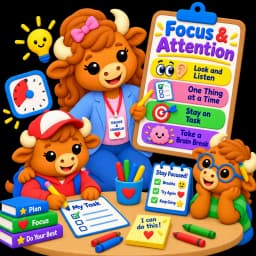
“Attention is the gateway for learning. Children need to focus their attention on learning material in order to commit it to memory. Time stayed on task is one of the important variables that account for school success.”[1]
— Savina (2026), Early Childhood Education Journal
Attention is a developing cognitive capacity, not a switch that children can flip on demand. Most classrooms are designed in ways that make it harder, not easier, for developing brains to sustain focus. The good news: attention skills can be improved.[1]
Three Types of Attention
Selective
Focus on what is relevant while ignoring what is not. Listening to the teacher while ignoring the whispered conversation behind you.
Most environmentally influenced. Excessive decoration can hinder learning by overwhelming this capacity.[2]
Sustained
Maintain focus over time. Staying engaged with a 20-minute lesson or continuing a problem set for 15 minutes.
Most frequently demanded, least frequently scaffolded. Structured breaks have the strongest correlation with this type.[2]
Switching
Shift focus between tasks or mental sets. Moving from listening to writing. Transitioning from math to reading.
Each switch consumes resources. A student who has switched 6 times by 10am has less capacity for the 7th.
Why Attention Is Hard for Elementary Students
The brain is developing
The prefrontal cortex manages attentional control alongside impulse control and emotional regulation. It continues developing into adulthood. They are not choosing to lose focus.
Capacity varies widely
Two students of the same age can have vastly different attention spans — one sustains 15 minutes, another loses focus after 5. Both are within the normal range. The difference is neurological, not a character distinction.
Attention is depletable
A student who sustained excellent attention all morning has less capacity for the afternoon. The depletion is physical, not motivational. They are not choosing to lose focus — their resources have been consumed.
Emotion consumes attention
Anxious, sad, angry, hungry, or tired students are using attentional resources to manage internal states. Self-regulation and attention are inseparable.
Strategies That Build Individual Attention Skills
Teach the refocus
The most important attention skill is not sustaining perfect focus. It is noticing when focus has been lost and returning it. The attention equivalent of self-awareness.
“Everyone's mind wanders. That is normal. The skill is catching the wander and bringing your attention back. When you notice your mind has drifted, that noticing is the skill.”
Teach body awareness
Physical self-awareness that supports attention. A 10-second body check before any instructional segment.
“Feet on the floor? Hands still? Eyes on the speaker? Breathing calm? Is your body ready?”
Teach the brain break
Research confirms the strongest correlation with sustained attention.[2] Not rewards — attentional hygiene. 1-3 minutes, physical/sensory, structured.
Stretching, Simon Says, 5 deep breaths, standing & shaking out, mindfulness moment.
Teach self-monitoring
Attention check
“Are you paying attention right now? Check in with yourself.”
Focus rating
“Scale of 1-5, how focused were you? What helped? What pulled you away?”
Visual progress
Checklists generate micro-rewards that sustain momentum.
Teach the anchor strategy
A physical or sensory cue that signals “pay attention now.” Takes 10 seconds, improves reception of whatever follows.
“Anchor. Both feet on the floor. Sit up. Look at me. Take one breath. Ready.”
Over time, students develop personal anchors: a sitting position, a focus phrase, a physical gesture.
Strategies That Design the Environment for Focus
Environment matters as much as individual skill.[1][2]
Reduce visual clutter
Not bare walls — intentional walls. Currently relevant displays stay. Last month's come down. Fisher, Godwin & Seltman found students in highly decorated classrooms spent more time off task.[3]
Reduce ambient noise
Noise reduces sustained attention and impairs comprehension.[2] Close the door. Use sound-absorbing materials. Allow noise-reducing headphones for independent work.
Use multimodal instruction
Visual + auditory + kinesthetic engages three systems. Research: multimodal instruction shows r = 0.884 correlation with sustained attention.[2] A structured curriculum with projector activities, songs, stories, and printables is multimodal by design.
Shorten instructional segments
Match segments to attentional capacity:
Provide movement opportunities
Physical movement resets the attentional system. Cognitively engaging activity improves executive function.[4] Partner-shares across the room, gallery walks, station rotations, physical responses to questions.
Seating matters
Next to best friend = constant selective attention demand. Near the window = changing visual stimulus. Near the door = hallway noise. Seat students who need the most support closest to instruction, away from distractions.
Strategies by Grade Band
Short, varied, physical
5-8 min cycles. Songs, chants, movement to encode content. External routines (specific sitting position, response to signal).
Allow fidgeting within boundaries. A moving kindergartner often attends better than one forced to sit still.
Building independence
Segments can lengthen. Teach self-monitoring. Brain breaks as routine. Visual progress tracking (checklists, timers).
“I notice some minds wandered. That's normal. Take a breath. Look at the board. Let's refocus together.”
Strategic & metacognitive
Teach anchor, body check, refocus. Independent self-monitoring. Discuss attention metacognitively.
Students take ownership of their attention management — the self-management competency applied to attention.
What Not to Do
✗ Punish inattention
They have reached the limit of a developing capacity, not made a behavioral choice. Punishment adds negative emotion that consumes more attentional resources. Address with strategies, not consequences.
✗ Demand sustained stillness
Keeping the body perfectly still consumes self-control resources that compete with attention. Allowing movement (fidget tools, standing desks) often frees attentional resources.
✗ Assume attention is binary
Attention fluctuates continuously — 80% for 3 min, then 40%, then 90%. “Are you paying attention or not?” doesn't match how attention works and produces shame in students fluctuating within normal range.
✗ Blame the student for the environment
A student who can't focus in a noisy, cluttered, unpredictable room may focus well in a quiet, organized one. Before concluding the student has an attention problem, evaluate whether the environment does.
The SEL Connection
Attention is embedded within the social-emotional competencies that structured SEL instruction builds.
Noticing when attention has wandered. Recognizing your own attention patterns.
Self-managementDeploying strategies deliberately. Managing emotions that compete for attention.
Self-controlAttentional control is one of three components of self-control.
Self-disciplineSustaining attention on a task you'd rather not do — the most common daily form.
The Bigger Picture
The five who are focused are not morally superior. They may have more developed prefrontal cortices, calmer mornings, better-fitting environments, or more practice with attentional strategies. The eighteen who are not focused are not failing. They are operating at the limit of a developing capacity.
The teacher's job is twofold: teach the individual strategies that build attentional capacity and design the environment that supports the capacity that exists.
Build both. The attention improves. The learning follows. And the child who learns to manage their own focus has a skill they will use in every classroom, every meeting, and every challenging task for the rest of their life.
References
- Savina, E. (2026). Attention in the Classroom: Paving a Road to Success. Early Childhood Education Journal. springer.com
- ERIC. (2025). Engaging Young Minds: Strategies and Environmental Factors to Enhance Attention. eric.ed.gov
- Fisher, A. V., Godwin, K. E., & Seltman, H. (2014). Visual environment, attention allocation, and learning. Psychological Science, 25(7). doi.org
- Frontiers in Psychology. (2025). Cognitively engaging physical activity on executive function. ncbi.nlm.nih.gov
- Tao, T., et al. (2017). Latent Factors in Attention. Frontiers in Psychology, 8, 1725. ncbi.nlm.nih.gov
Build Both
Be The Buffalo builds attention through weekly lessons that are multimodal by design — projector activities, songs, stories, discussion, and printables. Short segments, built-in transitions, and the self-awareness and self-management skills that attention depends on.
Sign Up FreeRelated Resources
Teaching Self-Control
Attentional control as one of three components of self-control.
Self-Discipline
Sustaining attention as a self-discipline act.
Self-Regulation Activities
Building the regulatory capacity that attention depends on.
CASEL: What Is Self-Management?
The competency framework that attention sits within.