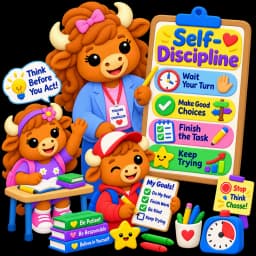
Self-discipline predicts academic performance better than IQ.[1]
Duckworth and Seligman found that the students who fell short of their intellectual potential did so not because they lacked ability but because they lacked the capacity to direct that ability consistently toward their goals.
If self-discipline matters more than IQ for academic outcomes, and if self-discipline is a learnable skill rather than a fixed trait, then teaching self-discipline is among the highest-value instructional investments a school can make.
Self-Discipline vs. Self-Control
🛑
Self-Control = The Brake
Stopping yourself from doing what you should not do. Not blurting. Not grabbing. Not melting down.
Self-control article →⚡
Self-Discipline = The Engine
Making yourself do what you should do, especially when you would rather not. Starting. Continuing. Finishing.
Both are components of self-management. Both require executive function. But they work in opposite directions. A child who never blurts (strong control) but never starts work without being reminded (weak discipline) has the brake without the engine.
What Self-Discipline Looks Like in Elementary School
Not dramatic. The accumulation of small daily choices that together produce outcomes no single choice could achieve.
Starting without being told
Sits down, looks at the board, begins morning work. The external cue is unnecessary because the routine is internalized.
Continuing when it gets boring
The worksheet is long and repetitive. They continue because the task matters and finishing is the expectation they have internalized.
Continuing when it gets hard
The math problem is beyond the comfort zone. They try another approach. Where self-discipline and perseverance overlap.
Finishing what you start
Part one was fun. Part two was okay. Part three is tedious. They finish all three because they committed to the whole project.
Choosing the harder right
They could copy or take the shortcut. They do the work honestly because their standard is internal. Where self-discipline and honesty intersect.
Effort without monitoring
The teacher steps out. The substitute is unfamiliar. The same standard persists regardless of who is watching. Where responsibility converges.
What Self-Discipline Is Not
✗ Not obedience
An obedient child does what the teacher says because the teacher said it. A self-disciplined child does what needs to be done because they understand why. Remove the teacher — obedience changes; discipline persists.
✗ Not rigidity
Self-discipline is deployed when it serves a purpose and released when it does not. A child who cannot stop working may be demonstrating anxiety, not discipline. The two look similar outside and feel different inside.
✗ Not the absence of wanting to quit
They want to stop and choose to continue. The wanting is present. The choice overrides it. Tell children: “The urge to quit is normal. Overriding it is the skill.”
✗ Not punishment-driven
Doing homework because of lost recess is threat-driven, not self-disciplined. Fear-based discipline collapses when the threat is removed. Internal motivation persists.
How Self-Discipline Develops
The role of executive function
Self-discipline depends on working memory (keeping the goal in mind), inhibitory control (overriding the impulse to stop), and cognitive flexibility (adjusting strategy). These are housed in the prefrontal cortex, which develops throughout childhood.[2]
Calibrate expectations: A kindergartner sustaining 5 minutes of independent work is age-appropriate. A fifth grader sustaining 20 minutes is the same skill at a higher developmental level.
The role of habit
Much of what looks like self-discipline is actually habit: routinized behavior that no longer requires deliberate effort. Habits conserve the self-discipline resource.
Build habits early: A child who has habituated the morning routine does not need self-discipline to follow it — they have more available for the hard math problem later.
The role of motivation
Self-discipline is easier when the goal matters to the child. A child working toward a goal they helped set sustains effort more naturally than one pursuing an imposed goal.
But also: Self-discipline includes doing things you do not enjoy because they serve a purpose you understand. Connecting tasks to purposes reduces the demand.
Teaching Self-Discipline in the Classroom
Build the routines first
Routines are the scaffolding. Clear, consistent routines for transitions, independent work, group work, and cleanup reduce the self-discipline demand for those activities — freeing the child's limited resource for tasks that are genuinely challenging. Establish them in the first weeks. Practice explicitly. Reinforce consistently.
Connect effort to outcomes
Self-discipline is sustained by the belief that effort produces results. Children develop what Bandura called self-efficacy: the belief that their actions matter.
“You practiced your spelling words every night. Your score went up. That is what self-discipline produces.”
“You chose to rewrite your paragraph even though the first draft was done. The final version is stronger. That came from your choice to do the harder thing.”
Teach the “start” skill
For many children, the hardest part is starting.
Two-minute rule
“Just start for two minutes.” Most children who start continue — initiation was the barrier, not the task.
Break it down
“Just do the first part.” Step one generates the momentum for step two.
Environment setup
“Clear everything except what you need.” Fewer distractions, fewer decisions consuming discipline.
Teach the “continue” skill
Sustaining effort is different from initiating it.
Self-talk
“I can do hard things. I am almost done. The effort is worth it.” Internal encouragement replaces external.
Progress monitoring
“Check off each problem. Count done vs. left.” Visible progress sustains effort in real time.
Strategic breaks
“Work 10 min, stretch 1 min, work 10 more.” Planned breaks maintain higher quality effort.
Praise the discipline, not just the product
“You started without being reminded. That is self-discipline.”
“You kept working even when it was frustrating. That choice is worth more than the right answer.”
“You finished all three parts, including the part that was not fun. That takes more discipline than the easy parts.”
Model self-discipline transparently
“I need to grade these papers even though I'd rather relax. They're important, so I'll do them first. That is self-discipline.”
“I'm choosing the harder explanation because it will help you understand better.”
Making the internal choice visible shows children what the process looks like from the inside.
The Harder Dimensions
When self-discipline looks like compliance
A child who does everything they are told and never causes a problem may be anxiously compliant — performing discipline out of fear rather than exercising it from internal motivation.
The test: Does the behavior persist without monitoring? Do they show initiative, or only compliance? Do they pursue their own goals, or only assigned ones?
When self-discipline is unequally available
Self-discipline is a depletable resource. A child who navigated a chaotic home, who is hungry or anxious, arrives with reserves already reduced. They may not be less disciplined — they may have less discipline available.
Accommodate: Provide structure. Scaffold the demand. Do not judge the child who needs more support as less disciplined than the child who needs less.
When self-discipline becomes harmful
Self-discipline directed toward unhealthy goals is not a virtue. Perfectionism, inability to stop working, self-punishment for imperfection — these direct discipline toward suffering rather than growth.
Teach: Self-discipline includes knowing when to stop — when to rest, when to ask for help, when to accept “good enough.” Self-discipline without self-compassion is rigidity. Both together produce sustainable effort.
Self-Discipline and Every Character Trait
Self-discipline is the operational skill that converts character values into character behavior:
The discipline to tell the truth when lying would be easier
ResponsibilityThe discipline to follow through on commitments when tasks are boring
KindnessThe discipline to act for others when self-interest pulls the other direction
PerseveranceSelf-discipline sustained over time, day after day, when results aren't yet visible
CourageThe discipline to act despite fear when the right thing is the hard thing
PatienceThe discipline to wait when acting now would feel better
GratitudeThe discipline to notice and appreciate when it would be easier to take things for granted
The CASEL Connection
Self-discipline maps directly to CASEL's self-management competency. The definition includes “exhibiting self-discipline and self-motivation” and “setting personal and collective goals” as components.[3]
The Character Education Connection
Self-discipline appears in state mandates under multiple names: self-discipline (Alabama, South Carolina), self-control (Alabama, South Carolina), diligence (Alabama), perseverance (Alabama, Iowa, South Carolina). Named more often than almost any other trait because it is recognized across political and cultural lines as essential.[4]
The Bigger Picture
Intelligence determines what a child can do. Self-discipline determines what a child actually does. The gap between potential and performance is not filled by ability. It is filled by the daily choice to direct ability toward effort, even when effort is not enjoyable.
Self-discipline is not about creating children who never want to stop. It is about creating children who notice the pull toward the easier path and choose the harder one because they understand that the harder path leads somewhere worth going.
The brake stops the car. The engine moves it. Teach the engine.
References
- Duckworth, A. L., & Seligman, M. E. P. (2005). Self-discipline outdoes IQ in predicting academic performance. Psychological Science, 16(12), 939-944. semanticscholar.org
- Duckworth, A. L., & Carlson, S. M. (2015). Self-regulation and school success. Via: annualreviews.org
- CASEL. (2026). What Is the CASEL Framework? casel.org
- Code of Alabama, §16-6B-2(h); South Carolina Code, §59-17-135; Iowa Code, §256.18A.
- OECD. (2024). Self-Regulation: Social and Emotional Skills. oecd.org
- APA. (2012). What You Need to Know About Willpower. apa.org
Teach the Engine
Be The Buffalo builds self-discipline through weekly lessons — routines, habits, effort-outcome connections, and a classroom culture where disciplined effort is valued and modeled. The brake and the engine, together.
Sign Up FreeRelated Resources
Teaching Self-Control
The inhibition side: stopping yourself from doing what you should not.
Perseverance Activities
Self-discipline sustained over time through difficulty.
Goal Setting Activities
Directing self-discipline toward specific, chosen targets.
CASEL: What Is Self-Management?
The competency that self-discipline and self-control together compose.