A student's best friend asks to copy their homework. Four seconds to decide.
Self-Awareness
I feel pressured. I value honesty.
Self-Management
Can I manage the pressure long enough to think?
Social Awareness
How will this affect my friend? The teacher? Other students?
Relationship Skills
How do I say no without destroying the friendship?
Responsible Decision-Making
What do I do?
The competency where every other competency converges.
The Definition
“The abilities to make caring and constructive choices about personal behavior and social interactions across diverse situations. This includes the capacities to consider ethical standards and safety concerns, and to evaluate the benefits and consequences of various actions for personal, social, and collective well-being.”[1]
Caring and constructive
Reflects care for others and contributes constructively. Not purely self-interested.
Ethical and safe
Evaluated against what is right (ethical) and what is safe (practical). Both lenses necessary.
Personal, social, collective
Consequences evaluated for everyone affected, not just the decision-maker.
The Integrating Competency
Responsible decision-making requires all four competencies operating simultaneously. It is listed fifth not because it is less important, but because it depends on the other four being in place.[2]
Five Components of Responsible Decision-Making
1. Identifying the problem
Recognizing that a decision is needed. Children often act on impulse without seeing the choice point. The child who hits back after being pushed did not perceive a decision — they perceived a stimulus and reacted.
“Stop. You have a choice right now. What are your options?”
K-2
“Someone took your pencil. You could grab it back, ask for it back, or tell the teacher. Which one?”
3-5
“Your friend said something unkind about you. Before you react, what are your options?”
2. Analyzing the situation
Gathering relevant information: What happened? Who is involved? What are the facts vs. assumptions? A decision based on incorrect information may be reasonable but wrong.
K-2
“What did you see? What did you hear? Is there anything you're not sure about?”
3-5
“You think she did it on purpose. Do you know that for sure? What else could have happened?”
3. Generating and evaluating options
Identifying multiple responses and evaluating each: Is it safe? Ethical? Fair? What are the short- and long-term consequences? This separates impulsive action from responsible decision-making.
K-2
“You could tell the teacher, talk to your friend, or ignore it. What would happen with each?”
3-5
“Three things you could do. For each: what happens? Who is affected? Which is most fair?”
4. Making the choice and acting on it
Selecting an option and acting. Requires courage, because the responsible choice often costs something: social standing, comfort, or peer approval.
K-2
Tells the teacher about the broken pencil rather than blaming someone else. Manages the fear of consequences.
3-5
Refuses to exclude the unpopular student even when the group wants to. Accepts the social cost.
5. Evaluating and reflecting
After consequences unfold: What happened? Was the outcome expected? Did my decision help or hurt? What would I do differently? Reflection transforms individual decisions into accumulated wisdom.
K-2
“You told the truth. How did that go? How do you feel about your decision?”
3-5
“You chose to include everyone. How did it work out? Would you make the same choice again? Why?”
How Responsible Decision-Making Develops
Simple choices with adult guidance
The concept of choice
“You always have a choice about what to do. Even when something happens that you didn't choose, you choose how you respond.”
Simple consequence thinking
“If you do this, what might happen? If you do that instead?”
Choices and feelings
“You chose to share. How did that make you feel? How did it make your partner feel?”
K-2 students will often decide impulsively then evaluate afterward. The goal: building the habit of pausing.
Complex choices with independence
Multi-factor evaluation
“This involves what's fair, kind, and safe. They might not point the same direction. How do you weigh them?”
Ethical reasoning
“What if everyone made this choice? Is this the kind of person you want to be?”
Good decisions ≠ good outcomes
“Sometimes the best decision still produces a bad outcome. That doesn't mean the decision was wrong.”
Peer influence awareness
“Are you deciding because you believe it's right, or because your friends want you to?”
Teaching Responsible Decision-Making
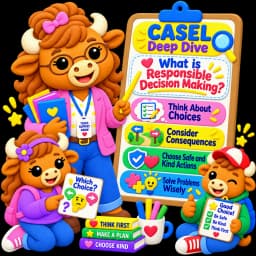
The Stop-Think-Choose-Reflect framework
🛑
Stop
Recognize you have a choice
💭
Think
Options? Consequences? Who is affected?
✓
Choose
Safe, ethical, fair, caring
🔄
Reflect
How did it go? What next time?
Practice during weekly SEL instruction with realistic scenarios. Rehearsal stores the framework for real moments.
Use dilemmas, not rules
Rules produce compliance. Dilemmas produce reasoning. Present age-appropriate dilemmas with no single correct answer.
K-2
“You found a toy on the playground. No one is looking. What do you do? Why?”
3-5
“Your friend told you a secret about another student. Someone asks you directly. What do you do?”
The reasoning is the skill, not the answer.
Connect decisions to values
Every decision reflects values. Make it intentional:
“You told the truth even though you were scared. What value?” → Honesty
“You kept working when it was hard. What value?” → Perseverance
Decision-making becomes identity-building: “I am the kind of person who...”
Debrief real decisions
“What was the decision? What options did you consider? What did you choose? How did it turn out?” Debrief good decisions too — reinforces the process that produced them.
Model your own decision-making
“I need to decide whether we keep working or move on. Some are almost done, some are not. I think I'll give three more minutes — a compromise.” Narrate the weighing process transparently.
Every Character Trait Is a Decision
The trait names the value. The decision enacts it. Responsible decision-making converts values into behavior:
The decision to tell the truth when lying would be easier
FairnessThe decision to treat people equitably even when inequality serves you
CourageThe decision to act on what is right despite the fear
KindnessThe decision to help, include, or comfort when indifference would be simpler
ResponsibilityThe decision to own your actions and their consequences
Self-controlThe decision to pause and choose rather than react
PatienceThe decision to wait when acting now would cost more
GratitudeThe decision to notice and appreciate rather than take for granted
The Harder Dimensions
When the right decision is unclear
A child choosing between loyalty to a friend and honesty to a teacher faces a genuine ethical conflict. Acknowledge the difficulty: “Two things you value are in conflict. There isn't always a perfect answer. The goal is to think carefully and choose what you can stand behind.” Teaching children to sit with ambiguity is itself a skill.
When consequences are unpredictable
A thoughtful decision may still produce a negative outcome. Teach the distinction: “You made a decision you can be proud of. The outcome wasn't what you hoped for. That doesn't mean the decision was wrong. Sometimes doing the right thing costs something. That's why it requires courage.”
When peer influence overrides reasoning
A child who decides well independently may decide impulsively in a group. Teach them to notice: “Are you choosing because you think it's right, or because everyone else is doing it? There's nothing wrong with going along when the group is headed somewhere good. The skill is noticing when it's not.”
What to Avoid
✗ Teaching decision-making as a single lesson
It's a practice, not a unit. Embed it across the year through weekly instruction, debriefs, and dilemma discussions.
✗ Providing only the "right" answer
If every dilemma ends with the teacher's answer, children learn to wait for judgment rather than developing their own reasoning.
✗ Focusing only on avoiding bad decisions
Responsible decision-making also means actively choosing to contribute: generous, courageous, kind decisions. Avoiding harm isn't enough.
✗ Ignoring the emotional dimension
Decisions aren't purely cognitive. Teach children to recognize: "What are you feeling? How might that feeling influence your decision?"
The Bigger Picture
Responsible decision-making is where the entire CASEL framework comes together. Every article in this series, every character trait, every competency deep dive, converges on this: the moment when a child faces a choice and decides what to do.
Self-awareness
knows
Self-management
regulates
Social awareness
perceives
Relationship skills
connects
Decision-making
chooses
Teach the choosing. It is the skill that matters most, because it determines what all the other skills produce.
References
- CASEL. (2026). What Is the CASEL Framework? casel.org
- Infobase. (2025). SEL & Beyond: Responsible Decision-Making. infobase.com
- Landmark School Outreach Program. (2024). Responsible Decision Making (SEL). landmarkoutreach.org
- Greater Good in Education, UC Berkeley. (2026). SEL: Ethical Decision-Making and Social Responsibility. ggie.berkeley.edu
- California Department of Education. T-SEL Competencies: Responsible Decision-Making. cde.ca.gov
Teach the Choosing
Be The Buffalo builds responsible decision-making through weekly lessons — the Stop-Think-Choose-Reflect framework, age-appropriate dilemmas, and the practice of connecting decisions to values. Where every competency comes together.
Sign Up FreeRelated Resources
CASEL: What Is Self-Awareness?
Knowing your values, emotions, and biases before making a choice.
CASEL: What Is Social Awareness?
Perceiving how your decision affects others.
Problem Solving Activities
Structured practice in the decision-making process.
SEL and Character Education
Why every character trait is, at its core, a decision.