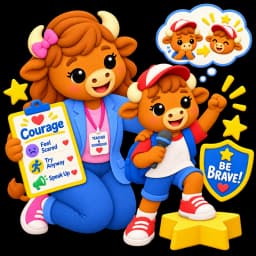
Ask second graders what courage means and they describe a firefighter. Ask what courage looks like in their classroom and they stare at you. The courage children need most is not the kind that involves burning buildings.
It is a raised hand, a hard truth, an unpopular choice, and the willingness to be uncomfortable in the service of something that matters.
Courage Is Not the Absence of Fear
Children often believe courageous people are not afraid. This belief produces a conclusion: “I am afraid, so I am not brave.” The opposite is true. Courage requires fear. If you are not afraid, the action does not take courage.[1]
✗ Common belief
“Brave people don't feel scared.”
✓ The truth
“Courage is feeling afraid and choosing to do the right thing anyway.”
The fear is what makes it brave. Children who understand this stop seeing fear as disqualifying and start seeing it as the starting line.
Four Types of Courage Children Need[2]
Moral Courage
Doing what is right even when it is difficult, unpopular, or carries social risk.
Telling the truth about a mistake. Refusing to exclude someone. Standing up for a student being teased.
A 2025 longitudinal study found moral courage significantly predicted defending behaviors in bullying situations.[3]
Disciplined Courage
Persisting through difficulty, tolerating discomfort, continuing when quitting would be easier.
Staying with a hard math problem. Trying again after failing. Working on a long-term project. The courage of perseverance.
Intellectual Courage
Taking academic risks: raising your hand when unsure, asking questions, sharing ideas that might be wrong.
The foundation of learning itself. A student too afraid to risk being wrong cannot participate fully in their own education.[1]
Empathetic Courage
Being emotionally vulnerable: sharing feelings, showing care, apologizing sincerely.
Saying “I'm sorry, I was wrong.” Admitting “I'm scared.” Expressing empathy when the group culture discourages it.
What Courage Looks Like by Grade Level
Building the concept
Trying new food. Walking in on the first day. Raising your hand. Telling the truth. Saying hello to someone new.
“Was the character afraid? What did they do even though they were afraid? That is courage.”
Deepening and applying
Standing up for someone excluded. Admitting a mistake. Disagreeing respectfully. Choosing not to gossip. Sharing an unpopular opinion.
“Standing up for the new student might cost you. They did it anyway. Why? What did it cost? Was it worth it?”
Teaching Courage, Not Just Talking About It
Create a classroom where courage is safe to practice
Wrong answers → respect
"That's not quite right, but I can see how you got there. Let me help you think differently."
The student will raise their hand again.
Truth-telling → acknowledgment first
"Thank you for being honest. That took courage. Now let's talk about what happened."
The student will tell the truth again.
Emotional expression → validation
"It takes courage to say you're scared. Thank you for trusting us with that."
The student will be vulnerable again.
Teach the upstander framework
A bystander sees something wrong and does nothing. An upstander sees something wrong and acts. Three levels:[5]
Direct
“That's not kind. Please stop.”
Indirect
Walk over, sit with them, include them, ask if they're okay.
Report
Tell a trusted adult. Not tattling — moral courage through a different channel.
Role-play all three during SEL instruction. A child who has rehearsed upstander language has the words available when the real moment arrives.
Name courage when you see it
Courage is often invisible because it is quiet. Name it specifically:
"You weren't sure of the answer and you said it anyway. That is intellectual courage."
"You invited Marcus to your table when he was sitting alone. That is empathetic courage."
"You told me the truth even though it might mean losing recess. That is moral courage."
When courage is named, the label becomes part of the child's self-concept: “I am someone who acts even when I'm scared.”
Model courage yourself
“I had to give a presentation yesterday. My hands were shaking. I did it anyway because the information was important. That was courage.”
“I made a mistake on the worksheet. I could have pretended, but that wouldn't be honest. Admitting mistakes in front of all of you takes courage for me too.”
The Courage-Fear Connection
Every type of courage requires managing fear. Teach the coping strategies that make courage possible:
Deep breathing
One slow breath buys the prefrontal cortex a moment to override the amygdala's impulse to withdraw.
Positive self-talk
"I can do hard things." "Being brave doesn't mean not being scared." Practiced calm, available when scared.
Visualization
"Picture yourself doing the brave thing. How do you feel after?" Mental rehearsal reduces the novelty.
Perspective-taking
"If you were the one being left out, what would you want someone to do?" Empathy provides moral motivation.
What Courage Teaches
Self-awareness
Recognizing fear and understanding it is normal, not disqualifying
Self-management
Managing fear well enough to act despite it. Choosing the harder right over the easier wrong
Social awareness
Recognizing when others need someone to stand up for them
Relationship skills
Speaking up, telling hard truths kindly, apologizing, including others despite social cost
Decision-making
Identifying what is right and choosing to act on it even when consequences are uncertain
The Character Connection
Courage is named in multiple state character education mandates (Alabama, South Carolina).[4] A program that integrates character with SEL teaches courage as both a value (why acting despite fear matters) and a skill (how to manage the fear, make the decision, and follow through).
The Trait That Activates Every Other Trait
Honesty
requires courage to tell the truth
Fairness
requires courage to speak up about injustice
Kindness
requires courage when the group rewards indifference
Responsibility
requires courage to own your mistakes
Perseverance
requires courage to keep going when quitting appeals
Empathy
requires courage to be vulnerable
Without courage, every other trait is conditional — practiced when easy, abandoned when hard. With courage, every trait becomes durable.
That is not a small lesson. That is the lesson that makes all the others work.
References
- Greater Good Science Center, UC Berkeley. (2026). Courage Challenge: Practice for Students and Educators. ggie.berkeley.edu
- Lassiter, C. J. (2020). The 4 Types of Everyday Courage. Cited in Tarheelstate Teacher (2026). tarheelstateteacher.com
- García-Carrera, P., et al. (2025). Moral courage and defending behaviors in bullying: A longitudinal study. Revista de Psicodidáctica. elsevier.es
- Code of Alabama §16-6B-2(h); South Carolina Code §59-17-135.
- ASU Principled Innovation. (2025). Tool for Performance Character: On Educating Upstanders. pi.education.asu.edu
Teach the Courage That Activates Every Other Trait
Be The Buffalo teaches courage, honesty, fairness, perseverance, and empathy through weekly 15-minute lessons. Build the classroom where being brave is safe to practice — so courage becomes durable, not conditional.
Sign Up FreeRelated Resources
Teaching Honesty
The character trait that most frequently requires moral courage.
Perseverance Activities
The disciplined courage of continuing through difficulty.
When Students Exclude Others
Where empathetic and moral courage turn bystanders into includers.
Emotional Regulation
Managing the fear that courage requires acting through.