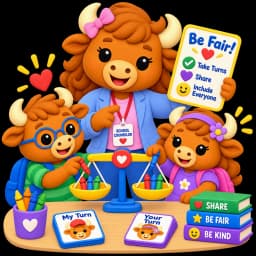
“That's not fair” when someone gets a bigger piece. “That's not fair” when someone gets to go first. “That's not fair” when the teacher gives one student extra time on a test. “That's not fair” when the rules seem to apply differently to different people.
The child who says “that's not fair” is not being whiny. They are practicing moral reasoning — evaluating a situation against a principle, finding a discrepancy, and protesting the violation.
The problem is not that children care about fairness. The problem is that their understanding of fairness is still developing, which means the principle they are applying is often simpler than the situation requires.
How Children's Fairness Reasoning Develops
Equality (ages 3–6)
“Fair” means “identical.” Everyone should get the same amount, the same treatment, the same turn, the same everything.
“She got a bigger cookie!” — not petty, but applying the only fairness principle they have. The reasoning is unsophisticated, but the process is sound.[1][2]
Merit (ages 5–8)
Effort matters. The child who worked harder should get more credit. The student who finished first should get to choose. Children as young as three can allocate rewards based on effort contribution.[4]
Adds a new variable: not just “did everyone get the same?” but “did everyone earn the same?”
Equity (ages 7–10+)
Need enters the equation. The struggling student deserves more help — not because they earned it, but because they need it to reach the same level. Children as young as four can distribute more to those who have less.[4]
The most complex principle: giving one student more help is unequal but may be equitable. A child at the equity stage can hold this tension.
Reading the Fairness Protest
Child says
"She got more than me!"
Principle applied
Equality
What to teach next
Sometimes people need different amounts. Fair does not always mean the same.
Child says
"That's not fair, I worked harder!"
Principle applied
Merit
What to teach next
Effort matters, and so does helping people who had a harder starting point.
Child says
"Why does he get extra help?"
Principle applied
Equality
What to teach next
Fair means everyone gets what they need to succeed. Some people need more support.
Child says
"She always gets picked"
Principle applied
Equality + social awareness
What to teach next
Let's make sure everyone has a chance. How could we set this up so turns are shared?
Teaching the Three Principles
Equality: Everyone gets the same
Teach equality as the starting point, not the only point. Practice through classroom routines: equal turns, equal access, equal time to share.
“If we have 20 crackers and 20 students, everyone gets one. That is equal and that is fair.”
Merit: Effort matters
Practice through collaborative work where contributions are visible. Connect to perseverance: effort deserves recognition.
“Your group finished the project because everyone contributed. Fair means the people who did the work get the credit.”
Equity: Everyone gets what they need
Use the fence illustration: three people trying to see over a fence. The tallest already sees. One needs a small box. One needs a tall box. Same-size boxes would be equal but the shortest still can't see. Right-size boxes are equitable.
“Some of you are working on the challenge version. Some are working on the practice version. Both are the right level for where you are. Fair means everyone is working on what helps them grow.”
The Hardest Fairness Moments
"Why does he get to use a fidget and I don't?"
Equality reasoning → needs equity
"Some people's brains need movement to concentrate. The fidget helps them learn the way sitting still helps you learn. Fair means everyone gets the support they need."
Note: If the protest persists, offer one to try. Most students find fidgets distracting and stop wanting one.
"She gets extra time and I don't"
Equality reasoning → needs equity
"Her brain processes some things at a different speed. The extra time lets her show what she knows, just like your regular time lets you show what you know."
Note: Don't reveal specific accommodation details. Teach the principle: fair means everyone gets what they need.
"I did more work and we got the same grade"
Legitimate merit concern
Acknowledge that unequal effort feels unfair — it does. Teach strategies for distributing work more evenly. Consider assessment that reflects individual contribution.
Note: Don't dismiss this. The child's merit reasoning is correct. Better group structures are the solution.
"The rules are different for different people"
Most sophisticated fairness concern
If differentiation is justified: "Different students need different support. The goal is the same: to learn and be safe." If inconsistency is real: "You're right. I should have been more consistent. Thank you for noticing."
Note: Children who see adults acknowledge real unfairness learn more about fairness than those who hear adults defend every decision.
What to Teach About Unfairness
Fixable vs. unfixable
Some unfairness can be addressed: “I didn't get a turn. Can I go next?” Some is beyond a child's control: the team lost, the weather ruined the trip.
Teach when to speak up and when to manage the emotional response.
Teach advocacy
A child who sees unfairness and says “that's not right” is demonstrating moral courage. Teach them to advocate effectively.
“I noticed Jayden didn't get a turn. Can we make sure he goes next?”
Unfairness vs. disappointment
Losing a game played by the rules is disappointing, not unfair. Not getting the role you wanted is disappointing, not unfair. Distinguishing “I don't like this outcome” from “this process was unjust” develops more precise moral reasoning.
The Classroom as a Fairness Laboratory
Make fairness visible in systems
Turn-taking
Visible, transparent methods: name sticks, rotation charts, numbered lists. The child can verify fairness.
Consistent rules
When a rule differs for different students, explain why. Unexplained inconsistency teaches rules are arbitrary.
Proportional consequences
Accidental vs. deliberate harm should not receive the same consequence. Children respect proportionality.
Use decisions as fairness practice
“We have three choices. We're going to vote. The one with the most votes wins. Is that fair?”
Discuss: what if the same choice always wins? What about those who wanted something else?
“Two people want to be line leader today. How should we decide?”
Discuss: who hasn't been leader recently? Who earned it? Random selection?
These are not distractions from instruction. They are instruction.
Discuss fairness in stories
Literature is full of fairness dilemmas. Use them during SEL instruction to rehearse moral reasoning:
"Was it fair that the character shared equally, even though some had already taken more?"
"The character worked hardest but didn't get the prize. Is that fair? What principle is violated?"
"Two characters both want the same thing. How should they decide? What would be fair?"
What Fairness Teaches
Self-awareness
Recognizing the emotion behind "that's not fair" — disappointment? frustration? moral outrage?
Self-management
Managing the emotional response to unfairness. Accepting outcomes while maintaining capacity to advocate
Social awareness
Understanding that fairness sometimes means different treatment because different people have different needs
Relationship skills
Advocating for fairness without aggression. Proposing solutions rather than just protesting problems
Responsible decision-making
Evaluating situations against multiple fairness principles and choosing the best response
The Character Connection
Fairness is named in multiple state character education mandates (Alabama, South Carolina, Iowa).[5] A program that integrates character education with SEL teaches fairness as both a value and a skill.
Value without framework: cares about fairness but can't articulate why equity sometimes requires unequal treatment
Both together: understands equality, merit, and equity — can navigate the complexity fairness actually involves
The Bigger Picture
Every child enters school with a fairness instinct. Even toddlers are sensitive to unequal distribution. By elementary school, they are not learning that fairness matters. They already know. What they are learning is what fairness means in a world more complex than “everyone gets the same.”
The teacher's response to “that's not fair” determines whether that moral instinct is dismissed, confirmed in its simplest form, or developed into something more sophisticated.
Start with the protest. Build the reasoning. The instinct is already there. A child who can evaluate situations against multiple principles, advocate for justice, and accept what they cannot change with resilience rather than resignation — that child is not born. They are taught.
References
- Shaw, A., & Olson, K. R. (2012). Children discard a resource to avoid inequity. Journal of Experimental Psychology: General, 141(2), 382-395. sciencedirect.com
- Grütter, J., Barth, C., et al. (2024). Children's and adolescents' reasoning about distributive fairness and educational inequalities. International Journal of Behavioral Development. pmc.ncbi.nlm.nih.gov
- Elenbaas, L., Rizzo, M. T., Cooley, S., & Killen, M. (2016). Rectifying social inequalities. Cognition, 155, 176-187. Cited in Killen, M. (2019), American Educator. aft.org
- Rizzo, M. T., & Killen, M. (2019). Against unfairness: Young children's judgments about merit, equity, and equality. Journal of Experimental Child Psychology, 187, 104653. sciencedirect.com
- Code of Alabama §16-6B-2(h); South Carolina Code §59-17-135; Iowa Code §256.18A.
Develop Fairness Reasoning Through Practice
Be The Buffalo teaches fairness, empathy, conflict resolution, and moral reasoning through weekly 15-minute lessons. When the “that's not fair” moment comes, students have a framework — equality, merit, and equity — and the reasoning skills to apply it.
Sign Up FreeRelated Resources
Conflict Resolution Activities
Resolving disputes about fairness through communication rather than complaint.
Empathy Lessons
Building the perspective-taking that allows children to understand why equity sometimes requires unequal treatment.
Teaching Kids to Lose Gracefully
When “that's not fair” is really about an unwanted outcome rather than an unjust process.
Teamwork Activities
Building group structures where contributions are visible and fairly recognized.