Social Awareness
Sees what other people feel
Perception → “She seems upset”
Relationship Skills
Acts on what you see
Action → “Do you want to talk about it?”
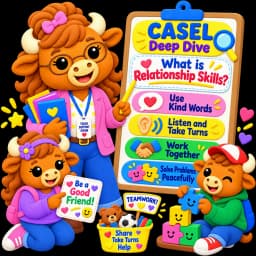
Relationship skills produce the observable social behaviors teachers and parents most want to see: communication, cooperation, conflict resolution, help-seeking, and the capacity to maintain healthy connections. It is also the competency most frequently assumed rather than taught.
Students do not learn social skills simply by being placed in groups.
They require structured practice, modeling, and reflective debriefs on how they interacted.[1]
The Definition
“The abilities to establish and maintain healthy and supportive relationships and to effectively navigate settings with diverse individuals and groups. This includes the capacities to communicate clearly, listen actively, cooperate, work collaboratively to problem solve and negotiate conflict constructively, navigate settings with differing social and cultural demands and opportunities, provide leadership, and seek or offer help when needed.”[2]
Establish AND maintain
Making a friend is a skill. Keeping a friend is a different skill. Instruction must address both formation and maintenance.
Diverse individuals and groups
Working with people you did not choose, in settings you did not design, toward shared goals. What the classroom, workplace, and community require.
Five Components of Relationship Skills
1. Communication
The medium through which every other relationship skill operates. Two equally important and unequally taught channels:
Expressive communication
Saying what you mean clearly, adjusting tone to the audience. “I don't like it when you take my things without asking” vs. grabbing and yelling.
Active listening
Attending to words and emotions, responding with understanding. Requires self-management (don't interrupt) and social awareness (read the speaker's state).
K-2
“I feel” statements. Eye contact when someone speaks. Waiting for the other person to finish.
3-5
Paraphrasing (“so you're saying...”). Expressing disagreement respectfully. Adjusting style to audience.
2. Cooperation and teamwork
Working toward a shared goal: flexible, sharing responsibilities, contributing, supporting. Requires every other competency in concert.
K-2
Taking turns. Sharing materials. Doing your part. Celebrating the group's success, not just yours.
3-5
Proposing not commanding. Adjusting when the group decides differently. Evaluating process, not just product.
3. Conflict resolution and repair
Navigating disagreements constructively and repairing relationships after harm. Research diverges from common practice: effective instruction focuses on repair, not just formation.[1]
Conflict resolution ≠ conflict avoidance
A child who avoids all disagreement demonstrates conflict aversion, not skill. Unresolved tensions accumulate. The full skill: disagree respectfully, listen, negotiate, and maintain the relationship through it.
K-2
Words instead of actions. Asking an adult for help. Accepting a simple repair.
3-5
Both perspectives. Solutions for both. Sincere apology: name the harm, acknowledge impact, commit to change. Forgive and move forward.
4. Help-seeking and help-offering
Help-seeking requires vulnerability — admitting you cannot do something alone. For many children, asking is an act of courage. Help-offering requires social awareness and kindness.
K-2
Raising a hand when stuck. “Can you help me?” Offering to help a struggling classmate.
3-5
Matching the right helper to the right problem. Offering without condescension. Accepting help without defensiveness.
5. Resisting negative social pressure
Maintaining values and boundaries when peers pressure you. Connects to moral courage and self-management (managing the fear of rejection).
K-2
Saying “no” when asked to do something wrong. Telling a teacher when something feels unsafe.
3-5
Refusing to exclude someone. “I don't think that's a good idea.” Maintaining honesty when others cover up.
Why Relationship Skills Must Be Taught, Not Assumed
The most common error: assuming social exposure equals instruction.
This is wrong in the same way that assuming children will learn to read by being surrounded by books is wrong. Exposure provides the environment. Instruction provides the skill.
Groups without instruction →
Bossy behavior, free-riding, and frustration.
Lunchroom without skills →
Misunderstandings, hurt feelings, unchecked social hierarchies.
Structured instruction during weekly SEL lessons teaches the specific skills that social exposure alone cannot.
The Awareness → Action Parallel
The same pattern, facing inward and outward:
Intrapersonal
Interpersonal
Perception
Self-awareness (your emotions)
Social awareness (others' emotions)
Action
Self-management (acting on self-perception)
Relationship skills (acting on social perception)
Awareness without action is incomplete. Action without awareness is uninformed. Responsible decision-making integrates all four.
How Relationship Skills Develop
Building the basics
Communication
“I feel” statements, asking permission, social conventions as connection facilitators.
Sharing and turn-taking
Not just “share” but how: offering, accepting, negotiating, being flexible.
Simple conflict resolution
Scripts for common conflicts, practiced until language is fluent. Adult mediation expected.
Help-seeking
“Everyone needs help sometimes. Asking is smart, not weak.”
Building complexity
Complex communication
Paraphrasing, constructive feedback, audience-adapted style.
Collaborative problem-solving
Brainstorming, compromising, evaluating group processes, giving credit.
Independent conflict resolution
Full sequence: describe → listen → generate solutions → choose → follow up.
Pressure resistance
Specific language, walking away, understanding that values sometimes cost social standing.
Relationship repair
Sincere apology, forgiveness, and rebuilding trust after it breaks.
Teaching Relationship Skills in the Classroom
Model every skill you teach
Relationship skills are caught as much as taught. The teacher who communicates respectfully, resolves disagreements calmly, asks for help, and repairs mistakes publicly models every component.
“I owe you an apology. I was short with you earlier, and that was not fair. I was stressed about something else, and I took it out on you. I am sorry.”
When the teacher models repair, every student learns what it looks like from the most powerful person in the room.
Structured practice, not just group work
Placing students in groups is the setting. The instruction must happen separately during SEL lessons.
The debrief is where learning happens
“How did your group communicate? Did everyone contribute? How did you handle disagreements?”
Teach repair as a core skill
Most instruction focuses on formation. The harder skill: maintaining through conflict, repairing after harm.
The repair sequence
Acknowledge harm → express remorse → commit to change → follow through. Practice during calm.
Diverse interaction opportunities
Assigned partners, rotating groups, mixed cooperative activities. A child who has worked with every peer has broader skills than one who only practiced with chosen friends.
Help-seeking as strength
“Knowing when you need help and asking for it is one of the smartest things a person can do. It means you understand yourself well enough to know your limits and trust others enough to let them help.”
Relationship Skills and Every Character Trait
The competency through which every outward-facing trait is expressed:
The kind act requires communication and willingness to act
RespectSpeaking respectfully, listening, honoring boundaries
CooperationA relationship skill by definition: working toward shared goals
HonestyTelling the truth requires skill to say hard things clearly and kindly
FairnessAdvocating for equitable treatment requires communication and courage
CourageStanding up, refusing pressure, speaking truth to the group
ResponsibilityBeing someone others can count on; repairing when you fail to follow through
What to Avoid
✗ Assuming social exposure equals instruction
Putting children in social situations without teaching skills is like putting them in a library without teaching reading.
✗ Focusing only on friendship formation
Maintaining through difficulty, repairing after harm, and working with people you didn't choose — these are the skills adult life depends on.
✗ Punishing failures instead of teaching alternatives
Consequence without instruction is behavior management, not skill building. Teach what to do instead.
✗ Neglecting quieter skills
Active listening, help-seeking, and accepting feedback receive less attention but determine success in every relationship and collaborative setting.
The Bigger Picture
Relationship skills are where every other competency becomes visible. Self-awareness is internal. Self-management is internal. Social awareness is perceptual. Relationship skills produce the observable behavior: the child communicates, cooperates, resolves, helps, includes, and connects.
The child who can communicate clearly, listen attentively, work with anyone, resolve disagreements without destroying relationships, ask for help without shame, and repair what has been broken is not just a good student. They are a good human.
Invest most heavily in the skill most schools invest in least: relationship repair. Because the capacity to fix what is broken is the skill that makes every other relationship skill durable.
References
- Flip Education. (2026). Relationship Skills (SEL Competency): Teaching Wiki. flipeducation.ai
- CASEL. (2026). What Is the CASEL Framework? casel.org
- California Department of Education. T-SEL Competencies: Relationship Skills. cde.ca.gov
- Landmark School Outreach Program. (2026). SEL: Developing Relationship Skills. landmarkoutreach.org
- Minnesota Department of Education & CASEL. Minnesota SEL Competencies: Relationship Skills. casel.s3.amazonaws.com
Turn Perception Into Connection
Be The Buffalo builds relationship skills through weekly lessons — communication, cooperation, conflict resolution, and the skill most schools underinvest in: repair. Teach children not just to make connections but to sustain them.
Sign Up FreeRelated Resources
CASEL: What Is Social Awareness?
The perceptual competency that relationship skills put into action.
Conflict Resolution Activities
The core relationship skill of navigating disagreements constructively.
Teamwork Activities
Building the cooperation component through structured practice.
When a Student Refuses to Apologize
Relationship repair in its most common classroom form.