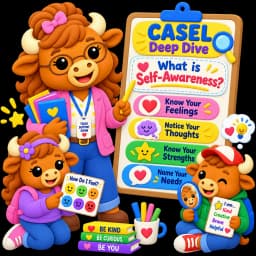
You cannot manage an emotion you have not identified
You cannot empathize if you don't understand your own experience
You cannot decide responsibly if you don't know what you value
You cannot build a healthy relationship without knowing what you bring
Self-awareness is not one skill. It is the foundation on which the entire CASEL framework rests.
The Definition
“The abilities to understand one's own emotions, thoughts, and values and how they influence behavior across contexts. This includes capacities to recognize one's strengths and limitations with a well-grounded sense of confidence and purpose.”[1]
Understanding emotions, thoughts, and values
The child knows what they feel, what they think, and what matters to them.
How they influence behavior
“I yelled because I was frustrated” is self-awareness. “I yelled because he's annoying” is not.
Strengths and limitations with confidence
Without collapsing into arrogance or self-doubt.
What Self-Awareness Includes
Four teachable categories for elementary educators:[1][2]
1. Emotional identification
Recognizing and naming what you feel. Not just “good” or “bad” but specific: frustrated, disappointed, nervous, embarrassed, proud, overwhelmed. The most fundamental self-awareness skill.
Research on affect labeling: naming an emotion engages the prefrontal cortex, which moderates the amygdala's response. The child who says “I'm angry” is already less overwhelmed by the anger than the child who simply experiences it.[3]
K-2
“I feel sad when my friend doesn't want to play with me.”
3-5
“I notice that I get anxious before tests, and that anxiety makes it hard to concentrate.”
2. The feeling-thought-behavior connection
Understanding that emotions, thoughts, and actions are linked. Teaching children to trace the chain backward from behavior to thought to feeling builds the metacognitive capacity that prevents automatic reactions.
Feeling
“I felt embarrassed”
Thought
“Everyone is laughing”
Behavior
“I stopped trying”
K-2
“When I feel angry, my body wants to push. But pushing is my body's idea, not my best idea.”
3-5
“When I think 'I can't do this,' I stop trying. When I change the thought, I try longer.”
3. Strengths and limitations
Accurately assessing what you do well and what you find difficult. “I am a strong reader and I struggle with math” is self-aware. “I'm the best” and “I'm the worst” are both failures. Connects to growth mindset: “I struggle with math right now” leaves room for growth.
K-2
“I'm really good at drawing. Writing is harder for me, but I'm getting better.”
3-5
“Reading is my strength. I also know I need to work on organization. That's something I can improve.”
4. Identity, values, and purpose
Understanding who you are, what matters to you, and what kind of person you want to be. Values are the internal standards — honesty, fairness, kindness, courage — that guide decision-making.
K-2
“I am someone who is kind to others. That is important to me.”
3-5
“I value fairness. When I see something unfair, I want to speak up. That is part of who I am.”
Why Self-Awareness Is the Foundation
Listed first among CASEL's five competencies for a reason. Every other competency depends on it.
Enables Self-management
You cannot manage what you haven't identified. "I'm getting frustrated" names the target. "Something is wrong" has no target for regulatory strategies.
Enables Social awareness
Empathy requires recognizing in others what you've first recognized in yourself. A child who has never identified their own disappointment can't see it in someone else.
Enables Relationship skills
Healthy relationships require knowing what you need, offer, and where your patterns create friction. "I get bossy when I'm anxious" catches the pattern before it damages a friendship.
Enables Responsible decision-making
Every decision is influenced by emotions, biases, and values. Knowing your emotional state ("I'm angry, maybe I shouldn't decide now") and your values gives an internal standard to evaluate against.
How Self-Awareness Develops in Elementary School
Building the vocabulary
Basic → intermediate emotion words
Happy, sad, angry, scared → frustrated, disappointed, nervous, embarrassed, proud, lonely, jealous, grateful, hopeful
Visual emotion charts
Posted visually, referenced daily: “Find the word that matches how you feel right now.”
Body connection
“Does angry feel like heat? Does nervous feel like butterflies? Does sad feel heavy?”
Goal is practice, not mastery. Vocabulary is being stored for later retrieval.
Building the connections
Feeling-thought-behavior chain
“When I felt [emotion], I thought [thought], so I did [behavior]. Next time I could think [alternative].”
Strengths and growth areas
Regular self-reflection: what went well, what was challenging, what to improve. Genuine practice, not performance.
Values identification
“What matters to you? What kind of friend do you want to be? What do you do when right is different from easy?”
Teaching Self-Awareness in the Classroom
Daily emotional check-ins
“On a scale of 1-5, how are you feeling? One word that describes your mood.” Normalizes emotional identification, builds vocabulary through daily use, gives teacher information about who may need support. Visual scales for younger students (faces, colors, weather). Specific emotion words for older students.
The “I notice” framework
“I notice” creates distance between child and experience. “I'm angry” is identity. “I notice I'm angry” is observation. The observer can choose a response.
"I notice I'm feeling frustrated."
"I notice my body is tense."
"I notice I want to give up."
"I notice I'm thinking 'this is too hard.'"
Reflective writing
Journaling prompts that build the metacognitive habit of examining your own experience:
"What was the hardest part of today, and how did you handle it?"
"What is something you did well this week that took effort?"
"What emotion did you feel most often today?"
"When you felt [emotion], what did you do? What else could you have done?"
Stories and characters
During SEL instruction, use characters who demonstrate or fail to demonstrate self-awareness. Safer than personal reflection because the child analyzes someone else's experience without vulnerability.
The strengths conversation
“Everyone has things they're naturally good at and things that take more effort. Three things you do well and one you're working on.” Model it: “I am a good listener and I'm working on being more organized.”
Growth mindset connection
✗ Fixed mindset
“I'm bad at math.” Accurate assessment → identity conclusion → no pathway forward.
✓ Growth mindset
“Math is hard for me right now, and I'm getting better with practice.” Accurate assessment → effort framing → clear pathway.
Teach “yet” and “right now.” “I can't do long division yet.” Qualifiers maintain accuracy while preserving agency.
Self-Awareness and Character Education
Self-awareness connects to every character trait:
Awareness of what is true about yourself and your actions
ResponsibilityAwareness of your role in outcomes
Self-controlAwareness of the impulse before managing it
CourageAwareness of the fear that precedes courageous action
KindnessAwareness of your capacity to help
PatienceAwareness of impatience that makes waiting strategies accessible
FairnessAwareness of your own biases and preferences
GratitudeAwareness of what you have received
What to Avoid
✗ Forcing self-disclosure
Self-awareness is internal. A child who knows what they feel but doesn't want to share has set a boundary, not failed at the skill. Don't conflate awareness with disclosure.
✗ Labeling children by emotions
"You're the angry one" turns a state into an identity. Self-awareness means recognizing emotions as states: "I feel angry right now" — not "I am an angry person."
✗ Skipping the vocabulary
A child who knows only "good" and "bad" has a two-word vocabulary for an experience that requires at least twenty. Invest in the words before expecting identification.
✗ Teaching it in isolation
Self-awareness without the other four competencies is incomplete. Awareness without tools (self-management), without empathy (social awareness), is knowledge without capacity. Foundation, not the whole building.
The Bigger Picture
Self-awareness is the first conversation the child has with themselves. The internal voice that says “I notice I'm feeling something” before the feeling drives the behavior. The honest self-assessment. The values recognition that says “this matters to me.”
Without self-awareness, every other SEL competency operates in the dark. Self-management without it is steering without seeing the road. Empathy without it is reading someone else's map when you haven't read your own.
Self-awareness is the light you turn on first. Everything else becomes visible after. The child who learns “I notice I'm frustrated” in second grade is building the capacity to say “I notice this decision is influenced by my fear of failure” in high school. The vocabulary changes. The skill is the same. Start building it now.
References
- CASEL. (2026). What Is the CASEL Framework? casel.org
- California Department of Education. T-SEL Competencies: Self-Awareness. cde.ca.gov
- Lieberman, M. D., et al. (2007). Putting Feelings into Words. Psychological Science, 18(5), 421-428. doi.org
- Dweck, C. S. (2006). Mindset: The New Psychology of Success. Random House.
- Washington OSPI. Alignment of Washington SEL Standards and CASEL SEL Competence Areas. ospi.k12.wa.us
- Massachusetts DESE. Social and Emotional Learning: The Five Core Competencies. doe.mass.edu
Build the Foundation First
Be The Buffalo builds self-awareness through weekly 15-minute lessons — emotion vocabulary, the feeling-thought-behavior chain, strengths identification, and values reflection. The light you turn on first, so everything else becomes visible.
Sign Up FreeRelated Resources
What Is CASEL?
An overview of all five competencies and how they work together.
Emotional Regulation Activities
The self-management skills that self-awareness makes possible.
Empathy Lessons
Social awareness that uses your own emotional map to understand others.
Perseverance Activities
Where growth mindset self-awareness meets sustained effort.