Self-Awareness
“I'm frustrated.”
Identified the fire
Self-Management
“I'm frustrated, so I'll take three breaths before I respond.”
Picked up the extinguisher
Self-management is the most immediately visible competency because its absence is the most immediately disruptive. But it is not just the absence of disruptive behavior. It is the presence of a suite of regulatory skills that enable a child to navigate the emotional, cognitive, and social demands of the school day.
The Definition
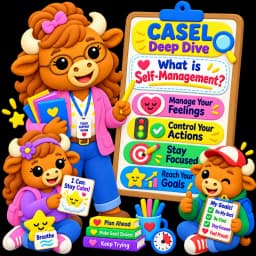
“The abilities to manage one's emotions, thoughts, and behaviors effectively in different situations and to achieve goals and aspirations. This includes the capacities to delay gratification, manage stress, and feel motivation and agency to accomplish personal and collective goals.”[1]
Regulatory half
Managing emotions, thoughts, and behaviors across situations. Not a fixed trait — fluctuates across contexts, energy levels, and emotional states.
Directional half
Achieving goals and aspirations. Not just restraint — the proactive capacity to set goals, organize effort, sustain motivation, and move toward something.
Five Components of Self-Management
1. Emotional regulation
Modulating intensity and duration of emotional responses so they don't override the capacity to think, communicate, and choose. Not suppressing — experiencing at a manageable intensity through appropriate channels.[2]
K-2
Using calming strategies when upset. Asking for a break. Expressing frustration with words instead of actions.
3-5
Recognizing early escalation signs. Choosing strategies by situation. Recovering from strong emotions and returning to the task.
Related: Emotional regulation, losing gracefully, student shutdowns
2. Impulse control
Pausing between impulse and action, evaluating, and choosing whether to act. Requires inhibitory control — an executive function that is genuinely still developing across elementary years.[3]
K-2
Raising hand instead of calling out. Waiting for turns. Using “stop, think, choose” protocol.
3-5
Pausing before responding in conflict. Resisting peer pressure. Choosing not to say something hurtful.
Related: Self-control, patience
3. Stress management
Recognizing stress, understanding its sources, and reducing it. Distinct from emotional regulation because stress is cumulative — it builds across the day and affects everything else simultaneously.
K-2
Identifying stressors (“tests make me nervous”). Simple strategies: breathing, movement, talking to a trusted adult.
3-5
Identifying patterns (“I get stressed with multiple deadlines”). Using planning/organization to reduce avoidable stress. Mindfulness and physical activity.
4. Goal setting and pursuit
The proactive dimension. Where regulation and impulse control manage what arises, goal setting directs effort toward something chosen. A child who can only regulate is reactive. A child who also sets goals is agentive.
K-2
Simple, short-term goals with visual tracking: “I want to read three books this week” with a chart and stickers.
3-5
Longer-term goals with multiple steps. Breaking projects into tasks. Monitoring progress. SMART goals.
Related: Goal setting, perseverance
5. Motivation and agency
Believing effort matters and sustaining it through difficulty. Connects to growth mindset, self-efficacy, and agency. Without motivation, a child has tools but no reason to use them.[4]
K-2
Trying again after failure without prompting. Starting tasks independently. “I can do hard things.”
3-5
Sustaining effort on long projects. Taking initiative on learning goals. Choosing challenging work over easy work.
Related: Perseverance, courage (disciplined courage)
Why Self-Management Matters for Academic Achievement
Self-management is not a supplement to academic instruction. It is a prerequisite for it.
Durlak et al. (2011): Meta-analysis of 213 SEL programs found an 11-percentile-point gain in academic achievement among students who received SEL instruction.[5]
A child who melts down during math is unavailable for the instruction that follows. A child who can't sustain attention doesn't absorb reading content. A child overwhelmed by stress can't store new information. Self-management keeps children in the learning zone.
How Self-Management Develops
Building the toolkit
Calming strategies
4-4-4 breathing, counting backward, squeeze-and-release, finding a quiet space.
Routine and structure
Predictable routines reduce the demand because the child doesn't need to manage uncertainty.
Simple goals
“Today I'll raise my hand three times instead of calling out.” Specific, short timeframe, observable.
Will need frequent adult prompting. Strategies are being stored, not yet independently deployed.
Building independence
Strategy selection
“Which strategy works best here? Breathing for the body. Self-talk for thinking. A break for stepping away.”
Planning and organization
Breaking projects into steps, checklists/planners, time estimation, prioritizing competing demands.
Metacognitive reflection
“What did you do when overwhelmed? Did it help? What would you try next time?”
Teaching Self-Management in the Classroom
Teach strategies explicitly
During calm moments, practiced repeatedly, then cued during stress. A strategy introduced during a meltdown won't work. Use weekly SEL instruction to role-play scenarios. Learn more
Provide visual supports
Calming poster on the wall. Strategy card on the desk. Choices chart for different emotions. These externalize the process for developing internal systems.
Build routines that reduce demand
Every predictable routine is a self-management support. A child who knows what happens next doesn't need to manage uncertainty. Invest early — it pays off all year.
Scaffold the difficulty
Start with mild frustration. Build to moderate. Then strong. Progressive exposure, not expecting the hardest thing first.
Praise the process
"I noticed you took a breath before trying again. That is self-management." Name it when you see it. The management itself is valued, not just the absence of the meltdown.
Self-Management and Every Character Trait
Self-management makes every character trait operational under pressure — precisely when traits matter most.
Self-management applied to impulses
PatienceSelf-management applied to time — tolerating the gap between wanting and receiving
PerseveranceSelf-management applied to effort — managing the impulse to quit
HonestySelf-management managing the fear that tempts you to lie
CourageSelf-management managing fear to act — every form of courage
KindnessSelf-management managing self-interest to share, help, or include
ResponsibilitySelf-management managing the impulse to avoid or deflect
FairnessSelf-management managing the bias toward self-interest
GratitudeSelf-management managing the impulse to take things for granted
The Harder Questions
When self-management fails despite effort
Not always an instruction problem. The child may be depleted (resource consumed earlier), overwhelmed (demand exceeds developmental capacity), or triggered (trauma bypassed the regulatory system). The response should be compassion and accommodation, not increased demand.
When the system is always overwhelmed
Chronic difficulty may indicate anxiety, ADHD, trauma, or other conditions affecting baseline capacity. Involve the school counselor, psychologist, or student support team for assessment.
When self-management looks like suppression
A child who never expresses emotion may have learned to suppress rather than manage. “I'm really upset about this” said calmly is self-management. Silence when genuinely distressed is suppression. Suppression stores emotions — they surface later, less controllably. Watch for the difference.
What to Avoid
✗ Expecting without teaching
“Calm down” without teaching how is an instruction the system can't execute. Teach strategies, practice them, then cue them.
✗ Punishing failures
A meltdown is a regulatory failure, not a behavior choice. Help recover, then teach. Don't add punishment to an already overwhelmed system.
✗ Making it the only priority
Visibility bias: its failures are disruptive, so it gets prioritized. But managing behavior without building awareness, empathy, and relationships produces compliance, not competence.
The Bigger Picture
Self-management is where the internal world meets the external world. Every moment of the school day crosses this bridge: when math gets hard, when a peer says something hurtful, when the line is too long, when the answer is wrong, when the game is lost, when the truth must be told.
At each moment, the child's system decides: act on the impulse or choose a response. React or regulate. Quit or continue. Hide or be honest. Exclude or include.
Self-awareness identifies the fire. Self-management picks up the extinguisher. Together, they form the intrapersonal foundation that every other competency builds on. The child who learns to manage frustration over a board game in second grade is building the same capacity they will use to manage a crisis at work in adulthood. The situations change. The skill is the same. Start building it now.
References
- CASEL. (2026). What Is the CASEL Framework? casel.org
- California Department of Education. T-SEL Competencies: Self-Management. cde.ca.gov
- Scientific Reports. (2014). Development of self-control in children aged 3 to 9. nature.com
- Dweck, C. S. (2006). Mindset: The New Psychology of Success. Random House.
- Durlak, J. A., et al. (2011). The impact of enhancing students' social and emotional learning. Child Development, 82(1), 405-432. doi.org
- Landmark School Outreach Program. (2026). Self-Management (SEL). landmarkoutreach.org
Build All Five Components
Be The Buffalo builds self-management through weekly 15-minute lessons — emotional regulation, impulse control, stress management, goal setting, and motivation. Not just restraint — the ability to choose your response and pursue your goals.
Sign Up FreeRelated Resources
CASEL: What Is Self-Awareness?
The foundational competency that self-management depends on.
Emotional Regulation Activities
Building the emotional regulation component.
Teaching Self-Control
The character trait that directly maps to self-management.
Perseverance Activities
The sustained effort component of self-management.