Self-Awareness
“What am I feeling?”
Faces inward
Self-Management
“What do I do about it?”
Faces inward
Social Awareness
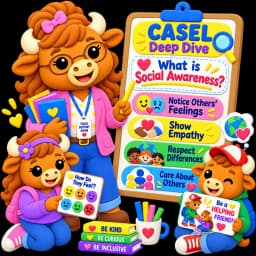
“What are they feeling?”
Faces outward ← the turn
Social awareness is the perception that makes everything interpersonal possible. You cannot build a relationship with someone you do not understand. You cannot resolve a conflict without taking the other person's perspective. You cannot include someone you have not noticed is excluded.
The Definition
“The abilities to understand the perspectives of and empathize with others, including those from diverse backgrounds, cultures, and contexts. This includes the capacities to feel compassion for others, understand broader historical and social norms for behavior in different settings, and recognize family, school, and community resources and supports.”[1]
Perspectives and empathy
Imagining what another person thinks, feels, or experiences — even when different from your own.
Diverse backgrounds
A bridge across difference, not just a mirror for similarity.
Norms and resources
Understanding how settings differ and knowing where to find help.
Four Components of Social Awareness
1. Perspective-taking
Understanding a situation from another person's point of view. Not just recognizing they have a perspective, but reasoning about what it actually is based on their situation, history, and position.[2]
K-2
“How do you think Marcus felt when nobody wanted to play with him?”
3-5
“Why do you think she reacted that way? What might be going on that we don't see?”
True perspective-taking develops significantly ages 5-10. Younger children often project their own feelings. Older students begin understanding others might feel differently in the same situation.
2. Empathy and compassion
Empathy is resonating with another's emotional experience. Compassion adds the motivation to respond.[3]
Cognitive empathy
Understanding through reasoning: “I can see she is sad.” Develops alongside perspective-taking.
Affective empathy
Feeling resonance with another's state. Appears early (infant crying) but becomes more sophisticated.
Compassion
See it + feel it + decide to act. The complete sequence that drives kindness and inclusion.
K-2
Sees a classmate crying, brings a tissue or sits with them without being asked.
3-5
Notices a peer withdrawing socially; mentions it to teacher or checks in. Reads subtle cues and responds with care.
3. Understanding social norms
Recognizing that different settings have different expectations and adjusting accordingly. Often undertaught — adults assume children absorb norms through exposure, but many need explicit instruction.
K-2
Playground voice vs. classroom voice. Running at recess vs. walking in the hallway.
3-5
Talking to friends vs. to the principal. Group work vs. independent work. Adapting to a new setting without explicit instruction.
4. Appreciating diversity
Recognizing, respecting, and valuing differences. Extending empathy beyond “people like me” to “people different from me” — the full competency.
K-2
“Amira's family celebrates different holidays than mine. That is interesting.” Different does not mean wrong.
3-5
Recognizing that fairness sometimes means treating people differently based on what they need.
The Bridge Competency
Social awareness bridges the intrapersonal and interpersonal competencies:
From self-awareness →
“I feel frustrated” extends to “She might feel frustrated too, but for a different reason.” Your emotional vocabulary becomes the map for reading others.
→ To relationship skills
Perception (seeing sadness) + action (sitting with them, listening) = connection. Without social awareness, you act without seeing. Without action, you see without acting.
→ To decision-making
Every responsible decision that considers others' well-being depends on first perceiving their feelings, needs, and perspectives. Social awareness provides the information.
How Social Awareness Develops
Recognizing emotions in others
Emotion recognition
“Look at her face. What do you think she is feeling? How can you tell?”
Basic perspective-taking
“How do you think he felt when that happened?” Accept approximate answers.
Concern for others
“She is upset. What could we do to help?” Connects awareness to response.
Understanding complexity
Complex perspective-taking
“You think you'd be fine. But she might feel differently. Why?”
Group dynamics awareness
“One person is doing most of the talking. Who hasn't shared? Why might they be quiet?”
Intent vs. impact
“He didn't mean to hurt her feelings. But he did. Both matter.”
Recognizing unfairness
“Is this fair for everyone? Who might be left out?”
Teaching Social Awareness in the Classroom
Stories as empathy exercises
Stories during weekly SEL instruction build each sub-skill in a safe, low-stakes context:
Perspective-taking
"Why did the character do that? What would you have done?"
Empathy
"How did the character feel? Have you ever felt that way?"
Social norms
"They acted differently at the party vs. school. Why?"
Diversity
"This family looks different from yours. Is different wrong?"
Teach emotion reading as a skill
Faces
"What emotions do you see? How can you tell sad from frustrated?"
Body language
"Arms crossed, looking away — what might they be feeling?"
Tone of voice
"Listen to two ways I say this sentence. What's different?"
Perspective-taking through role-play
“This time, you are the new student who doesn't know anyone. How do you feel? What do you notice? What do you wish someone would do?”
More powerful than discussion alone — creates an experiential understanding that talking about it cannot produce.
Practice noticing who is not seen
“Look around. Is anyone by themselves? Is anyone looking like they need something? What could you do?” Builds the kindness that social awareness produces when perception meets action.
Teach impact vs. intent
“Intent is what you meant. Impact is what happened. When your impact hurts someone, even with good intent, you are still responsible for the impact.” One of the most important upper elementary lessons.
Social Awareness and Every Character Trait
The perception that gives every outward-facing trait its target:
Social awareness in its purest form
KindnessSeeing a need and meeting it
FairnessAwareness of how situations affect different people differently
RespectAwareness of others' dignity, boundaries, and worth
CourageMoral courage: awareness that someone is being harmed
GratitudeAwareness of another person's effort and intention
HonestyAwareness that deception damages trust
The Harder Dimensions
Empathy fatigue
A highly empathetic child may absorb others' emotions to an overwhelming degree. Teach the distinction: “You can understand how someone feels without feeling it as strongly as they do. You can care without carrying.”
Empathy for people who are difficult
Easiest with friends, hardest with people who frustrate you. Teach that perspective-taking doesn't require agreement: “Understanding why someone did something doesn't mean you think it was okay. You can see their perspective and still believe they were wrong.”
When social norms conflict with values
A child who sees the group excluding someone faces a conflict: social awareness (understanding the norm) vs. moral awareness (knowing it's wrong). Social awareness without moral reasoning produces conformity. With it: courage to challenge the norm.
What to Avoid
✗ Assuming empathy means agreement
Perspective-taking doesn't require endorsing the position. Understanding is not approval.
✗ Forcing emotional sharing
A child can develop empathy through stories and observation without ever disclosing their own emotions publicly.
✗ Teaching only same-group empathy
Empathy only for similar people produces tribalism. Intentionally cross social boundaries in exercises.
✗ Neglecting the behavioral component
Seeing without acting is awareness without impact. Always connect: "You noticed she was alone. What could you do?"
The Bigger Picture
Social awareness is what makes a person capable of community. The child who reads sadness on a peer's face and sits with them. The child who recognizes a new student is nervous and introduces themselves. The child who notices an unfair norm and speaks up.
Self-awareness turns the lens inward. Self-management puts the inward view into action. Social awareness turns the lens outward. And what the child sees determines whether everything that follows will be grounded in understanding or operating in the dark.
The world has enough people who see only themselves. Teach children to see each other.
References
- CASEL. (2026). What Is the CASEL Framework? casel.org
- Selman, R. L. (1980). The Growth of Interpersonal Understanding. Academic Press. Via: landmarkoutreach.org
- Decety, J., & Jackson, P. L. (2004). The Functional Architecture of Human Empathy. Behavioral and Cognitive Neuroscience Reviews, 3(2), 71-100. doi.org
- California Department of Education. T-SEL Competencies: Social Awareness. cde.ca.gov
- Changing Perspectives. (2024). 5 Core Competencies of SEL Fundamentals. changingperspectivesnow.org
Turn the Lens Outward
Be The Buffalo builds social awareness through weekly lessons — perspective-taking, empathy, social norms, and diversity appreciation. Teach children to see each other clearly, and watch the classroom community transform.
Sign Up FreeRelated Resources
CASEL: What Is Self-Awareness?
The inward-facing competency that social awareness extends outward.
Empathy Lessons
Building the core social awareness skill through structured instruction.
Teaching Kindness
Where social awareness becomes prosocial action.
Conflict Resolution Activities
The relationship skills that social awareness makes possible.