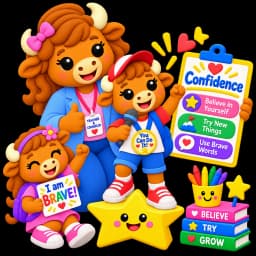
What Confidence Actually Is
Self-esteem
“I am a good person.” Global, general, relatively stable. Valuable but not what most teachers mean.
Self-efficacy
“I can solve this problem.” Domain-specific, task-specific, highly responsive to experience. The most actionable.[2]
Confidence
The behavioral expression: willingness to try, take risks, persist, and engage with challenges rather than avoid them.
Building confidence is not about making children feel good in general.
It is about providing specific experiences that build belief in specific capacities. Feeling good follows from capability, not the other way around.
How Confidence Develops and Declines
Unrealistic optimism
Children believe they can do everything. Not arrogance — a developmental feature. This overconfidence is functional: it motivates exploration and risk-taking.[1]
The correction
Social comparison develops. Self-evaluations become more accurate — and more negative. The most important window for confidence instruction.[1]
Growth mindset → realistic confidence. Fixed mindset → learned helplessness.
Domain differentiation
“I'm good at reading but not math.” Healthy when accurate and growth-oriented. Problematic when it becomes permanent sorting.[3]
Four Sources of Confidence
Bandura's research, arranged from most to least powerful:[2]
1. Mastery experiences
Succeeding at something that required effort. Not easy success (teaches nothing) and not impossible challenge (teaches helplessness). Calibrated challenge: hard enough to require effort, achievable enough to produce success.
Scaffold challenge
Just beyond the comfort zone. Vygotsky's zone of proximal development applied to confidence.
Visible milestones
Break large tasks into steps. Three milestones = three mastery experiences in one project.
Let struggle happen
Rescuing a struggling child robs them of the mastery experience. Intervene when stuck, observe when productively struggling.
2. Vicarious experiences
Watching someone similar succeed. The key word: “similar.” A classmate who also struggles but succeeds is more powerful than a professional expert performing.
Peer modeling
“Maya was stuck. She tried three strategies. Watch what she did.”
Relatable struggle stories
Ordinary people working through difficulty, not just famous success myths.
Strategic pairing
Slightly more advanced + slightly behind. Proximity in skill makes it believable.
3. Social persuasion
Encouragement works only under specific conditions. Generic praise has minimal effect. Specific, credible feedback tied to effort and strategy has meaningful effect.
Be specific
“You stayed with that for 10 minutes and tried 3 strategies. That persistence is why you got it.”
Be credible
Inaccurate praise erodes trust. Name what the child genuinely did well, even in a failed effort.
Effort, not ability
“You're so smart” → fragile. “You used a great strategy” → durable.[3]
4. Physiological and emotional states
Children interpret bodily sensations as capability information. Calm = “I'm ready.” Anxious = “I can't do this.”
Reinterpret arousal
“Butterflies don't mean failure. They mean your body is preparing. Athletes feel the same before a game.”
Teach calming strategies
Deep breathing, muscle relaxation, positive self-talk change the state → change the interpretation.
Positive associations
A classroom where hard work is celebrated and mistakes are normalized.
What Undermines Confidence
✗ Praise for ability
“You're so smart” produces a fixed mindset. Confidence that is real but fragile — works until the child encounters something hard, then shatters.[3]
✗ Removing all challenge
Eliminating difficulty eliminates mastery experiences. A child who always succeeds without effort has no evidence they can handle difficulty.
✗ Comparison to peers
“Look how well Sarah did” shifts confidence from internal (did I improve?) to external (did I beat her?). Compare to the child's own past performance.
✗ Punishment for mistakes
Teaches that mistakes are dangerous → avoids challenges → avoids mastery experiences. Fear of failure is the enemy of confidence.
Teaching Confidence as a Skill
The “I can't do this YET” reframe
“Yet” preserves the growth trajectory. It acknowledges the limitation without making it permanent. Practice during SEL instruction: when a child says “I can't,” add “yet” — “That word matters. It means you are on the way.”[3]
The effort-outcome connection
Make the connection explicit:
“You practiced every night. Your score went up 15 points. That happened because of what you did.”
“You rewrote this three times. Each version was better. That's the result of your effort.”
Safe risk-taking
The classroom culture around failure is the single biggest determinant of risk-taking.
“In this classroom, mistakes are how we learn. I expect you to make mistakes. I make them too.”
“That didn't work. That's not failure — that's information. What will you try next?”
Strength identification
Not generic (“you're great!”) but specific: “You are really good at explaining things. When you helped Marcus, you used clear language and patience. That is a real strength.” Evidence-grounded, not reassurance-grounded.
Graduated challenge
Slightly hard → moderately hard → genuinely hard. Each success builds belief that the next level is achievable. Do not skip levels — deep challenge without accumulated mastery produces anxiety, not confidence.
Confidence Across the CASEL Competencies
"A well-grounded sense of confidence and purpose." Accurate self-assessment of strengths and growth areas.
Self-managementConfidence enables initiative, goal pursuit, and perseverance. The fuel for motivation and agency.
Social awarenessSocial confidence: willingness to engage, join groups, navigate situations. Believing you have something to offer.
Relationship skillsConfident enough to express needs, assert boundaries, resolve conflicts, and resist pressure.
Decision-makingWillingness to make hard decisions rather than defaulting to the safest option. Trusting your own judgment.
The Character Connection
Confidence is the enabling condition for every trait that requires action:
Requires the confidence that your action will matter
PerseveranceRequires the confidence that continued effort will produce results
HonestyRequires the confidence that the relationship will survive the truth
ResponsibilityRequires the confidence that you can handle the consequences of owning your actions
ResilienceRequires the confidence that recovery is possible
What to Avoid
✗ Building confidence without competence
Telling children they're great without teaching capability produces hollow confidence that collapses under challenge. Mastery produces the belief.
✗ Protecting from all difficulty
A child who has never faced difficulty has no evidence they can handle it. Overprotection produces someone who falls apart in challenging environments.
✗ Treating confidence as uniform
Confident in reading, terrified of math. Confident with friends, anxious with strangers. Build it where it's weak without assuming it's weak everywhere.
✗ Equating confidence with extroversion
A quiet child who knows their capabilities and works persistently is confident. A loud child seeking constant validation may not be. Volume ≠ confidence.
The Bigger Picture
The kindergartner who raises their hand for every question has natural, untested confidence. The third grader who will not raise their hand has had that confidence corrected by reality and has not yet rebuilt it on a more accurate foundation.
The goal is not to return the third grader to kindergarten-level overconfidence. It is to help them build a new kind — grounded in accurate self-assessment, growth mindset, accumulated mastery experiences, and the knowledge that effort produces outcomes.
The child who believes they can is more likely to try. The child who tries is more likely to succeed. The child who succeeds has evidence for the belief. And the cycle continues. Build the cycle. That is confidence instruction.
References
- Marsh, H. W., & Craven, R. G. (2006). Reciprocal effects of self-concept and performance. Perspectives on Psychological Science, 1(2). Via: frontiersin.org
- Bandura, A. (1997). Self-Efficacy: The Exercise of Control. W.H. Freeman. Via: positivepsychology.com
- Dweck, C. S. (2006). Mindset: The New Psychology of Success. Random House. proemergency.com
- Journal of Innovation and Research in Primary Education. (2025). Building Children's Self-Efficacy. doi.org
- Frontiers in Education. (2026). School-based interventions to enhance academic self-efficacy. frontiersin.org
Build the Cycle
Be The Buffalo builds confidence through weekly lessons that provide mastery experiences, growth mindset instruction, and a classroom culture where effort is valued and mistakes are safe. Earned belief, not empty praise.
Sign Up FreeRelated Resources
Perseverance Activities
Confidence applied to sustained effort through difficulty.
Teaching Resilience
Confidence as a protective factor in recovery from setbacks.
Teaching Kids to Lose Gracefully
Maintaining confidence through competitive setbacks.
CASEL: What Is Self-Awareness?
The accurate self-assessment that grounds healthy confidence.