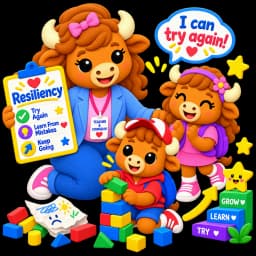
What Resilience Actually Is
“Resilience is not a singular trait enabling children to bounce back from adversity. It is a dynamic interaction between the individual and their environment, marked by positive outcomes despite difficulty.”[1]
A resilient child is not one who does not cry when they fail a test.
A resilient child is one who cries, processes the disappointment, identifies what went wrong, and decides what to do differently next time. The crying is not a resilience failure. The giving up would be.
Resilience operates through protective factors:[2]
Internal factors
Emotional regulation, problem-solving, self-efficacy, growth mindset
Relational factors
At least one stable, caring adult. Positive peer connections. A sense of belonging.
Environmental factors
Safe, predictable settings. Consistent routines. Autonomy and choice. Access to help.
The classroom provides, or can provide, every one of these. That is not aspirational. It is a design specification.
What Resilience Is Not
✗ Not toughness
Equating emotional expression with weakness teaches suppression. The resilient child feels the disappointment, names it, processes it, and moves through it. The “tough” child buries it and carries the unprocessed weight forward.
✗ Not a fixed trait
If resilience is a trait, struggling children are unlucky. If it is skills and conditions, they need instruction and support. The second framing is more accurate and more useful.[1]
✗ Not overcoming adversity alone
The strongest predictor of positive outcomes: at least one stable, caring adult relationship.[3] Resilience is relational. The classroom teacher is, for many children, that adult.
✗ Not being okay with everything
Teaching children to cope with conditions adults should fix is burden-shifting, not resilience education. Resilience instruction should never substitute for systemic change.
Eight Protective Factors Teachers Can Build
Caring relationships with adults
The single most powerful protective factor. No curriculum can replicate it.
How to build it
Learn every student's name and something about their life. Greet them at the door. Check in on students who seem to be struggling — not just academically but emotionally. Follow up: “I noticed you seemed upset yesterday. How are you doing today?”
Emotional regulation skills
Not suppression — modulation to a level that allows thinking and action.
How to build it
Teach emotional identification, self-regulation strategies (breathing, self-talk, grounding), and the feeling-thought-behavior connection.
Problem-solving skills
Agency when things go wrong, instead of reaction or helplessness.
How to build it
Teach the problem-solving process explicitly and practice with academic, social, and hypothetical problems during SEL instruction.
Self-efficacy
The belief that your actions can produce desired outcomes. Built through experience, not encouragement.
How to build it
Tasks challenging enough to require effort, achievable enough to produce success. Praise effort and strategy, not ability. Connect outcomes to actions: “You improved because you practiced every day.”
Growth mindset
Setbacks as information (“try a different approach”) not identity (“I'm bad at this”).
Teach “yet.” Normalize mistakes. Praise process, not product. See perseverance and losing gracefully.
Sense of belonging
Included, valued, and known = a social safety net. Isolated and excluded = no net.
Help-seeking skills
A relationship skill and a resilience skill simultaneously.
Normalize asking. Identify trusted adults and peers. Practice: “I'm stuck and I need help.” “I'm not feeling okay and I need to talk.”
Optimism
Not toxic positivity. The realistic expectation that things can improve and effort can produce change.
Focus on progress over perfection. “Look how far you've come since September.” Model realistic optimism: “This is hard. I believe we can figure it out together.”
Teaching Resilience Across the School Day
When a student fails
What to avoid
✗ “It's okay” (minimizes)
✗ “You should have studied harder” (adds blame)
✗ “Don't worry about it” (dismisses)
The three-step sequence
1. Validate: “That is disappointing. You worked hard.”
2. Redirect: “What happened? What would you try differently?”
3. Affirm: “I know you can handle hard things.”
When a student faces social difficulty
Exclusion, conflict, friendship loss, and clique dynamics feel devastating because the child's world is small and relationships loom large.
Validate without catastrophizing. Problem-solve with them: “What are your options? Who else could you connect with?” Build skills proactively through SEL instruction so children are prepared when social adversity arrives.
When a student faces adversity outside school
You cannot fix the circumstances. You can provide the protective factors: be the reliable adult, maintain routines, offer consistency, create safety, teach coping skills. For some children, the classroom is the most stable, predictable, and caring environment in their life. That is not a small thing. It may be the most important thing.
Building a Resilient Classroom Culture
Normalize struggle
“This is hard. Hard is normal. Hard is where learning happens.” Share stories of struggle and recovery. When the class faces a challenge, model the resilience process: “That didn't go as planned. Let's figure out what happened.”
Celebrate recovery, not just success
“Jordan got a score that wasn't what they hoped for. Instead of giving up, they came to me, we found what they missed, they studied differently, and they improved. That recovery is worth celebrating.”
Provide autonomy and choice
Children who make choices — which book, which problem, how to demonstrate learning — develop agency. Agency is a muscle. It develops through exercise. Provide the exercise.
Resilience Builds Every CASEL Competency
Recognizing how adversity affects you emotionally. Knowing your strengths and coping patterns.
Self-managementRegulating the emotional response to difficulty. Managing stress. Sustaining effort.
Social awarenessRecognizing others face adversity too. Developing empathy for those who are struggling.
Relationship skillsSeeking help. Offering help. Maintaining relationships through difficult periods.
Decision-makingEvaluating options when things go wrong. Choosing a constructive response. Learning from it.
The Character Connection
Resilience connects to every character trait — the capacity to practice what you value when practicing it is hard:
Resilience applied to sustained effort
CourageResilience applied to fear — acting despite anxiety
Self-controlResilience applied to impulses — managing the urge to quit or lash out
HonestyThe willingness to face truth-telling consequences rather than hide behind a lie
ResponsibilityThe willingness to own mistakes and do the work of repairing them
The Bigger Picture
Resilience is not about building children who do not break. It is about building children who know how to repair, recover, and continue when things do not go as planned.
The child who fails a test and studies differently. The child who loses a game and plays again. The child who is excluded and finds a way to connect. The child who makes a mistake, tells the truth, and learns from it.
Resilience is not asking children to be strong alone. It is building everything around them — the skills, the relationships, the environment — so that when difficulty arrives, they have what they need to move through it.
References
- Taylor & Francis. (2025). Resilience in context: a synthesis of theories and practices. Educational Psychology in Practice. tandfonline.com
- Doll, B., & Song, S. Y. (2023). Enhancing Resilience in Classrooms. In Handbook of Resilience in Children (3rd ed.). Springer. springer.com
- Werner, E. E. (2006). What Can We Learn about Resilience from Large-Scale Longitudinal Studies? In Handbook of Resilience in Children. Springer. springer.com
- The Responsive Counselor. (2023). Activities for Developing Resiliency in Kids. theresponsivecounselor.com
- The Responsive Counselor. (2025). Helping Kids Be More Resilient. theresponsivecounselor.com
- Dr. Matthew Lynch. (2026). How to Foster Resilience in Elementary Students After Trauma. drmattlynch.com
Build the Protective Factors
Be The Buffalo builds resilience through weekly lessons that develop the skills, relationships, and conditions children need to move through difficulty. Not toughness. Not a trait. A practice.
Sign Up FreeRelated Resources
Perseverance Activities
Resilience applied to sustained effort.
Emotional Regulation Activities
Building the core internal protective factor.
Teaching Kids to Lose Gracefully
Resilience practiced through competitive setbacks.
How to Help a Student Who Shuts Down
When the resilience system is overwhelmed entirely.