What Is the Emotional Weather Station?
A student walks into the classroom. They are quiet, tense, and cannot settle in. When you ask “How are you feeling?” they say “Fine.” They are not fine — they just do not have the words for what is happening inside.
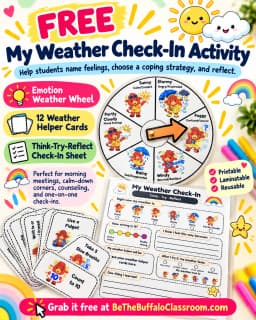
The Emotional Weather Station gives students a weather metaphor for emotions — something concrete, visual, and non-threatening. Instead of labeling themselves as “angry” or “sad,” they describe their internal weather: Stormy, Rainy, Foggy. Then they choose a coping strategy and reflect on whether it helped. It is a complete Think-Try-Reflect cycle that builds emotional awareness, self-regulation, and metacognition.
What's Included
1
Emotion Weather Wheel
Spinner with 6 weather-based feelings and a movable arrow — attach with a paper fastener
12
Weather Helper Cards
Cut-out coping strategy cards students place on the check-in sheet or keep at their desk
1
Think-Try-Reflect Sheet
Guided check-in worksheet: name your weather, rate intensity, choose a helper, and reflect
The 6 Weather Feelings
Each weather type represents a category of emotions. The weather metaphor makes abstract feelings concrete and reduces the stigma of labeling emotions directly — it is easier for a child to say “I'm Stormy” than “I'm angry.”
☀️ Sunny
Calm / Content
Everything feels okay. Settled, ready to learn, at peace.
⛈️ Stormy
Angry / Frustrated
Big feelings are crashing around. Irritable, overwhelmed, ready to explode.
🌫️ Foggy
Confused / Unsure
Hard to think clearly. Lost, uncertain, cannot figure out what to do.
💨 Windy
Worried / Restless
Thoughts are swirling. Anxious, cannot sit still, mind is racing.
🌧️ Rainy
Sad / Disappointed
Feeling down. Something did not go the way they hoped. Heavy, tearful, low energy.
⛅ Partly Cloudy
Mixed Feelings
Not all one thing. A little happy, a little unsure. Something is off but not everything.
The 12 Weather Helper Cards
Each card is a concrete coping strategy students can try right away. They pick one, place it on the check-in sheet, try it, and then evaluate whether their weather changed.
Take 5 Slow Breaths
Calming the nervous system
Talk to a Trusted Adult
Help-seeking
Stretch or Move
Body regulation
Ask for Help
Self-advocacy
Take a Quiet Break
Sensory regulation
Talk to a Friend
Social support
Count to 10
Impulse control
Draw
Creative expression
Use Positive Self-Talk
Cognitive reframing
Write or Journal
Reflective processing
Use a Fidget
Sensory input
Listen to Calming Music
Auditory regulation
The Think-Try-Reflect Check-In Sheet
The check-in sheet walks students through a complete self-regulation cycle. It is not a worksheet to grade — it is a tool for building self-regulation habits.
The Five Steps
Right now my weather is…
Student selects one of the 6 weather feelings and circles it.
How strong is it?
A color-coded intensity scale from “Just a little” to “Really strong.” Builds emotional granularity.
I think I feel this way because…
Students write or dictate the reason. Connecting cause to feeling builds self-awareness.
My weather helper will be…
Student places a weather helper card on the sheet. This is their coping strategy to try.
After I try it, my weather feels…
Student reflects: The same, A little calmer, A lot calmer, or Different. Then names their new weather. Metacognition in action.
How to Use It
Setup (One Time)
Download the free PDF and print all pages in color.
Cut out the weather wheel, arrow, and 12 weather helper cards.
Attach the arrow to the wheel with a paper fastener (brad).
Laminate everything for durability (recommended). Use the check-in sheet with dry-erase markers.
Ways to Use It
Morning Check-In
Start every day with a weather check. Students spin the wheel, share their weather, and the class practices normalizing different emotions. Sets the tone for the entire day.
Calm-Down Corner
Place the wheel and helper cards in a calm-down space. When a student needs a break, they check their weather, pick a helper card, and try it independently. Self-serve self-regulation.
Counseling Sessions
Use the full Think-Try-Reflect sheet during one-on-one or small group counseling. The structured format gives students language for what they are experiencing and a framework for trying solutions.
Whole-Class Lesson
Introduce all 6 weather feelings and 12 helpers. Practice matching: “If your weather is Stormy, which helper might work?” Build shared emotional vocabulary across the class.
After a Conflict
When two students have a disagreement, each fills out a check-in sheet. It gives them space to process before talking through what happened. Reduces escalation and builds conflict resolution skills.
Home Use
Parents can use the wheel at home after school or during homework. “What's your weather right now?” opens conversations that “How was your day?” never will.
Why It Works
Weather is safe language
Saying “I'm Stormy” feels less vulnerable than “I'm angry.” The metaphor creates distance between the child and the emotion, making it easier to talk about. Weather also normalizes change — weather shifts all day, and so do feelings. That is okay.
The cycle builds agency
Name it → Choose something → Try it → Check if it worked. This is not a one-time activity; it is a thinking routine students internalize over time. Eventually they run the cycle in their head without the worksheet.
Reflection closes the loop
Most emotion check-ins stop at identification. This one asks: Did it help? That reflection step is where metacognition happens. Students learn that some strategies work better for certain feelings — and that is data they can use next time.
CASEL-aligned skills
Maps directly to CASEL competencies: self-awareness (naming emotions and their intensity), self-management (choosing and applying coping strategies), and responsible decision-making (evaluating what worked and what to try next time).
CASEL Connections
Each weather helper card maps to specific coping and SEL skills:
Weather Helper
Coping Skill
CASEL Competency
Best For
Take 5 Slow Breaths
Nervous system regulation
Self-management
Stormy, Windy — high activation
Talk to a Trusted Adult
Help-seeking, co-regulation
Social awareness
Any weather — especially when stuck
Stretch or Move
Body-based regulation
Self-management
Windy, Stormy — restless energy
Ask for Help
Self-advocacy
Responsible decision-making
Foggy — confused, unsure what to do
Take a Quiet Break
Sensory regulation
Self-management
Stormy, Windy — overstimulated
Talk to a Friend
Social connection
Relationship skills
Rainy, Partly Cloudy — feeling alone
Count to 10
Impulse control, pause
Self-management
Stormy — about to react
Draw
Creative expression
Self-awareness
Rainy, Foggy — hard to use words
Use Positive Self-Talk
Cognitive reframing
Self-awareness
Foggy, Rainy — negative thinking
Write or Journal
Reflective processing
Self-awareness
Partly Cloudy — sorting mixed feelings
Use a Fidget
Sensory input
Self-management
Windy — need physical outlet
Listen to Calming Music
Auditory regulation
Self-management
Stormy, Rainy — need to shift mood
Download the Emotional Weather Station
Completely free. Print it, cut it, laminate it, and start helping students name their feelings, choose a coping strategy, and reflect on what works. For classrooms, counseling offices, calm-down corners, and homes.
Download Free PDFWant More Like This?
The Emotional Weather Station is one free sample from Be The Buffalo — a full 40-week CASEL-aligned curriculum with interactive projector activities, character-driven stories, original songs, printable worksheets, and structured discussion prompts. Bilingual. No student devices. No prep.
Sign Up FreeRelated Resources
Choices Vending Machine
10 self-regulation strategies packaged as vending machine snacks, plus 30 scenario cards across K-5 grade bands.
Self-Regulation Activities
Practical strategies for teaching students to manage emotions, control impulses, and stay focused.
Emotional Regulation Activities
Teach students to identify, name, and manage big emotions. Build the vocabulary and skills they need.
CASEL Deep Dive: Self-Management
Five components: emotional regulation, impulse control, stress management, goal setting, and motivation.