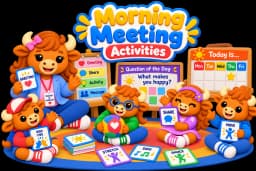
What's Inside: 62+ Activities
Pick one from each category and run a meeting tomorrow.
What Is Morning Meeting?
Morning Meeting is a daily whole-class routine, most closely associated with the Responsive Classroom approach, in which students and the teacher gather in a circle at the start of the day.[1] The traditional format has four parts:
1. Greeting
Every student is greeted by name.
2. Sharing
A few students share news or answers to a prompt, and classmates respond.
3. Group Activity
The class does something together — a game, song, chant, or movement.
4. Morning Message
A short written message that previews the day and invites a response.
A 15-Minute Morning Meeting
On short days, do a greeting and one other part. A five-minute meeting done every day beats a 25-minute meeting done once a week.
Greeting
Every student is seen and named
Sharing
Speaking, listening, empathy
Group Activity
Fun, energy, teamwork
Morning Message
Transition to learning
Greeting Activities
The one part to keep every day. Every student hears their name said kindly.
Kindergarten & First Grade
Second & Third Grade
Fourth & Fifth Grade
Sharing Activities & Prompts
Ways to Structure Sharing
K-1 Prompts
2-3 Prompts
4-5 Prompts
Emotional Check-In Prompts (Any Grade)
For building feeling words, see emotional regulation for K-5.
Group Activities
Movement & Energy
Thinking & Cooperation
Calming Activities
Songs & Chants
See how music supports SEL, self-regulation activities, and teamwork activities.
Morning Message Ideas
Basic Structure
“Good morning, Scientists!”
“Today we will learn about how plants grow.”
“Write one thing you know about plants on a sticky note.”
“Have a great day! — Ms. Rivera”
Interactive question
“Would you rather fly or breathe underwater? Make a tally mark.”
Skill practice
Include a word to sound out, a math problem, or a sentence to fix.
SEL focus
“This week we are practicing patience. When is it hard to wait?”
Gratitude
“Write one thing you’re thankful for on the chart.”
Celebration
“Yesterday our class helped clean the library. Thank you, helpers!”
Goal setting
“What is one goal for today? Write it on your sticky note.”
Bilingual message
Write in English and Spanish, or include key words in both.
A Sample Week of Morning Meetings
| Day | Greeting | Sharing | Activity | Message |
|---|---|---|---|---|
| Monday | Wave and name | Weekend highlight | Stand up if | Preview the week |
| Tuesday | Greeting in Spanish | Something kind someone did | Count to 20 | Kindness |
| Wednesday | Category greeting | A goal for this week | Freeze dance | Goal check-in |
| Thursday | Compliment greeting | A mistake you learned from | Mirror me | Growth mindset |
| Friday | Secret handshake | Something you’re proud of | Class song | Celebrate the week |
Link the week’s prompts to one SEL theme. See weekly SEL lessons for elementary.
Morning Meeting in Bilingual Classrooms
- •Alternate greeting languages by day, or greet in both.
- •Post sentence frames for sharing in English and Spanish.
- •Let students share in whichever language feels most natural.
- •Sing greeting songs in both languages.
- •Write the morning message bilingually, or include a “word of the day” in both.
Differentiating by Grade Band
K-1
10-15 min. Songs, chants, puppets, movement. Teach every part explicitly. Practice many times. See kindergarten SEL guide.
2-3
Add focused sharing with questions. Cooperative games. Students begin leading parts. Connect prompts to the week’s SEL theme.
4-5
Student-designed greetings, student-led meetings, deeper prompts. Respect privacy. See SEL for upper elementary.
Troubleshooting Common Problems
“We don’t have time.”
Do a 2-minute greeting and a 1-minute message. A calmer start saves time later.
“Some students won’t share.”
Offer a pass, use partner sharing first, give thinking time, provide sentence starters. Never force.
“It gets silly and out of control.”
Teach expectations explicitly. Keep activities short. End before energy peaks.
“The same students always talk.”
Use whip shares or name sticks.
“A student shares something concerning.”
Thank them, move on calmly, follow up privately. Follow your school’s reporting procedures.
“Some students get left out.”
Use structured greetings (around the circle or name sticks). See students exclude others.
What to Avoid
Skipping the greeting
It’s the shortest part and ensures every student is noticed.
Letting sharing become show-and-tell competition
Focus prompts on thoughts and experiences, not possessions.
Forcing participation
Pressure undermines safety.
Running it inconsistently
Consistency matters more than length.
Using it for discipline
Don’t address individual behavior problems in front of the class.
Making every activity high-energy
Mix energizing and calming so students are ready to learn.
Measuring Whether Morning Meeting Is Working
Participation
More students greeting, sharing, joining over time?
Names
Do students know and use each other’s names?
Listening
Are students responding with questions and comments?
Morning transitions
Is the first lesson calmer and quicker?
Inclusion
Fewer students left out at recess or in groups?
Student feedback
What do students like? What would they change?
Final Thoughts
Morning Meeting does not need to be elaborate. A greeting, a short share, a quick game, and a message can fit into 15 minutes, and even a five-minute version gives every student a moment to be seen.[4]
Start with one greeting and one game. Do it every day. The routine is the point.
Sources
- Kriete, R., & Davis, C. (2014). The Morning Meeting Book (3rd ed.). Center for Responsive Schools. ERIC
- Rimm-Kaufman, S. E., & Chiu, Y. I. (2007). Psychology in the Schools, 44(4), 397–413. DOI
- Responsive Classroom. SALS summary. PDF
- Rimm-Kaufman, S. E., et al. (2014). American Educational Research Journal, 51(3), 567–603. DOI
- Allen, K., et al. (2018). School belonging meta-analysis. Educational Psychology Review, 30(1), 1–34. DOI
- Durlak, J. A., et al. (2011). SEL meta-analysis. Child Development, 82(1), 405–432. DOI
- Cipriano, C., et al. (2023). SEL meta-analysis. Child Development, 94(5), 1181–1204. DOI
What the Research Says
(and Doesn't Say)
Research on Morning Meeting comes from studies of the Responsive Classroom approach. A quasi-experimental study found greater growth in prosocial skills and higher reading and math scores. A larger randomized trial found that higher-fidelity implementation produced greater gains.
The findings describe the Responsive Classroom approach as a whole, not Morning Meeting on its own. Isolating the effect of one component from a multi-component approach is difficult.
Research also shows:
- Consistency matters most. A short daily meeting does more than an occasional long one.
- Belonging predicts outcomes. Teacher support and positive relationships are among the strongest predictors of students feeling they belong at school.
- SEL broadly produces measurable gains in social-emotional skills, behavior, and academic achievement.
Most Morning Meeting research is embedded in broader Responsive Classroom studies. Standalone studies of the morning meeting component specifically are limited.
This article is published by Be The Buffalo Classroom. Morning Meeting is associated with the Responsive Classroom approach published by the Center for Responsive Schools. Be The Buffalo is not affiliated with Responsive Classroom.
Make Morning Meeting Part of Your SEL Week
Be The Buffalo gives you a weekly SEL theme, projector activities, original songs, stories, and printables you can use in Morning Meeting or anywhere in your day. Bilingual. No student devices. No prep. First four weeks free.
Sign Up Free