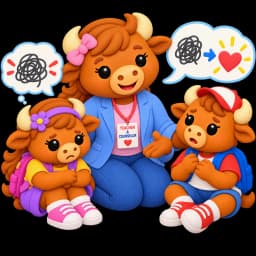
It usually comes out at an inconvenient time. A student is standing by the door after recess, or sitting alone at a table during centers, or crying over a worksheet that has nothing to do with friendship. Then they say it: “Nobody likes me.”
The instinct is to fix it fast. “That's not true! Everybody likes you!” It is a kind response, and it rarely helps. The student does not feel heard, and the teacher has not learned anything about what actually happened.
“Nobody likes me” can mean a lot of different things. It can be a bad afternoon talking. It can be a real pattern of exclusion. It can be bullying. Occasionally, it can be an early sign of something more serious.
This guide covers what the research says about peer rejection and loneliness in elementary school, what to say in the moment, how to find out what is really going on, and what teachers can do at the classroom level so fewer students end up feeling this way.
What the Research Says
Key Research Findings on Peer Rejection and Loneliness
Even one mutual friend protects against the escalating cycle of victimization
Loneliness Is Common in Elementary School
In a classic study of third through sixth graders, more than 10% of children reported feelings of loneliness and social dissatisfaction, and their self-reports lined up with how their peers rated them.[1] Children as young as kindergarten can understand loneliness and describe it. In other words, when a young student says “nobody likes me,” it is worth taking seriously.
Peer Rejection Is Linked to Later Difficulties
A major review of the research found that children with low peer acceptance were at higher risk for later problems, including dropping out of school.[2] A long-term study following children from ages 5 to 12 found that chronic peer rejection predicted later psychological difficulties, even after accounting for children's behavior.[3]
These studies are correlational. They do not prove that rejection causes later problems on its own, and many rejected children do fine. But the pattern is consistent enough that ongoing exclusion should not be dismissed as a phase.
One Friend Makes a Large Difference
Children do not need to be popular. Research on peer victimization found that having even one mutual friend helped protect children from the escalating cycle where being picked on leads to more withdrawal, which leads to more victimization.[4] For a student who feels like nobody likes them, the realistic goal is not universal popularity. It is one or two solid connections.
Teachers Shape Peer Relationships More Than They Might Think
Researchers have described teachers as an “invisible hand” in children's peer experiences.[5] Seating charts, grouping decisions, how a teacher responds to a student in front of peers, and which students get leadership roles all influence who is accepted and who is left out. A warm, supportive teacher-student relationship has been linked to better peer acceptance over time.[6]
How Children Interpret Social Situations Matters
Some children are more likely to read ambiguous situations as hostile or rejecting. If two classmates laugh nearby, one child assumes it is about them while another assumes it is about something else.[7] Children who are highly sensitive to rejection tend to expect it, look for it, and react more strongly when they think they see it.[8] This does not mean the student is wrong about being excluded. It means the teacher's job includes finding out both what happened and how the student is interpreting it.
What “Nobody Likes Me” Might Mean
Before responding beyond the first moment, it helps to know which situation you are dealing with.
A Single Hurtful Moment
Someone said no to a game, a friend sat with someone else at lunch, or the student was picked last. The feeling is real, but it reflects one event, not a pattern.
An Overgeneralization
The student had one or two bad interactions and has concluded that "nobody" likes them. Young children tend to think in all-or-nothing terms when upset.
A Real Pattern of Exclusion
The student is consistently left out of games, groups, or lunch tables. More likely if peers seem to avoid them regularly.
Bullying
Repeated, intentional unkindness: name-calling, targeted exclusion, rumors, or physical aggression. Requires your school's bullying policy.
Social Skill Gaps
The student wants friends but struggles with joining games, reading cues, sharing, or handling losing. Peers may pull away in response to specific behaviors.
A Transition
A new student, a friend who moved away, a change in class makeup, or a friendship group that shifted over the summer.
Something Bigger
Sometimes "nobody likes me" is part of a broader pattern of sadness, hopelessness, or withdrawal. See the section on when to bring in support below.
Most of the time, you will not know which of these it is in the moment. That is fine. Your first job is not to diagnose. It is to listen.
What to Say in the Moment
Start by Acknowledging the Feeling
The first goal is for the student to feel heard.
"That sounds really lonely. Can you tell me what happened?"
"It feels like nobody likes you right now. That's a hard feeling."
"I'm glad you told me. I want to understand."
Ask Open, Specific Questions
Gently move from the big statement to the specific situation:
"What happened today that made you feel that way?"
"Was there a time today when you felt left out?"
"Who were you hoping to play with?"
"Is this a today feeling or an every day feeling?"
That last question is especially useful. It helps you separate a single bad moment from an ongoing pattern, and it helps the student notice the difference too.
Responding: What Helps vs. What Backfires
Avoid Saying
"That's not true, everybody likes you!"
Student may hear that their experience is wrong.
"Just go play with someone else."
Assumes the student has a skill or option they may not have.
"Don't worry about them."
Dismisses something the student clearly is worried about.
"I'm sure they didn't mean it."
Can feel like taking the other children's side.
Try Instead
"Let's check in again after lunch."
"Would you like to help me pass out supplies with someone this afternoon?"
"Tomorrow at recess, let's figure out a game you could join."
The point is not to solve everything in one conversation. It is to show the student that an adult is paying attention and something will happen.
Finding Out What Is Really Going On
Observe for a Week
Watch the student at recess, lunch, transitions, and group work. Notice:
Who do they approach, and how do peers respond?
Are they alone by choice, or do they try to join and get turned away?
Are there specific behaviors that tend to end interactions (grabbing, bossing, changing the rules)?
Is there one classmate they seem to connect with, even a little?
Other adults see things you do not. Ask recess aides, specials teachers, and lunch staff what they notice.
Check for Bullying
Ask directly but gently: “Has anyone been saying or doing mean things to you on purpose?” If the answer suggests repeated, intentional targeting, follow your school's bullying protocol and involve your administrator or counselor. See our guide on what to do when students exclude others.
Talk With the Family
Families often know things teachers do not: a friendship that fell apart over the weekend, a sibling situation, a neighborhood conflict, or a long history of social struggles. Approach the conversation as partners. “Your child mentioned feeling left out at school. I wanted to let you know what I'm seeing and hear what you're noticing at home.”
Bring in the School Counselor When It Fits
Counselors can run friendship groups, do individual social skills work, and assess whether something more serious is going on. You do not need to wait for a crisis to make a referral.
Classroom-Level Strategies That Help
Individual support matters, but classroom structures often matter more. Many students who feel like nobody likes them are in classrooms where social connection is left entirely to chance.
The Teacher's “Invisible Hand” in Peer Relationships
How classroom structures affect who is included and who is left out
Based on research describing teachers as the “invisible hand” in children's peer experiences[5]
Structure Partner and Group Assignments
When students always choose their own partners, the same students get left out every time. Use a mix of teacher-assigned partners, random pairing (craft sticks, cards, number matching), and rotating groups. See our guide to teamwork activities for elementary students.
Give the Student a Visible, Positive Role
Class jobs that involve interacting with peers — handing out materials, being line leader, being the greeter — give the student a reason to connect and give peers a chance to see them positively.
Pair the Student Around a Shared Interest
If you notice that the student and another classmate both love dinosaurs, drawing, or a particular game, create a reason for them to work together. Shared interests are one of the most reliable foundations for early friendships.
Structure Recess
Teach and post games that anyone can join. Set up a buddy bench — but pair it with teaching students what to do when they see someone sitting there. Have an adult occasionally start a game that includes students who are often alone.
Teach the Whole Class How to Include
Students who exclude others are not always being cruel. Many simply have not thought about it. Explicit lessons on noticing who is left out, inviting someone to join, and what to say when a game is "full" benefit the whole class. See our guide to kindness activities.
Watch How You Respond Publicly
Because students take cues from teachers, avoid public correction that makes a student look like "the kid who's always in trouble." Redirect privately and look for real opportunities to acknowledge the student positively in front of peers.
Building the Student's Social Skills
When observation shows that specific skill gaps are contributing, teach those skills directly, privately or in a small group, with plenty of practice.
Joining a Game
Watch first, notice what the game is, then ask or offer to help. "Can I be on the red team?" works better than "Can I play?"
Handling "No"
Practice responses like "Okay, maybe next time," and having a backup plan — another group to ask or a game to start.
Taking Turns and Following Rules
Many friendships end over a game where one child keeps changing the rules. Role-play turn-taking and accepting losses.
Reading Cues
Practice noticing when someone looks bored, annoyed, or wants a turn.
Interpreting Ambiguous Moments
"They were laughing. Maybe it was about me. What else could it be about?"
Being a Friend
Asking questions, sharing, noticing when someone is sad, and following up the next day.
Interpreting ambiguous moments connects to perspective-taking work and problem solving skills.
Differentiating by Grade Band
How peer dynamics and teacher response shift across K-5
| Dimension | K-1 | Grades 2-3 | Grades 4-5 |
|---|---|---|---|
| Friendships | Fluid, based on proximity and shared play | Stabilizing, group awareness grows | Tighter groups, peer status matters more |
| Exclusion Type | Momentary, usually unintentional | More deliberate “you can't play” | Relational aggression, rumors, ignoring |
| Best Response | Name the feeling, quick next step | Today vs. every day question, class norms | Private conversations, involve in solutions |
| Key Tools | Joining scripts, structured play, stories | Alternative explanations, role-play | Clubs, interest groups, respect lessons |
Kindergarten and First Grade
Friendships at this age are fluid and often based on proximity. “Nobody likes me” frequently reflects one moment, such as a friend choosing a different game. Focus on naming the feeling, offering a quick concrete next step, and structuring play heavily.
Use characters and stories to talk about feeling left out. Our guide to SEL read-alouds can help.
Second and Third Grade
Friendships start to stabilize, and children become more aware of who is included. Ask the “today feeling or every day feeling” question. Watch for early group exclusion and address it as a class norm, not just an individual issue. Teach students how to respond to “you can't play” and begin teaching alternative explanations for ambiguous situations.
Fourth and Fifth Grade
Peer status becomes more noticeable and relational aggression becomes more common. Take indirect signals seriously: a journal entry, sitting alone repeatedly, reluctance to come to school. Have private conversations and address relational aggression directly. See our guide on teaching respect. Consider clubs, lunch groups, or interest-based activities.
When to Bring in More Support
Most students who say “nobody likes me” are having a hard moment or working through an ordinary friendship problem. Some need more help. Involve your school counselor, social worker, or psychologist if you notice:
Persistent sadness, crying, or withdrawal lasting more than a couple of weeks
Statements of hopelessness, such as "nothing will ever get better" or "everyone would be happier without me"
Any mention of hurting themselves or not wanting to be alive
Sudden changes in eating, sleeping, energy, or school performance
Reluctance or refusal to come to school
Signs of bullying or harassment
Any statement about self-harm or not wanting to live should be referred to your school's mental health staff the same day, following your district's protocol. Do not wait to see whether it passes. In the United States, the 988 Suicide and Crisis Lifeline (call or text 988) is available around the clock and can also advise adults who are concerned about a child.
What to Avoid
Dismissing the Feeling
"Everybody likes you" or "You have lots of friends" may feel reassuring, but it often makes students feel unheard and less likely to tell you next time.
Forcing Friendships
Telling a group that they have to play with someone can create resentment and make the student more of a target. Structure opportunities instead of mandating relationships.
Assuming the Student Is Entirely Right or Wrong
The student's account matters, and so does what you observe. Both can be partly true.
Publicly Calling Out Excluders
Announcing to the class that "some people are being left out" can single out the student who told you. Address norms through general lessons and handle specific incidents privately.
Relying on a Buddy Bench Alone
Without teaching students what to do when someone sits there, a buddy bench can become a public signal that a child has nobody to play with.
Waiting for It to Resolve on Its Own
Some friendship problems do fade. Ongoing exclusion usually does not, and the research suggests it matters.
Treating SEL as a Reaction Only
If friendship and inclusion lessons only happen after something goes wrong, students learn to associate them with problems. Teach these skills proactively throughout the year.
Measuring Progress
Track a few simple indicators over several weeks
Belonging Indicators Over Time
Illustrative targets — one mutual friendship is the single most protective factor[4]
Recess & Lunch
Is the student with peers more often? Are interactions lasting longer?
At Least One Connection
Has the student formed at least one relationship that seems mutual?
Student Self-Report
"How has recess been this week?" Look for change over time.
Peer Responses
Are classmates more likely to include the student in groups?
Skill Use
Is the student using joining scripts, handling "no" more calmly?
Classroom-Wide Patterns
Simple private surveys can reveal students who are consistently not mentioned.
Final Thoughts
When a student says “nobody likes me,” they are usually telling you something true about how they feel, even if it is not literally true about every classmate. The best response is not to argue with the feeling or fix everything in one conversation. It is to listen, find out what is actually happening, and change the conditions that leave some students on the outside.
Research consistently links peer acceptance and friendship to how children do over time, and teachers have more influence over peer relationships than they often realize.[2][3][5] Structured grouping, visible roles, recess support, explicit skill teaching, and classroom-wide lessons on inclusion are all within a teacher's reach. Social-emotional learning programs more broadly have been shown to improve social skills, behavior, and academic outcomes.[9][10]
The goal is not that every student is liked by everyone. It is that every student has somewhere to belong.
References
- [1]
Asher, S. R., Hymel, S., & Renshaw, P. D. (1984). Loneliness in children. Child Development, 55(4), 1456-1464.
https://doi.org/10.2307/1130015 - [2]
Parker, J. G., & Asher, S. R. (1987). Peer relations and later personal adjustment: Are low-accepted children at risk? Psychological Bulletin, 102(3), 357-389.
https://doi.org/10.1037/0033-2909.102.3.357 - [3]
Ladd, G. W. (2006). Peer rejection, aggressive or withdrawn behavior, and psychological maladjustment from ages 5 to 12: An examination of four predictive models. Child Development, 77(4), 822-846.
https://doi.org/10.1111/j.1467-8624.2006.00905.x - [4]
Hodges, E. V. E., Boivin, M., Vitaro, F., & Bukowski, W. M. (1999). The power of friendship: Protection against an escalating cycle of peer victimization. Developmental Psychology, 35(1), 94-101.
https://doi.org/10.1037/0012-1649.35.1.94 - [5]
Farmer, T. W., Lines, M. M., & Hamm, J. V. (2011). Revealing the invisible hand: The role of teachers in children's peer experiences. Journal of Applied Developmental Psychology, 32(5), 247-256.
https://doi.org/10.1016/j.appdev.2011.04.006 - [6]
Hughes, J. N., Cavell, T. A., & Willson, V. (2001). Further support for the developmental significance of the quality of the teacher-student relationship. Journal of School Psychology, 39(4), 289-301.
https://doi.org/10.1016/S0022-4405(01)00074-7 - [7]
Crick, N. R., & Dodge, K. A. (1994). A review and reformulation of social information-processing mechanisms in children's social adjustment. Psychological Bulletin, 115(1), 74-101.
https://doi.org/10.1037/0033-2909.115.1.74 - [8]
Downey, G., Lebolt, A., Rincón, C., & Freitas, A. L. (1998). Rejection sensitivity and children's interpersonal difficulties. Child Development, 69(4), 1074-1091.
https://doi.org/10.1111/j.1467-8624.1998.tb06161.x - [9]
Durlak, J. A., Weissberg, R. P., Dymnicki, A. B., Taylor, R. D., & Schellinger, K. B. (2011). The impact of enhancing students' social and emotional learning: A meta-analysis of school-based universal interventions. Child Development, 82(1), 405-432.
https://doi.org/10.1111/j.1467-8624.2010.01564.x - [10]
Cipriano, C., Strambler, M. J., Naples, L. H., et al. (2023). The state of evidence for social and emotional learning: A contemporary meta-analysis of universal school-based SEL interventions. Child Development, 94(5), 1181-1204.
https://doi.org/10.1111/cdev.13968
Build Belonging Every Week
Be The Buffalo teaches friendship, inclusion, empathy, and perspective-taking through interactive projector activities, scenario-based class discussions like Friendship Challenges and Two Sides of the River, character-driven stories, original songs, and printable worksheets as part of a 40-week CASEL-aligned scope and sequence. Bilingual. No student devices. No prep.
Sign Up FreeRelated Resources
Conflict Resolution Activities for Elementary Students
How to help students work through the peer disputes that often sit underneath feeling left out
Empathy Lessons for Elementary Students
Activities that teach students to notice when a classmate is on the outside and do something about it
Kindness Activities for Elementary Students
Classroom-wide practices that make inclusion a normal part of the day