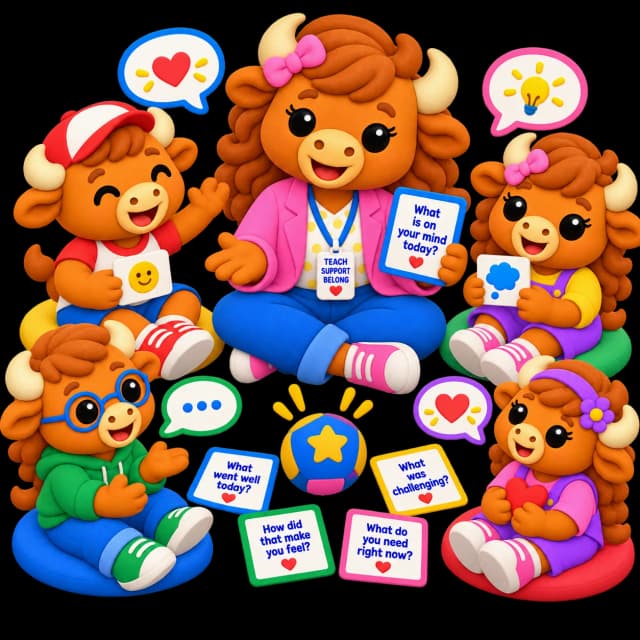
Restorative circles bring a class together, usually seated in a circle with a talking piece, to build relationships, solve problems, or repair harm. In elementary classrooms, most circles are not about conflict at all. They are about getting to know each other, checking in, and building the kind of trust that makes it easier to talk when something does go wrong.
The questions you ask shape what happens in the circle. This guide covers what the research says about restorative practices, more than 100 restorative circle questions organized by circle type and grade band, how to run a circle, and when a circle is not the right tool.
What Are Restorative Circles?
Restorative circles come from the broader approach of restorative practices, which focuses on building relationships and repairing harm rather than relying only on punishment. Organizations such as the International Institute for Restorative Practices (IIRP) have developed widely used frameworks for schools.[1]
Most school circle approaches describe a continuum:
Proactive circles build community and relationships before problems happen. Most classroom circles are this type.
Responsive circles address a classroom problem or a specific incident after it happens.
A typical circle includes:
A circle shape so everyone can see each other
A talking piece that is passed around; only the person holding it speaks
Agreements about how the group will listen and respond
An opening and a closing, often a short reading, breath, or round of words
Rounds of questions where each person has the chance to answer or pass
What the Research Says
The evidence on restorative practices is promising in some areas and mixed in others.
A randomized study in Pittsburgh found that schools implementing restorative practices saw improvements in teacher-rated school climate and larger reductions in suspensions, including narrower suspension gaps for African American students and students from low-income families. It also found no improvement in academic outcomes.[2]
A two-year randomized trial in Maine middle schools found few differences overall, but students who reported more experience with restorative practices tended to report better outcomes, suggesting that how fully practices are implemented matters.[3]
Elementary-specific evidence is limited. Most rigorous studies involve middle and high schools.
How to Run a Restorative Circle
Before the circle
Arrange chairs or floor spots in a circle with no desks in between.
Choose a talking piece that is easy to hold and pass: a soft toy, a stone, or a classroom object.
Set or review circle agreements: speak from the heart, listen with respect, it’s okay to pass, what’s said in circle stays in circle (with the limit that safety concerns will be shared with adults).
During the circle
Opening: A short breath, a quote, or a simple “Welcome to circle.”
Check-in round: One quick question everyone can answer.
Main round(s): One or two deeper questions related to the circle’s purpose.
Closing round: One word or one sentence to end the circle.
Facilitator tips
Answer first to model the kind of answer you are looking for.
Keep it moving. Most elementary circles should last 10 to 20 minutes.
Allow passes and come back to students who passed at the end of the round.
Don’t fix or correct answers. The circle is for listening.
Follow up privately on anything that suggests a student needs support.
Check-In Questions (Any Circle)
What is one word for how you feel today?
On a scale of 1 to 5, how is your energy right now?
What color matches your mood today?
What is one thing you are looking forward to?
If your feelings were weather, what would they be today?
What is something that made you smile recently?
What do you need from this group today?
What is one thing on your mind right now that you’d like to share?
Community-Building Circle Questions
Kindergarten and First Grade
What is your favorite animal and why?
What is your favorite thing to play?
What makes you laugh?
Who is someone who helps you?
What is something you are good at?
What is your favorite food?
What makes a good friend?
What makes you feel happy at school?
Second and Third Grade
What is something most people in our class don’t know about you?
If you could have any superpower, what would it be and how would you use it?
What is a place where you feel safe and calm?
What is something you are proud of?
Who is someone you look up to, and why?
What is one thing that makes our class a good place to be?
What is something kind someone did for you this week?
What is a skill you are working on?
Fourth and Fifth Grade
What is something you care about a lot?
What is a time you felt really included?
What is something you wish adults understood about kids your age?
What is a challenge you have overcome?
What does respect look like to you?
Who has made a difference in your life, and how?
What is one thing you want to be remembered for?
What makes it hard to be yourself sometimes?
For more get-to-know-you questions, see Morning Meeting activities.
SEL-Focused Circle Questions
Use these to connect circles to the SEL skill you are teaching that week. See understanding the CASEL framework.
Self-Awareness
What is a feeling you had this week, and what caused it?
What is one of your strengths?
What is something you are still learning?
How can you tell when you are getting upset?
Self-Management
What helps you calm down when you are upset?
What is something hard you kept trying to do?
What do you do when you have to wait for something?
What is a goal you have right now?
Social Awareness
How can you tell when someone else is having a hard day?
What is something you learned from someone different from you?
How do you think a new student feels on their first day?
Who helps our school that people might not notice?
Relationship Skills
What does a good listener do?
What can you say to include someone who is left out?
How do you fix things with a friend after a disagreement?
What is one way you can show someone you care?
Responsible Decision-Making
What is a good choice you made recently?
What would you do if you saw someone being unkind?
How do you decide what’s right when your friends want to do something you don’t?
What is one way you can help our classroom?
Problem-Solving Circle Questions
Use these when a classroom-wide issue comes up, such as recess conflicts, noise during work time, or students being left out. Keep the focus on the problem, not on individual students.
What have you noticed about [the problem]?
How has this affected you?
How do you think it affects others in our class?
Why do you think this keeps happening?
What is one thing you could do differently?
What could we do together to make it better?
What would make our classroom feel safer or fairer?
What agreement can we make as a class?
How will we know if our plan is working?
What support do you need to keep this agreement?
Responsive and Repair Circle Questions
Responsive circles address a specific incident where someone was harmed. They require care, preparation, and often a trained facilitator.[1]
For the student who caused harm
What happened?
What were you thinking or feeling at the time?
What have you thought about since?
Who was affected by what happened?
How were they affected?
What do you need to do to make things right?
For the student who was harmed
What happened from your point of view?
How did you feel when it happened?
How do you feel now?
What has been the hardest part for you?
What do you need to feel better or to make things right?
For classmates who were affected
How did what happened affect you?
How did it affect our class?
What would help our class move forward?
Closing a repair circle
What is one thing you will do differently next time?
What did you learn from this circle?
How can we support each other going forward?
See our guides on what to do when a student refuses to apologize and conflict resolution activities.
Reflection and Gratitude Circle Questions
What is one thing you learned this week?
Who is someone you want to thank, and why?
What is something that was hard this week, and how did you handle it?
What is one thing you did that you are proud of?
What is something you want to do better next week?
What made our class strong this week?
What is one kind thing you saw someone do?
How have you grown since the start of the year?
Fun and Lighthearted Circle Questions
Not every circle needs to go deep. Light questions build comfort and make it easier to share when circles get more serious.
Would you rather be able to fly or be invisible?
If you could be any animal for a day, what would you be?
What is the funniest thing that ever happened to you?
If you could invent a new holiday, what would it celebrate?
What would you do with a day off from school?
If you could have dinner with any book character, who would it be?
What is your favorite season and why?
If you could design a new recess game, how would it work?
Closing Questions
Say one word that describes how you feel now.
What is one thing you will take with you from this circle?
Share one hope for tomorrow.
Give a thumbs up, sideways, or down for how today’s circle went.
What is one thing someone said today that you appreciated?
What is one thing you are looking forward to?
Questions by Circle Type
When Not to Use a Restorative Circle
Circles are useful, but they are not the right tool for every situation.
Serious harm or safety concerns
Incidents involving physical injury, threats, weapons, or abuse require following school safety and reporting procedures first.
Bullying with a power imbalance
Bringing a targeted student face to face with a student who has repeatedly bullied them can be harmful if the targeted student is not fully willing and supported.
When participation isn’t voluntary for the person harmed
A student who was hurt should never be pressured into a repair circle.
When the facilitator isn’t prepared
Responsive circles for serious incidents should be led by someone with training, such as a counselor or trained staff member.
When emotions are still too high
Students need time to calm down before they can participate productively.
See our guide on how to handle mean comments.
Differentiating by Grade Band
• Keep circles to 10 minutes or less
• Use simple, concrete questions with picture supports
• Use a soft talking piece and practice passing it
• Focus mostly on community-building and check-ins
• Introduce problem-solving circles for classroom issues
• Teach and practice circle agreements explicitly
• Let students help choose questions
• Use deeper questions about values, fairness, and relationships
• Let students co-facilitate or lead circles
• Use repair circles for appropriate classroom conflicts, with careful preparation
What to Avoid
Using circles only after problems
If circles only happen when something goes wrong, students will associate them with trouble. Hold proactive circles regularly.
Forcing students to share
Always allow passes.
Public shaming disguised as a circle
A circle that singles out one student in front of the class is not restorative.
Promising complete confidentiality
Be clear that safety concerns will be shared with appropriate adults.
Skipping preparation for repair circles
Talk with each participant beforehand to make sure they are willing and ready.
Expecting circles to replace consequences entirely
Many schools use restorative practices alongside other discipline systems.
Measuring Whether Circles Are Working
Participation: Are more students sharing over time?
Relationships: Do students know more about each other and refer to things shared in circle?
Classroom climate: Do short surveys show students feel safer and more connected?
Conflicts: Are classroom conflicts resolved more often without adult intervention?
Follow-through: After problem-solving circles, do students keep the agreements they made?
Final Thoughts
Restorative circles work best as a regular part of classroom life, not only as a response to conflict. Most of their value comes from the everyday circles where students get to know each other, practice listening, and learn that their voices matter. Research suggests their benefits depend heavily on consistent, well-supported implementation, and that they are not a fit for every situation.[2][3]
Start with a check-in circle once a week. Build trust first. Then, when something goes wrong, the circle will already be there.
References
International Institute for Restorative Practices. (n.d.). What is restorative practices? https://www.iirp.edu/restorative-practices/what-is-restorative-practices
Augustine, C. H., Engberg, J., Grimm, G. E., Lee, E., Wang, E. L., Christianson, K., & Joseph, A. A. (2018). Can restorative practices improve school climate and curb suspensions? An evaluation of the impact of restorative practices in a mid-sized urban school district. RAND Corporation. https://www.rand.org/pubs/research_reports/RR2840.html
Acosta, J., Chinman, M., Ebener, P., Malone, P. S., Phillips, A., & Wilks, A. (2019). Evaluation of a whole-school change intervention: Findings from a two-year cluster-randomized trial of the restorative practices intervention. Journal of Youth and Adolescence, 48(5), 876-890. https://doi.org/10.1007/s10964-019-01013-2
Durlak, J. A., Weissberg, R. P., Dymnicki, A. B., Taylor, R. D., & Schellinger, K. B. (2011). The impact of enhancing students’ social and emotional learning: A meta-analysis of school-based universal interventions. Child Development, 82(1), 405-432. https://doi.org/10.1111/j.1467-8624.2010.01564.x
Cipriano, C., Strambler, M. J., Naples, L. H., et al. (2023). The state of evidence for social and emotional learning: A contemporary meta-analysis of universal school-based SEL interventions. Child Development, 94(5), 1181-1204. https://doi.org/10.1111/cdev.13968
Build the Skills That Make Circles Work
Circles work better when students already have words for their feelings, ways to calm down, and practice seeing other perspectives. Be The Buffalo teaches those skills through a 40-week CASEL-aligned K–5 curriculum with projector activities, discussion prompts, original songs, stories, and printables. Bilingual. No student devices. No prep. The first four weeks are free.
Sign Up Free