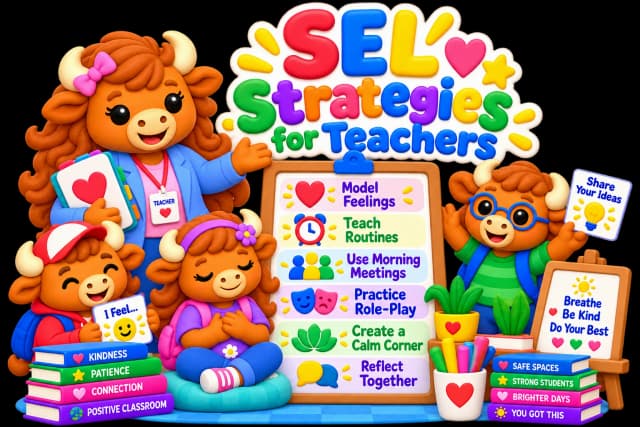
Most teachers do not need another thing to add to the day. What they need is a way to build social-emotional skills into the day they already have: how class starts and ends, how students work together, how conflicts get handled, and how the teacher responds when a student is struggling.
That is the difference between SEL activities and SEL strategies. Activities are things you do. Strategies are ways of teaching. A single SEL lesson a week matters, but the strategies a teacher uses every day often matter just as much.
This guide covers what the research says about SEL strategies, 15 practical strategies for K–5 classrooms, how they look at different grade levels, and how to tell whether they are working.
What the Research Says
Explicit SEL programs work
A meta-analysis of 213 school-based SEL programs found gains in social-emotional skills, behavior, and academic achievement, including an average 11-percentile-point gain in achievement.[1] A more recent meta-analysis of 424 studies confirmed benefits.[2]
Effective programs share four features (SAFE)
Programs tend to be more effective when they are Sequenced, Active, Focused on skill development, and Explicit about which skills they target.[1]
Strategies matter alongside programs
Researchers have argued that SEL should not depend only on packaged programs, and that schools also need everyday strategies and routines that reinforce skills throughout the day.[3]
15 Strategies by Category
Strategy Distribution
Follow a Sequence
InstructionWhat it looks like: A scope and sequence that moves through skills in a logical order across the year, rather than a different random topic each week.
Start the Day With Connection
RoutineWhat it looks like: A short Morning Meeting with a greeting, a sharing question, and a quick group activity. CASEL describes this kind of welcoming opening as one of its three signature practices.[6]
End With Reflection
RoutineWhat it looks like: A two-minute closing circle or exit ticket: “What is one thing you are proud of today?” or “What is one thing you will try tomorrow?”[6]
Closing routines give students a chance to reflect on what they practiced, and end the day on a positive note—CASEL’s “optimistic closure.”[6]
Build a Shared Feelings Vocabulary
ClimateWhat it looks like: Feeling words posted in the room, daily check-ins, and teacher language that names emotions: “You look frustrated. That makes sense. This problem is tricky.”
Model the Skills Out Loud
ClimateWhat it looks like: Think-alouds during real moments: “I’m feeling frustrated that the projector isn’t working. I’m going to take a deep breath and try something else.”
Co-Regulate Before You Correct
ClimateWhat it looks like: A calm voice, few words, staying nearby, and offering a calming strategy before addressing the behavior. The conversation about what happened comes later.
Integrate SEL Into Academic Lessons
IntegrationWhat it looks like: SEL skills fit naturally inside reading, writing, math, science, and social studies.
Use Cooperative Learning Structures
IntegrationWhat it looks like: Clear roles (recorder, materials manager, timekeeper, encourager), think-pair-share, and explicit expectations for how to listen and disagree respectfully.
Create Classroom Agreements Together
ClimateWhat it looks like: At the start of the year, the class discusses how they want to treat each other and writes three to five agreements in positive language. Revisit them regularly.
Post and Practice a Problem-Solving Routine
ClimateWhat it looks like: A simple sequence posted in the room: stop and calm down, talk and listen, think of solutions, choose one, and try it. Practice it with role-plays before students need it for real.
Praise Effort and Strategy, Not Just Results
ClimateWhat it looks like: “You kept trying different strategies on that problem,” instead of “You’re so smart.” Praising process supports persistence after mistakes.[7]
Give Students Voice and Choice
ClimateWhat it looks like: Choices in how to show learning, input on classroom procedures, student leadership roles, and class meetings to solve classroom problems together.
Connect With Families
IntegrationWhat it looks like: Share the week’s SEL skill, a feeling word, or a calming strategy in newsletters or take-home pages, in families’ home languages when possible.
Take Care of Your Own Social-Emotional Health
ClimateWhat it looks like: Simple routines for your own regulation: a deep breath before responding, a short break between demanding periods, and support from colleagues.[4]
Research on teacher social-emotional competence suggests this shapes the classroom climate students experience.[4]
How These Strategies Look Across Grade Bands
- •Very short explicit lessons with songs, puppets, and characters
- •Lots of teacher modeling and co-regulation
- •Simple feeling words and one or two calming strategies
- •Picture-based routines and visual problem-solving steps
- •Partner work with clear roles
- •Problem-solving routines practiced through role-play
- •Growing feeling vocabulary and simple self-reflection
- •Students begin co-creating classroom agreements
- •More student voice, leadership, and class meetings
- •SEL integrated into writing, literature discussions, and projects
- •Perspective-taking and more complex decision-making
- •Private, respectful conversations about behavior
What to Avoid
Treating SEL as a once-a-week add-on only
A weekly lesson matters, but skills grow through daily practice.
Teaching skills you do not model
Students notice when adults do not follow the strategies they teach.
Using SEL language as discipline
“Use your calming strategy!” shouted at an upset student rarely helps. Co-regulate first.
Public shaming
Behavior charts and public correction undermine the emotional safety SEL depends on.
Ignoring the teacher’s own well-being
Strategies are harder to use consistently when teachers are depleted.
Trying everything at once
Pick two or three strategies, use them consistently, and add more over time.
Measuring Whether SEL Strategies Are Working
Classroom climate
Do transitions run more smoothly? Is the room calmer?
Student language
Are students using feeling words and problem-solving steps on their own?
Conflict resolution
Are students resolving more small conflicts without adult help?
Participation
Are more students sharing, collaborating, and taking risks?
Relationships
Do students seem more comfortable coming to you with problems?
Teacher experience
Do you feel more effective and less depleted?
Simple tools work: a few notes each week, a short student survey a few times a year, and a count of office referrals or conflicts.
Final Thoughts
SEL strategies are not extra lessons. They are ways of running a classroom that give students daily practice with the skills they learn in SEL lessons. Explicit, sequenced instruction builds skills.[1] Routines, modeling, co-regulation, and academic integration give students reasons and chances to use them.[3]
Start with two strategies. Use them every day. Add more once they become habits.
Sources
- Durlak, J. A., et al. (2011). The impact of enhancing students’ social and emotional learning. Child Development, 82(1), 405–432. DOI
- Cipriano, C., et al. (2023). SEL meta-analysis. Child Development, 94(5), 1181–1204. DOI
- Jones, S. M., & Bouffard, S. M. (2012). Social and emotional learning in schools: From programs to strategies. Social Policy Report, 26(4), 1–33. PDF
- Jennings, P. A., & Greenberg, M. T. (2009). The prosocial classroom. Review of Educational Research, 79(1), 491–525. DOI
- Hamre, B. K., & Pianta, R. C. (2001). Early teacher-child relationships. Child Development, 72(2), 625–638. DOI
- CASEL. (2020). The SEL 3 signature practices. PDF
- Mueller, C. M., & Dweck, C. S. (1998). Praise for intelligence can undermine children’s motivation. Journal of Personality and Social Psychology, 75(1), 33–52. DOI
Put SEL Strategies Into Practice Every Week
Be The Buffalo gives you a sequenced, 40-week CASEL-aligned K–5 curriculum with explicit weekly lessons, projector activities, original songs, stories, discussion prompts, and printables, so the strategies in this guide have something to build on. Bilingual. No student devices. No prep. The first four weeks are free.
Sign Up Free