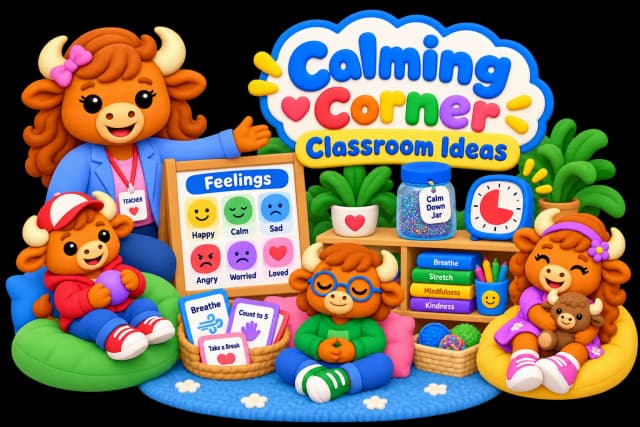
A calming corner is one of the simplest tools an elementary teacher can add to a classroom: a small, quiet space where a student can go for a few minutes to reset when feelings get big. It might be called a calm down corner, a peace corner, a cozy corner, or a reset space. The name matters less than how it is set up and taught.
Done well, a calming corner helps students practice the self-regulation skills they need for the rest of their lives. Done poorly, it becomes a hiding spot, a timeout area with pillows, or a place that gets so popular nobody can use it when they actually need it.
This guide covers what a calming corner is and is not, what the research does and does not say, how to set one up on a small budget, how to teach students to use it, and how to troubleshoot the problems that usually come up.
What a Calming Corner Is (and Isn’t)
✅ A calming corner IS
- •A small, defined space where a student can go briefly to calm their body and mind
- •A place to practice specific calming strategies that have been taught ahead of time
- •Available to students before a situation escalates, ideally by their own choice
- •A short stop, followed by a return to learning
❌ A calming corner is NOT
- •A punishment or timeout
- •A place to avoid work indefinitely
- •A reward or free-play area
- •A substitute for adult support when a student is in crisis
Key distinction: A timeout removes a student as a consequence for behavior. A calming corner offers a student a tool to manage a feeling. If students experience the calming corner as a place they get sent when they are in trouble, it stops working as a calming space.
What the Research Says
Calming corners are widely used, but there is little direct research on them as a standalone tool. The evidence comes from related areas, and it is worth being clear about what is well supported and what is not.
Research Evidence by Area
Bar length reflects relative strength of evidence, not a precise metric
Well supported
- Self-regulation skills can be taught. Reviews of interventions for children ages 4 to 12 find that skills like inhibitory control and emotional regulation can be strengthened through practice.[1]
- SEL programs that teach self-management work. Meta-analyses of school-based SEL programs show gains in social-emotional skills, behavior, and academic achievement.[2][3]
- Self-calming routines can be taught to young children. The PATHS curriculum, which includes a simple self-calming routine, improved children’s emotional understanding in a randomized trial.[4]
- Children learn regulation through co-regulation. Developmental research describes how children build self-regulation through warm, responsive support from adults.[5]
Less certain
- Calming corners specifically. We could not find rigorous studies testing calming corners on their own. Their value likely depends on whether they are paired with explicitly taught calming strategies and adult support.
- Sensory tools. Some popular items, such as weighted vests, have weak research support. A review found little evidence that they improve behavior or attention.[6]
- Breathing exercises. Slow breathing has research support for reducing physiological stress, but much of that research involves adults.[7] For children, breathing is best taught as a skill and practiced regularly.
Practical takeaway: A calming corner is a place to practice self-regulation skills. The skills are what the research supports. The corner is the setting.
Where to Put Your Calming Corner
Visible but not on display
The student should be somewhat private, but you should be able to see them at all times for safety.
Away from high-traffic areas
Avoid spots near the door, the pencil sharpener, or the line-up area.
Away from main instruction
But close enough that the student can still hear and rejoin easily.
Defined by boundaries
A rug, a small bookshelf, a beanbag, or tape on the floor helps students know where the space begins and ends.
You do not need a lot of space. A single chair or floor cushion with a bin of tools can work.
What to Put in a Calming Corner
Keep it simple. Too many items turn the space into a play area. Start with a few things from each category.
Recommended Supply Breakdown (12 items)
🪑 Seating
A beanbag, floor cushion, soft rug, or small chair.
👁️ Visual Supports
- Feelings chart: Faces with feeling words so students can identify how they feel.
- Calming strategy cards: Picture cards showing taught strategies, such as breathing, counting, or squeezing.
- Steps poster: A simple visual sequence, such as “1. Name my feeling. 2. Choose a strategy. 3. Check how I feel. 4. Go back to my spot.”
- Bilingual labels: If you teach in a bilingual classroom, label feelings and strategies in English and Spanish.
🫧 Calming Tools
- Breathing tools: A pinwheel, a breathing card (trace a star or square while breathing), or a feather to blow.
- Hand tools: A stress ball, a small fidget, or modeling clay.
- Timer: A sand timer or visual timer for 3 to 5 minutes.
- Quiet activity: A coloring sheet, a calm picture book, or a “glitter jar” to watch settle.
- Noise-reducing headphones: For students who are overwhelmed by sound.
📝 Reflection Tools
- Check-out sheet: For older students, a short form: “How did I feel? What did I try? How do I feel now? What do I need?”
- Feelings thermometer: A 1 to 5 scale to rate intensity before and after.
🚫 What to Leave Out
- Toys, games, and electronics that make the corner more fun than the rest of the classroom
- Too many items to choose from
- Anything that could be unsafe if thrown
Budget tip: Most of these can be made for free or nearly free: printed cards and charts, a cushion from home, a jar with water and glitter, a coloring sheet. For printable feelings and strategy cards, see our list of free SEL activities for elementary classrooms.
How to Teach Students to Use the Calming Corner
This is the step most often skipped, and it is the one that determines whether the corner works.
1. Introduce it when everyone is calm
Never introduce the calming corner during a meltdown. Introduce it during a calm moment, as a class, like any other classroom routine.
2. Explain the purpose
“Everyone has big feelings sometimes. When our feelings get really big, it can be hard to learn. This is a place where you can go to help your body and brain calm down, so you can come back and keep learning.”
3. Teach each tool and strategy
Model each item. Show how to use the breathing card, how to squeeze the stress ball, how to use the timer. Practice breathing strategies as a whole class many times. For ideas, see our guide to self-regulation activities.
4. Teach the Routine
Signal
Use a quiet signal to tell the teacher you need the calming corner.
Go
Walk calmly to the corner.
Set the timer
Usually 3 to 5 minutes.
Name the feeling
Use the feelings chart.
Choose a strategy
Pick one from the strategy cards.
Check in
When the timer ends, ask yourself: Am I ready?
Return
Go back to your spot and rejoin the class.
5. Practice the routine
Have students role-play using the corner. Every student should practice going, using a tool, and returning before the corner is available for real use.
6. Set clear expectations
- • One student at a time (or two, if your space allows)
- • The corner is for calming, not playing
- • Use the timer
- • Return when the timer ends or check in with the teacher
- • Respect the person in the corner: no talking to them or watching them
7. Revisit often
Review the routine after long breaks, after holidays, and any time it starts to drift. Morning Meeting is a good time for quick reviews. See our guide to Morning Meeting activities.
Helping Students Use It Before Things Escalate
The calming corner is most useful early, before a student is at the peak of a big feeling.
Teach body clues
Students learn to notice a hot face, tight fists, or a fast heartbeat as signals that they might need a break. See our guide to emotional regulation for K–5 students.
Offer, don’t send
“It looks like your body is getting tense. Would the calming corner help?” is very different from “Go to the calm down corner.”
Praise the choice
“You noticed you were frustrated and took a break. That’s a great self-control skill.”
When a student is already at the peak of an outburst, they may not be able to use the corner on their own. That is when adult co-regulation matters most: a calm voice, few words, and staying nearby. See how to help a student who gets angry easily.
Differentiating by Grade Band
| K–1 | 2–3 | 4–5 | |
|---|---|---|---|
| Timer | 2–3 min | 3–5 min | 3–5 min |
| Strategy choices | 1–2 | 3–4 | 4–6+ |
| Visual style | Mostly pictures | Pictures + words | Words / mature design |
| Reflection | None / verbal | Simple written | Written sheet |
| Adult role | Co-regulate often | Prompt & check in | Student-led |
Kindergarten and First Grade
Use mostly pictures and few words on visual supports. Keep strategies to one or two well-practiced options. Expect to co-regulate—young children often need an adult to breathe with them before they can do it alone. Use songs and characters to teach calming strategies. See our kindergarten SEL curriculum guide.
Second and Third Grade
Add more feeling words and a feelings thermometer. Offer a few more strategy choices. Introduce a simple reflection: “What did I feel? What did I try?” Encourage students to signal before things escalate.
Fourth and Fifth Grade
Older students may feel embarrassed by a space that looks “babyish.” Use a more grown-up name, such as “reset station” or “focus spot,” and simpler, more mature design. Use written reflection sheets. Give students more ownership. Some older students prefer a portable option. See SEL curriculum for upper elementary.
Supporting Students With Additional Needs
Some students benefit from individualized calming plans, especially students with disabilities, sensory differences, anxiety, or trauma histories.
- •Work with the school counselor, special education teacher, occupational therapist, and family to identify what helps.
- •Individual students may need specific tools, a different location, or a longer time.
- •Follow any calming or break strategies written into a student’s IEP or 504 plan.
- •Recognize that some students are better served by movement (a walk, a job) than by a quiet corner.
See our guides to SEL curriculum for special education and SEL for neurodivergent students.
Troubleshooting Common Problems
“Students use it to get out of work.”
Track how often and when each student uses it. If a student consistently goes during one subject, that may signal a skill gap or frustration with that work. Address the underlying issue. Keep the timer firm, and have the student return to the same task.
“Everyone wants to go at once.”
Limit it to one or two students at a time. Teach a waiting plan, such as using a breathing card at your desk until the corner is free. The novelty usually fades after the first few weeks.
“A student never wants to leave.”
Use the timer consistently. Offer a check-in: "Are you ready, or do you need two more minutes?" If a student regularly needs much longer, involve the counselor.
“A student refuses to go.”
Never force it. A calming corner works only if students see it as a tool, not a consequence. Offer other options, such as a drink of water or a walk with a buddy.
“Students play in the corner.”
Remove items that encourage play, reteach expectations, and practice the routine again.
“Other students tease the student in the corner.”
Teach the whole class that everyone has big feelings and that using the corner is a strong choice. Address teasing directly.
“It isn't helping one particular student.”
Some students need more support than a calming corner can give. Involve the student support team.
What to Avoid
Using it as punishment
Sending students to the calming corner as a consequence turns it into a timeout and undermines its purpose.
Skipping the teaching
A calming corner without taught strategies is just a quiet spot.
Overloading it with stuff
Too many items turn it into a play area and make choices harder.
Making it more fun than class
If the corner is the most exciting place in the room, students will find reasons to go there.
Leaving students unsupervised
Always keep the corner within your line of sight.
Treating sensory items as cures
Tools may help some students feel comfortable, but the research on many sensory items is limited.
Measuring Whether It’s Working
Keep it simple. Over several weeks, look at:
Usage frequency & patterns
How often, by whom, and when. Patterns reveal triggers.
Visit duration over time
Are visits getting shorter as students build skills?
Self-initiated use
Are more students choosing the corner before escalation?
Return to learning
Do students rejoin and get back to work afterward?
Outburst frequency
Are big outbursts becoming less frequent or shorter?
Student reflection quality
Can students name what they felt and what strategy they used?
A simple log on a clipboard (name, time, minutes, strategy used) is enough to spot patterns.
Final Thoughts
A calming corner is not magic, and it is not a timeout. It is a place to practice the self-regulation skills that research shows can be taught. The most important ingredients are not the beanbag or the glitter jar. They are the strategies students learn ahead of time, the routine they practice, and the adult who helps them use it.
Teach the skills first. The corner is just where students go to use them.
Sources
- Diamond, A., & Lee, K. (2011). Interventions shown to aid executive function development in children 4 to 12 years old. Science, 333(6045), 959–964. DOI
- Durlak, J. A., et al. (2011). The impact of enhancing students’ social and emotional learning. Child Development, 82(1), 405–432. DOI
- Cipriano, C., et al. (2023). SEL meta-analysis. Child Development, 94(5), 1181–1204. DOI
- Greenberg, M. T., et al. (1995). Promoting emotional competence: The effects of the PATHS curriculum. Development and Psychopathology, 7(1), 117–136. DOI
- Murray, D. W., et al. (2015). Self-regulation and toxic stress (OPRE Report #2015-21). U.S. DHHS. Link
- Stephenson, J., & Carter, M. (2009). Weighted vests with children with ASD. Journal of Autism and Developmental Disorders, 39(1), 105–114. PubMed
- Zaccaro, A., et al. (2018). How breath-control can change your life. Frontiers in Human Neuroscience, 12, 353. DOI
Teach the Calming Skills Behind the Corner
Be The Buffalo teaches feeling words, body clues, breathing and calming strategies, and self-control through projector activities, original songs, stories, and printables, as part of a 40-week CASEL-aligned K–5 curriculum. Bilingual. No student devices. No prep. The first four weeks are free.
Sign Up FreeRelated Resources
Emotional Regulation for Elementary Students
The skills students practice in a calming corner, taught step by step.
Self-Regulation Activities for Elementary Classrooms
Games and routines that build calm and focus.
Teaching Self-Control in Elementary Classrooms
How to build impulse control across the school day.