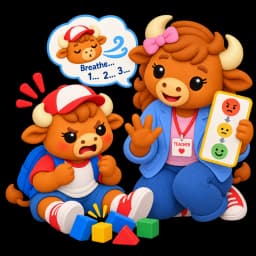
Every elementary teacher has had this student. One minute they are fine. The next, a pencil snaps, a chair tips, or a classmate is getting yelled at over a lost turn in a game. The trigger often looks small from the outside. The reaction does not.
Students who get angry easily take up a lot of a teacher's energy, and they are often the students who get the least patience in return. They are sent out of the room, lose recess, and get a reputation among peers as the kid who “always freaks out.” None of that teaches them what to do differently next time.
Anger itself is not the problem. It is a normal, useful emotion that tells a child something feels unfair, blocked, or threatening. The problem is when anger arrives too fast and too big for the child to manage. That is a skill gap, and skill gaps can be taught.
What the Research Says
Evidence for Teaching Anger Management Skills
Anger Management Skills Can Be Taught
A meta-analysis of cognitive-behavioral anger interventions for children and adolescents found a medium overall effect, with the strongest results for programs that taught skills such as problem solving, social skills, and recognizing anger cues, combined with practice.[1] In other words, children who get angry easily can learn to respond differently, especially when they practice new skills repeatedly.
School-Based Programs Reduce Aggression
The Coping Power program showed lower rates of delinquent behavior and substance use at follow-up, with teacher-rated improvements in behavior.[2] The PATHS curriculum improved children's emotional vocabulary and understanding of emotions in a randomized trial.[3]
How a Child Interprets a Situation Affects Their Anger
Many children who anger quickly are more likely to read ambiguous situations as intentional. If a classmate bumps into them, they assume it was on purpose. Researchers call this hostile attribution bias.[4] An intervention that taught students to consider non-hostile explanations reduced hostile interpretations and teacher-rated aggression.[5]
For teachers: Part of helping an angry student is helping them ask, “Was that on purpose, or could it have been an accident?”
Skills, Not Just Consequences
Ross Greene's Collaborative and Proactive Solutions approach starts from the premise that “kids do well if they can”: children with explosive behavior usually lack specific skills — flexibility, frustration tolerance, or problem solving — rather than motivation.[6][7]
SEL Helps More Broadly
School-based SEL programs produce measurable reductions in conduct problems along with gains in social-emotional skills and academic achievement.[8][9] Students who get angry easily often benefit the most from consistent whole-class SEL, because it gives them shared language and repeated practice without singling them out.
What Is Often Underneath a Quick Temper
Anger is frequently a secondary emotion. Something else comes first, and anger is how it comes out.
Frustration With a Task
A student who struggles with reading or math may explode when work feels too hard, especially in front of peers. The anger protects them from embarrassment.
Feeling Treated Unfairly
A perceived injustice — someone cutting in line, a rule applied unevenly — can set them off instantly.
Misreading Intent
The student may genuinely believe a classmate hurt them on purpose (hostile attribution bias).
Transitions and Changes
Stopping a preferred activity, unexpected schedule changes, or a substitute teacher can be major triggers.
Physical Needs
Hunger, poor sleep, illness, and overstimulation lower everyone's tolerance. Fine at 9:00, explosive at 11:30.
Sensory Overload
Noise, crowding, and busy environments like the cafeteria or gym can push some students past their limit.
Social Stress
Feeling left out, teased, or rejected can show up as anger rather than sadness.
Things Outside School
Stress at home, family changes, or difficult experiences can leave a child with less capacity for everyday frustrations.
Social stress often overlaps — see what to do when a student says nobody likes me. Underlying conditions may need the SEL curriculum for special education approach.
Track the Pattern Before You Change Anything
Outbursts often feel random. They usually are not. For one or two weeks, keep simple notes on each incident using an ABC format:
Antecedent
What was happening right before? Time of day, activity, who was nearby, what was said.
Behavior
What did the student do? How long did it last?
Consequence
What happened afterward? What did adults and peers do?
Patterns often emerge quickly. Outbursts may cluster before lunch, during writing, at recess transitions, or around one particular classmate. You may also find that a response is accidentally reinforcing the behavior — such as an outburst during writing reliably ending in the student leaving the room and avoiding the writing.
Understanding the Escalation Cycle
Knowing where a student is in the cycle tells you what will help[10]
Calm
Looks like: Regulated and engaged
What helps: Teach and practice skills; build the relationship
Trigger
Looks like: Something sets the student off
What helps: Remove or reduce known triggers when possible
Agitation
Looks like: Fidgeting, muttering, tense body
What helps: Quiet check-in, offer a choice, offer a break
Acceleration
Looks like: Arguing, provoking, refusing
What helps: Calm voice, few words, avoid power struggles
Peak
Looks like: Yelling, throwing, hitting, running
What helps: Keep everyone safe; minimal talk
De-escalation
Looks like: Starting to calm, may be confused
What helps: Space, quiet, no lecture
Recovery
Looks like: Calm, may be tired or embarrassed
What helps: Reconnect, then reflect and plan
The most important point: teaching only works in the calm phase. Once a student reaches acceleration or peak, the thinking part of the brain is not available for learning. Lectures, reasoning, and consequences delivered at the peak rarely change future behavior.
What to Do Before an Outburst
Most of the work with a quick-tempered student happens when they are calm.
Build the Relationship
Short, positive interactions that have nothing to do with behavior — asking about a favorite game, noticing something they did well — build the trust you will need during harder moments.
Teach the Student Their Warning Signs
Help the student notice body clues before anger takes over: hot face, clenched fists, tight jaw, fast heartbeat. A simple 1-to-5 scale gives them language. "I'm at a 3" is much easier than a full explanation.
Teach and Practice One or Two Calming Strategies
Pick one or two and practice when calm, many times. Slow breathing, counting backward, pushing hands together, a quick walk to a designated spot. A strategy never practiced will not be available during anger. See our guide to self-regulation activities.
Set Up a Break Routine
Agree in advance on a signal, where they will go, how long they will stay, and how they come back. A planned break is a skill. A break that only happens when sent out is a consequence.
Reduce Predictable Triggers
If your ABC data shows outbursts before lunch, consider a snack. If transitions are hard, give warnings. If writing triggers frustration, break the task smaller. Reducing triggers is not giving in — it is removing obstacles while you build skills.
Practice the "Accident or On Purpose" Question
"Someone bumped your desk. Was that on purpose? How could you tell? What else might have happened?" See our guide to perspective-taking activities.
What to Do During an Outburst
The goal shifts from teaching to safety and de-escalation.
Stay calm yourself
Your voice, posture, and pace matter more than your words. A lower, slower voice helps more than a louder one.
Use fewer words
"You're safe." "Take a breath with me." "Let's take a break."
Offer a choice
"Break at the calm spot or get a drink of water?" Choices give control without a power struggle.
Avoid an audience
Move the student, or move the class. Peers watching makes it harder to back down.
Don't argue the facts
Whether the classmate did it on purpose can wait. Right now, calm down.
Hold off on consequences
Announcing a consequence during an outburst usually escalates it. Discuss when calm.
Keep everyone safe. If a student is at risk of hurting themselves or others, follow your school's safety protocols and call for support.
What to Do After an Outburst
Give Time to Recover
A student coming down from a big outburst is often tired, embarrassed, or confused. Give them time before talking.
Reconnect First
"I'm glad you're feeling calmer. I'm still here for you." Students need to know the relationship has survived the outburst.
Reflect Together
What happened right before? What did your body feel like? What did you do? What could you try next time? Is there anything you need to fix?
Repair, Don't Just Punish
Help the student make it right: an apology, fixing something broken, or helping a classmate. Repair teaches responsibility in a way loss of recess alone does not.
Make a Plan
"Next time you feel your face get hot, you'll show me the break card. Let's practice that now."
See our guide to conflict resolution activities for more on repair.
Differentiating by Grade Band
How anger looks and how to respond shifts across K-5
Kindergarten and First Grade
Big emotions are developmentally normal. Anger often comes out physically: hitting, throwing, kicking, crying. Focus on naming feelings, noticing body clues, and teaching one calming strategy at a time using songs, movement, and characters. Expect to co-regulate — stay close, breathe with the student, model calm.
See SEL read-alouds and our kindergarten SEL curriculum guide.
Second and Third Grade
Students are starting to manage emotions more independently. Arguments over fairness and rules are common triggers. Introduce an anger thermometer, practice the “accident or on purpose” question with role-play, and teach a simple problem-solving routine. Set up a planned break routine the student can use without asking.
Fourth and Fifth Grade
Older students may be embarrassed by outbursts. Anger may look more like arguing, refusing, or shutting down. Keep conversations private. Involve the student in identifying triggers and choosing strategies. Address thinking patterns directly. Connect anger management to goals the student cares about.
When to Bring in More Support
Many students who anger easily improve with consistent classroom support. Involve your school counselor, psychologist, or student support team if:
Outbursts are frequent, intense, or getting worse despite consistent support
The student is hurting themselves or others, or damaging property regularly
Anger is accompanied by persistent sadness, anxiety, or withdrawal
You suspect an underlying need such as a learning disability, ADHD, or language difficulty
The behavior is significantly interfering with learning for the student or classmates
A team may conduct a functional behavior assessment and develop a behavior intervention plan. Your ABC notes will be useful here.
What to Avoid
Reasoning During the Peak
A student in the middle of an outburst cannot process a lecture. Save it for later.
Power Struggles
Demanding immediate compliance from an escalating student usually makes things worse.
Public Consequences
Calling out a student in front of peers adds shame and can increase future outbursts.
Relying Only on Punishment
Losing recess may stop the moment but does not teach what to do instead.
Labeling the Student
Calling a child "the angry one" shapes how they see themselves and how peers treat them.
Telling Them Not to Be Angry
Anger is valid. The goal is safe expression, not eliminating the feeling.
Inconsistency
Students who struggle with anger do best with predictable routines and responses.
Forgetting the Rest of the Class
Peers who witness outbursts may feel scared. Whole-class SEL lessons support everyone.
Measuring Progress
Track over weeks rather than days — progress is rarely a straight line
Key Progress Indicators
Illustrative targets — faster recovery is one of the clearest signs of progress, even if outbursts still happen
Frequency
Are outbursts happening less often?
Intensity
Are outbursts less severe — yelling instead of throwing?
Recovery Time
How long to calm down? Faster recovery = real progress.
Strategy Use
Does the student use a break card or breathing on their own?
Self-Awareness
Can the student identify warning signs or say where they are on the scale?
Repair
After an outburst, is the student more willing to reflect and make things right?
Final Thoughts
A student who gets angry easily is not a bad kid. In most cases, they are a kid whose anger arrives faster than their skills to manage it. Research shows those skills can be taught — through practice, through learning to read situations more accurately, and through consistent support from adults.[1][2][5]
The work happens mostly in calm moments: building the relationship, teaching warning signs, practicing strategies, and reducing predictable triggers. During an outburst, the job is safety and de-escalation. Afterward, it is reconnecting, reflecting, and repairing.
Anger is not the enemy. Unmanaged anger is, and managing it is a skill.
References
- [1]
Sukhodolsky, D. G., Kassinove, H., & Gorman, B. S. (2004). Cognitive-behavioral therapy for anger in children and adolescents: A meta-analysis. Aggression and Violent Behavior, 9(3), 247-269.
https://doi.org/10.1016/j.avb.2003.08.005 - [2]
Lochman, J. E., & Wells, K. C. (2004). The Coping Power program for preadolescent aggressive boys and their parents: Outcome effects at the 1-year follow-up. Journal of Consulting and Clinical Psychology, 72(4), 571-578.
https://doi.org/10.1037/0022-006X.72.4.571 - [3]
Greenberg, M. T., Kusche, C. A., Cook, E. T., & Quamma, J. P. (1995). Promoting emotional competence in school-aged children: The effects of the PATHS curriculum. Development and Psychopathology, 7(1), 117-136.
https://doi.org/10.1017/S0954579400006374 - [4]
Crick, N. R., & Dodge, K. A. (1994). A review and reformulation of social information-processing mechanisms in children's social adjustment. Psychological Bulletin, 115(1), 74-101.
https://doi.org/10.1037/0033-2909.115.1.74 - [5]
Hudley, C., & Graham, S. (1993). An attributional intervention to reduce peer-directed aggression among African-American boys. Child Development, 64(1), 124-138.
https://doi.org/10.2307/1131441 - [6]
Greene, R. W. (2014). Lost at school: Why our kids with behavioral challenges are falling through the cracks and how we can help them (Rev. ed.). Scribner.
https://www.scribd.com/doc/100316348/Lost-at-School-Why-Our-Kids-with-Behavioral-Challenges-are-Falling-Through-the-Cracks-and-How-We-Can-Help-Them-by-Ross-W-Greene-Ph-D - [7]
Ollendick, T. H., Greene, R. W., et al. (2016). Parent management training and collaborative & proactive solutions: A randomized control trial for oppositional youth. Journal of Clinical Child & Adolescent Psychology, 45(5), 591-604.
https://doi.org/10.1080/15374416.2015.1004681 - [8]
Durlak, J. A., Weissberg, R. P., Dymnicki, A. B., Taylor, R. D., & Schellinger, K. B. (2011). The impact of enhancing students' social and emotional learning: A meta-analysis of school-based universal interventions. Child Development, 82(1), 405-432.
https://doi.org/10.1111/j.1467-8624.2010.01564.x - [9]
Cipriano, C., Strambler, M. J., Naples, L. H., et al. (2023). The state of evidence for social and emotional learning: A contemporary meta-analysis of universal school-based SEL interventions. Child Development, 94(5), 1181-1204.
https://doi.org/10.1111/cdev.13968 - [10]
Colvin, G., & Scott, T. M. (2015). Managing the cycle of acting-out behavior in the classroom (2nd ed.). Corwin.
https://www.corwin.com/books/manage-cycle-of-act-out-beh-cls-243522
Teach Calm Before You Need It
Be The Buffalo teaches emotional awareness, calming strategies, perspective-taking, and problem solving through interactive projector activities, character-driven stories, original songs, scenario-based class discussions, and printable worksheets as part of a 40-week CASEL-aligned scope and sequence. Whole-class lessons give every student shared language for big feelings without singling anyone out. Bilingual. No student devices. No prep.
Sign Up FreeRelated Resources
Emotional Regulation for K-5 Elementary Students
Strategies for helping students recognize and manage the full range of big feelings
Self-Regulation Activities for Elementary Classrooms
Classroom-ready activities for practicing calm, focus, and impulse control
Conflict Resolution Activities for Elementary Students
How to help students work through the peer disputes that often trigger anger