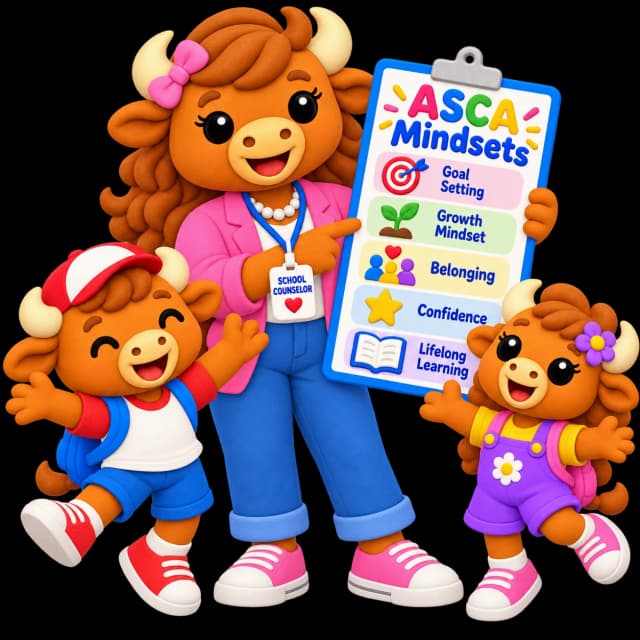
If you are an elementary school counselor, the ASCA Student Standards: Mindsets & Behaviors for Student Success are likely at the center of your planning. They guide what you teach in classroom lessons, what you target in small groups, and how you report on the impact of your program.
This guide explains what the standards are, how they are organized, how they map to the CASEL framework, how counselors use them to write learning objectives, and how classroom SEL instruction can support a counselor’s ASCA-aligned program in grades K–5.
The ASCA Student Standards are published by the American School Counselor Association. This guide summarizes and discusses them; for the full official text, see ASCA’s published standards.[1]
What Are the ASCA Mindsets and Behaviors?
The ASCA Student Standards: Mindsets & Behaviors for Student Success describe the knowledge, attitudes, and skills students need for academic, career, and social/emotional success. The current version was published in 2021.[1]
Key point: They are designed for K–12 and are not grade-specific. Instead of listing what every third grader should know, they provide broad standards that school counselors use to write their own measurable, grade-appropriate learning objectives based on their students’ needs.[1]
How the Standards Are Organized
Three domains[1]
Academic development
Career development
Social/emotional development
Mindset standards (6)[1]
Mindsets are the beliefs and attitudes students hold about themselves and learning.
Belief in development of the whole self, including mental, social/emotional, and physical well-being
A sense of acceptance, respect, support, and inclusion at school
A positive attitude toward work and learning
Self-confidence in the ability to succeed
Belief in using one’s abilities to their fullest to achieve high-quality results
Understanding that postsecondary education and lifelong learning are necessary for long-term success
Behavior standards (30)[1]
Behaviors are the observable skills students use. There are 30 behavior standards, 10 in each of three categories:
Learning Strategies (10)
Skills for learning: critical thinking, organization, goal setting, and time management
Self-Management Skills (10)
Skills for managing oneself: responsibility, self-discipline, perseverance, and coping
Social Skills (10)
Skills for relating to others: communication, empathy, collaboration, and advocating for oneself and others
How the ASCA Standards Align With CASEL
A crosswalk published by the Wisconsin Department of Public Instruction maps them this way:[2]
Self-awareness
Self-management
Self-management and responsible decision-making
Mostly relationship skills, with some social awareness and responsible decision-making
This alignment means that classroom SEL instruction built on the five CASEL competencies can directly support many of the mindsets and behaviors counselors target. For background, see understanding the CASEL framework.
How Counselors Use the Standards
According to ASCA, counselors use the standards to develop, deliver, and assess direct student services: classroom instruction, appraisal and advisement, and counseling.[1] In practice, that usually looks like this:
Start with data
Look at attendance, discipline, achievement, and climate data to identify a need.
Choose the relevant standard(s)
Select the mindset or behavior that addresses the need.
Write a measurable learning objective
Appropriate for the grade level.
Plan instruction or intervention
Classroom lessons, small groups, or individual counseling.
Measure results
Pre- and post-assessments, behavior data, or other indicators.
Reflect and adjust
Use what you learned to refine your approach.
ASCA also maintains a database of grade-level learning objectives that counselors can search and contribute to.[1] The standards are part of the broader ASCA National Model for school counseling programs.[3]
Example K–5 Learning Objectives
The examples below illustrate how a counselor might write grade-level objectives aligned to each behavior category. They are not official ASCA objectives.
Learning Strategies
Students will name one thing they can do when a task feels hard.
Students will set one goal for the week and identify one step to reach it.
Students will break a project into steps and create a simple timeline.
See goal setting for elementary students and problem solving for K–5.
Self-Management Skills
Students will demonstrate one calming strategy, such as belly breathing.
Students will identify two strategies to use when they feel frustrated.
Students will describe how they persisted through a difficult task and what helped.
See emotional regulation for K–5 and teaching perseverance.
Social Skills
Students will use an I-statement to describe a feeling to a partner.
Students will identify how a classmate might feel in a given scenario.
Students will use problem-solving steps to resolve a role-played peer conflict.
See conflict resolution activities and empathy lessons.
Mindsets
Students will name one thing they are good at and one thing they are still learning.
Students will rewrite a fixed-mindset statement as a growth-mindset statement.
Students will identify one adult at school they can go to for support.
How Classroom SEL Supports the Counselor’s Program
Most elementary counselors serve hundreds of students, often across many classrooms. The American School Counselor Association recommends one counselor for every 250 students, and many schools have far more. Classroom SEL instruction helps extend the counselor’s reach:
Shared language
When teachers use the same feeling words and problem-solving steps, students hear them every day, not just during counselor visits.
Tier 1 coverage
A consistent classroom SEL program reaches every student, freeing counselor time for Tier 2 and 3 support.
Data alignment
If classroom SEL lessons are mapped to CASEL, and CASEL is crosswalked to ASCA, counselors can show how schoolwide instruction supports specific mindsets and behaviors.
Reinforcement
Counselor lessons stick better when teachers reinforce them during the week.
Using the Standards for Counselor Classroom Lessons
Map your year. Plan which mindsets and behaviors you will emphasize each month or quarter.
Keep lessons short and active. Twenty to thirty minutes with discussion, role-play, or a game works well in K–5.
Leave teachers with follow-up. A visual, a song, or a short activity the teacher can repeat.
Use pre- and post-measures. Short, simple checks show what students learned.
Connect to family. A take-home page helps families use the same language.
See SEL games and weekly SEL lessons for elementary teachers.
Differentiating by Grade Band
• Focus on concrete self-management and social skills: calming, sharing, taking turns, asking for help
• Use pictures, songs, puppets, and role-play
• Measure with simple observations and picture-based checks
• Add learning strategies such as goal setting and organization
• Introduce empathy and perspective-taking
• Use short written or verbal reflections for measurement
• Emphasize learning strategies, self-advocacy, and responsible decision-making
• Begin early career awareness activities tied to the career domain
• Prepare students for the transition to middle school
What to Avoid
Treating the standards as a checklist
The standards are meant to guide data-driven decisions, not to be covered one by one.
Writing objectives you can’t measure
“Students will understand kindness” is hard to measure. “Students will name two ways to include a classmate” is not.
Skipping data
Starting from school data keeps your program focused on real needs.
Working in isolation
Counselor lessons are more effective when teachers reinforce them.
Copying without attribution
Cite ASCA as the source when referencing the standards in public materials.
Frequently Asked Questions
Are the ASCA standards grade-specific?
No. They are K–12 standards. Counselors write grade-appropriate learning objectives aligned to them.
How many ASCA Mindsets & Behaviors standards are there?
There are 36: 6 mindset standards and 30 behavior standards, divided evenly among learning strategies, self-management skills, and social skills.
Are ASCA standards the same as SEL standards?
No, but they overlap heavily. The ASCA standards cover academic, career, and social/emotional development, while SEL standards focus on social and emotional competencies. Crosswalks show strong alignment between them.
Do teachers use the ASCA standards?
They are written for school counselors, but teachers often support them through classroom SEL instruction and reinforcement.
Final Thoughts
The ASCA Mindsets & Behaviors give elementary counselors a flexible framework for deciding what students need, teaching it, and showing results. Because they align closely with the CASEL competencies, they connect naturally to classroom SEL instruction, which can extend the reach of a counselor’s program to every student, every week.
Start with your data, pick a few standards to focus on, and partner with teachers so the skills you teach get practiced long after you leave the classroom.
References
American School Counselor Association. (2021). ASCA student standards: Mindsets & behaviors for student success. Alexandria, VA: Author. Copy hosted by the Illinois State Board of Education: https://www.isbe.net/Documents/mindsets-behaviors-2021.pdf
Wisconsin Department of Public Instruction. (n.d.). ASCA student standards crosswalk with the CASEL framework. https://dpi.wi.gov/sites/default/files/imce/sspw/pdf/Student_Standards_Crosswalk_with_CASEL.pdf
American School Counselor Association. (2019). The ASCA national model: A framework for school counseling programs (4th ed.). Alexandria, VA: Author. https://www.cheapesttextbooks.com/subjects/The-ASCA-National-Model-A-Framework-for-School-Counseling-Programs-4th-edition-9781929289592.html
Durlak, J. A., Weissberg, R. P., Dymnicki, A. B., Taylor, R. D., & Schellinger, K. B. (2011). The impact of enhancing students’ social and emotional learning: A meta-analysis of school-based universal interventions. Child Development, 82(1), 405-432. https://doi.org/10.1111/j.1467-8624.2010.01564.x
Cipriano, C., Strambler, M. J., Naples, L. H., et al. (2023). The state of evidence for social and emotional learning: A contemporary meta-analysis of universal school-based SEL interventions. Child Development, 94(5), 1181-1204. https://doi.org/10.1111/cdev.13968
Tier 1 SEL That Supports Your Counseling Program
Be The Buffalo is a 40-week, CASEL-aligned K–5 curriculum that teachers can deliver every week with no prep, giving students shared language for feelings, calming strategies, problem-solving, and friendship skills that reinforce your ASCA-aligned lessons. Projector activities, original songs, stories, and printables in three grade bands, in English and Spanish. No student devices. The first four weeks are free.
Sign Up Free