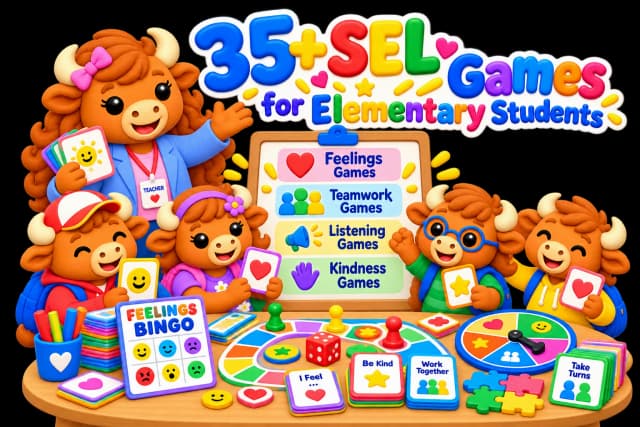
Kids will sit through a lecture about self-control. They will actually practice self-control in a game of Simon Says. That is the case for social emotional learning games: they turn skills like waiting, listening, reading emotions, and solving problems into something students want to do, and they give students many low-stakes chances to practice.
This guide covers what the research says about using games to build social-emotional skills, more than 35 SEL games organized by the five CASEL competencies, interactive projector games the whole class can play together, and how to run games so the learning sticks after the fun ends.
What the Research Says
Some games directly build self-regulation
A review of interventions for children ages 4 to 12 found that executive function skills, including inhibitory control (stopping yourself from acting on impulse), can be improved through practice, and that activities like games with changing rules can provide that practice.[1] A randomized trial of short circle-time games such as Red Light, Purple Light found improvements in preschoolers’ behavioral self-regulation.[2] That study was with preschoolers, so applying it to older students is an extrapolation, but the games themselves work well in K–2.
A classroom game has long-term evidence
The Good Behavior Game, in which first and second grade classroom teams earn rewards for following agreed-upon behavior rules, was tested in randomized trials. Follow-up into young adulthood found reductions in some later problems, especially among boys who had been rated highly aggressive in first grade.[3] It is a classroom management approach more than an SEL lesson, but it shows that a well-designed game can affect behavior.
SEL programs work best when they are active
Meta-analyses of school-based SEL programs show gains in social-emotional skills, behavior, and academic achievement.[4][5] Effective programs tend to be SAFE: sequenced, active, focused, and explicit.[4] Games are one of the most natural ways to make SEL active.
The caveat: A game on its own is not an SEL lesson. Games build skills when they are connected to a specific skill and followed by a short discussion about what students practiced.
35+ Games by CASEL Competency
33 unplugged games plus 6 interactive projector activities, organized by the five CASEL competencies.
Game Distribution by Competency
Sequenced
Skills build on each other
Active
Students practice, not just listen
Focused
Time dedicated to skill-building
Explicit
Skills are named and discussed
🧠 SEL Games for Self-Awareness
Games that help students name feelings, notice what is happening in their bodies, and recognize their strengths.
Feelings Charades
A student acts out an emotion without words while classmates guess. Add a challenge for older students: act out the difference between similar feelings, such as nervous and scared.
Emotion Freeze Dance
Play music. When it stops, the teacher calls out a feeling and students freeze in a pose that shows it.
Feelings Bingo
Bingo cards with feeling words or faces. Call out situations (“You lost your favorite toy”) and students mark the feeling it might cause. Accept more than one answer.
Body Clues Detective
Describe a body sensation (“My face feels hot and my fists are tight”) and students guess the feeling. Builds the link between body signals and emotions.
Strength Spotlight
One student sits in the “spotlight” chair while classmates name a strength they have seen in that student.
Mood Meter Toss
Students toss a soft ball and the catcher names a feeling word, then tosses to someone else. No repeats allowed.
⏱️ SEL Games for Self-Management
Games that practice waiting, stopping, focusing, and calming down.
Simon Says
A classic for inhibitory control. Increase the challenge with faster commands or tricky combinations.
Red Light, Green Light
Add a twist for older students: reverse the rules so red means go.
Freeze Dance
Students must stop instantly when the music stops.
Head, Shoulders, Knees, and Toes (Opposite Version)
When the teacher says “head,” students touch their toes. Builds attention and impulse control.
Count to 20
The class counts aloud to 20, one person at a time, with no set order. If two people speak at once, start over.
Breathing Challenge
Lead “smell the flower, blow out the candle” breaths, then challenge students to make one breath last a full count of five.
Statue Challenge
Everyone freezes as still as a statue. The teacher walks around trying (gently) to make them laugh.
Waiting Game
Place a fun object in the middle of the circle. Students practice waiting for their name to be called before touching it. Simple, but useful for kindergarten.
👥 SEL Games for Social Awareness
Games that build empathy, perspective-taking, and appreciation for others.
Walk in Their Shoes
Read a short scenario. Students step to one side of the room if they think the character feels one way, and the other side if they think differently. Discuss why.
Two Sides of the Story
Present a conflict from one character’s point of view, then retell it from the other’s. Students discuss how each person felt.
What’s Different?
Partners study each other for 30 seconds, turn around, change one small thing, and turn back. The partner guesses what changed. Builds attention to others.
Compliment Circle
Students pass a ball and give a specific compliment to the person they pass it to.
Guess Who Helped
Describe a kind act that happened in the class (without names). Students guess what kind of help it was and how it made someone feel.
Same and Different
Pairs find three things they have in common and one way they are different.
See Empathy lessons for elementary students and Perspective-taking through conflict scenarios.
🤝 SEL Games for Relationship Skills
Games that practice cooperation, communication, and teamwork.
Human Knot
Small groups tangle hands and must untangle without letting go. Best for grades 3–5.
Back-to-Back Drawing
One student describes a simple picture while a partner, sitting back to back, draws it. Builds clear communication and listening.
Cooperative Tower
Teams build the tallest tower they can from paper cups or blocks, with a rule like “no talking” or “only one hand each.”
Telephone
Whisper a message around the circle and compare the start and end. Use it to talk about listening and rumors.
Pass the Squeeze
Students hold hands in a circle and pass a hand squeeze around. Time it and try to beat the class record.
Partner Mirror
One partner leads slow movements and the other mirrors them, then they switch.
Kindness Relay
Teams take turns writing or drawing kind actions on a chart. The class reviews them together at the end.
See Teamwork activities for elementary students and Kindness activities.
🧐 SEL Games for Responsible Decision-Making
Games that practice thinking through choices and solving problems.
What Would You Do?
Read a short scenario (“You see someone sitting alone at lunch”). Students vote with thumbs, cards, or by moving to a corner, then discuss.
Choice Path
Tell a story that pauses at a decision point. Students vote on what the character should do, then hear what happens next.
Problem-Solving Relay
Teams race to list as many solutions to a problem as they can, then pick the best one together.
Would You Rather (Values Edition)
“Would you rather tell the truth and get in trouble, or stay quiet and feel bad?” Students explain their reasoning.
Consequence Chain
One student states a choice, and each student adds the next thing that might happen.
Good Behavior Game
Divide the class into teams that earn points for following agreed classroom rules during a set time.
See Problem solving for K-5 and Conflict resolution activities.
Interactive Projector SEL Games for the Whole Class
Projector games give you the engagement of a digital game without one-to-one devices, student logins, or screen time spent alone. The teacher projects the game, and the class plays together by voting, discussing, and choosing as a group. That keeps the social part of social-emotional learning intact.
See SEL without screens and why your SEL curriculum shouldn’t need student accounts.
Be The Buffalo includes more than 80 interactive projector activities, built to be played as a class. A few examples:
Yet Power! (Growth Mindset)
Students see a fixed-mindset thought like “I can’t do this,” add the magic word “yet,” and watch it transform into a growth mindset thought.
Buffalo’s Big Mistake (Growth Mindset)
Buffalo tries something new and makes a mistake. The class chooses how Buffalo should respond and sees what happens, reinforcing that mistakes are information, not verdicts.
Two Sides of the River (Perspective-Taking)
Seven conflict scenarios told from both sides, so students practice understanding why two people can see the same situation differently.
Friendship Challenges (Relationship Skills)
Thirteen everyday friendship scenarios where the class decides how to handle common problems.
The Invisible Crew (Gratitude and Social Awareness)
A whole-class projector activity built around gratitude and noticing others. Free to try with no signup.
The Lunch Table (Interactive Story)
An interactive story built around a social situation at lunch. Free to try with no signup.
Activities switch between English and Spanish with one click, and the curriculum includes separate content for K–1, 2–3, and 4–5.
How to Run SEL Games So the Learning Sticks
Name the skill before you play
“This game is about self-control. Pay attention to what your brain and body do when you want to move but have to wait.”
Keep it short
Most SEL games work best in 5 to 10 minutes. Stop while students still want more.
Always debrief
Spend two or three minutes after the game asking what skill was practiced and what was hard.
Connect to real situations
“Remember how you waited in Simon Says? That’s the same skill you use when you want to answer but someone else is talking.”
Repeat favorites
Students improve at games they play often, and the improvement is the skill-building.
Use games at transition times
Morning Meeting, after recess, and end of day are natural times for short SEL games.
Debrief Questions
The debrief is what turns a game into an SEL lesson. Ask:
“What skill did we practice?”
“What was hard about it?”
“What helped you?”
“Where else could you use this skill?”
See our guide to Morning Meeting activities.
Differentiating SEL Games by Grade Band
- •Movement games with simple rules: Simon Says, Freeze Dance, Red Light Green Light
- •Feelings games with faces and pictures
- •Short debriefs with one or two questions
- •Lots of repetition
- •Partner and small-group cooperation games
- •Scenario voting games
- •Rule-twist versions of familiar games to challenge self-control
- •Longer debriefs with “why” questions
- •Cooperative challenges like Human Knot and Cooperative Tower
- •Values and decision-making discussions
- •Perspective-taking games with more complex scenarios
- •Student-led games and debriefs
What to Avoid
Games with no debrief
Without a short discussion, students remember the fun but not the skill.
Elimination games that leave students out
In games like Simon Says, have “out” students become helpers or judges instead of sitting out.
Too much competition
Winning and losing can overwhelm the skill you are trying to teach. Mix in cooperative games.
Forced emotional sharing
Feelings games should not require students to share personal experiences in front of the class.
Screens without interaction
Videos and apps that students watch passively or play alone miss the social practice that makes SEL games work.
Using games only as rewards
If SEL games only happen when the class has been good, students who need the practice most may get the least of it.
Measuring Whether SEL Games Are Working
In-game improvement
Are students getting better at the game itself, such as fewer early moves in Simon Says or faster times in Pass the Squeeze?
Debrief quality
Can students name the skill and give examples of using it elsewhere?
Transfer
Do students refer to games during real situations (“This is like Count to 20, we have to take turns”)?
Participation
Are quieter students joining in more over time?
Classroom climate
Are transitions smoother and conflicts easier to resolve?
Final Thoughts
Games are one of the most natural ways to make SEL active. They give students repeated, low-pressure practice with skills like waiting, listening, reading emotions, cooperating, and solving problems. The research suggests that games targeting specific skills, especially self-regulation, can make a real difference, as long as they are connected to a skill and followed by a short conversation about what students learned.[1][2]
Play the game. Then ask what it taught.
References
- Diamond, A., & Lee, K. (2011). Interventions shown to aid executive function development in children 4 to 12 years old. Science, 333(6045), 959–964. DOI
- Tominey, S. L., & McClelland, M. M. (2011). Red light, purple light: Findings from a randomized trial using circle time games to improve behavioral self-regulation in preschool. Early Education and Development, 22(3), 489–519. DOI
- Kellam, S. G., Brown, C. H., Poduska, J. M., et al. (2008). Effects of a universal classroom behavior management program in first and second grades on young adult behavioral, psychiatric, and social outcomes. Drug and Alcohol Dependence, 95(Suppl. 1), S5–S28. DOI
- Durlak, J. A., et al. (2011). SEL meta-analysis. Child Development, 82(1), 405–432. DOI
- Cipriano, C., et al. (2023). SEL meta-analysis. Child Development, 94(5), 1181–1204. DOI
Play SEL Games as a Class
Be The Buffalo includes more than 80 interactive projector activities, along with original songs, stories, and printables, across a 40-week CASEL-aligned K–5 curriculum. Every activity is played together as a class, in English or Spanish, with no student devices, no student accounts, and no prep. The first four weeks are free.
Sign Up Free