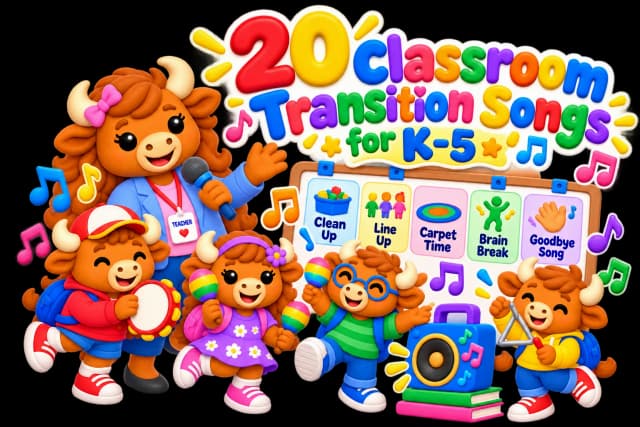
Transitions are where a lot of classroom time disappears. Lining up, cleaning up, coming to the rug, switching subjects, packing up at the end of the day: each one can take 30 seconds or five minutes, depending on how it goes. Multiply that by a dozen transitions a day and it adds up quickly.
Songs are one of the simplest tools for making transitions faster and calmer. A familiar tune signals that something is changing, tells students what to do, gives them a set amount of time to do it, and replaces a teacher’s raised voice with something students actually enjoy.
This guide covers why songs help with transitions, 20 original transition songs set to traditional tunes (free to use in your classroom), alternatives for older students, and how to introduce songs so they work.
Why Songs Help With Transitions
Songs are predictable signals
A specific song for a specific transition tells students what is happening before you say a word.
Songs give instructions in a memorable form
Information set to a simple, repeated melody can be easier to recall than spoken text.[1]
Songs can support independence
In a small study, adding songs to a morning routine increased children’s independence in completing it.[2]
Songs replace nagging
Instead of repeating “Clean up, please… I said clean up… We’re waiting,” the song does the reminding.
Songs support regulation
Singing together can help a class move from high-energy to calm, especially when the song slows down.
20 Songs by Transition Type
All songs are original lyrics set to public-domain tunes. Free to use in your classroom.
Song Distribution
One song per transition
Same song, same transition, every time.
Teach expectation with song
Students know what to do by the end.
Song is the timer
Finished when the song ends.
🚶 Songs for Lining Up
Line Up Song
Tune: Frère Jacques (Are You Sleeping?)
Time to line up, time to line up,
Find your spot, find your spot.
Hands down at your sides now,
Eyes ahead and quiet,
Ready to go, ready to go.
Walking Feet
Tune: Row, Row, Row Your Boat
Walk, walk, walk our feet
Quietly down the hall.
Hands to self and voices off,
We’re the best line of all.
Ready Line
Tune: London Bridge
We are standing in our line,
In our line, in our line.
We are standing in our line,
Ready, set, let’s go.
✨ Songs for Clean-Up
Tidy Up Time
Tune: Twinkle, Twinkle, Little Star
Tidy up, it’s time to go,
Put things back where they belong.
Crayons, paper, books, and blocks,
Every bin and every box.
Tidy up, our room looks great,
Now we’re ready, don’t be late.
Put It Away
Tune: Here We Go Round the Mulberry Bush
This is the way we put things away,
Put things away, put things away.
This is the way we put things away,
So we can learn and play.
Helping Hands
Tune: Mary Had a Little Lamb
Helping hands will clean the room,
Clean the room, clean the room.
Helping hands will clean the room,
Each one does their part.
🧨 Songs for Coming to the Rug
Come to the Rug
Tune: The Farmer in the Dell
We’re coming to the rug,
We’re coming to the rug,
Criss-cross, hands in lap,
We’re coming to the rug.
Circle Time
Tune: Skip to My Lou
Come and sit, it’s circle time,
Come and sit, it’s circle time,
Come and sit, it’s circle time,
Find a spot and join us.
🧘 Songs for Getting Quiet and Calm
Quiet Bodies
Tune: Twinkle, Twinkle, Little Star
Quiet bodies, quiet feet,
Quiet hands and quiet seat.
Take a breath in, nice and slow,
Let it out and let it go.
Quiet bodies, here we are,
Ready like a shining star.
Breathing Song
Tune: Row, Row, Row Your Boat (sung slowly)
Breathe in slow, breathe out slow,
Feel your body calm.
In through your nose, out through your mouth,
Peaceful, calm, and strong.
For more calming strategies, see: Self-regulation activities and Setting up a calming corner.
🔄 Songs for Switching Subjects
Next Thing Song
Tune: Frère Jacques
All done reading, all done reading,
Put it away, put it away.
Now it’s time for math, now it’s time for math,
Here we go, here we go.
Swap in any subjects: “All done writing… now it’s time for science.”
Brain Break Over
Tune: London Bridge
Now our break is over now,
Over now, over now.
Now our break is over now,
Back to work we go.
🍽️ Songs for Lunch, Recess, and Specials
Wash Our Hands
Tune: Row, Row, Row Your Boat
Wash, wash, wash our hands,
Scrub them nice and clean.
Front and back and in between,
The cleanest hands you’ve seen.
Lunch Time
Tune: The Farmer in the Dell
It’s time to go to lunch,
It’s time to go to lunch,
Grab your box and find your place,
It’s time to go to lunch.
Coming Back In
Tune: Mary Had a Little Lamb
We are coming back inside,
Back inside, back inside.
Slow our bodies, calm our minds,
Ready now to learn.
☀️ Songs for Morning and End of Day
Good Morning Song
Tune: Frère Jacques
Good morning, [name], good morning, [name],
How are you? How are you?
We’re so glad you’re here today,
Glad you’re here today,
Let’s begin, let’s begin.
Sing each student’s name as a Morning Meeting greeting.
Pack Up Song
Tune: Here We Go Round the Mulberry Bush
This is the way we pack our bags,
Pack our bags, pack our bags.
This is the way we pack our bags
At the end of the day.
Goodbye Song
Tune: Twinkle, Twinkle, Little Star
Now it’s time to say goodbye,
We worked hard and we tried.
We were kind and we were brave,
Proud of all the work we made.
See you soon, my friends, goodbye,
Tomorrow we will try and try.
⏳ Songs for Waiting and Taking Turns
Waiting Song
Tune: Row, Row, Row Your Boat
Wait, wait, wait my turn,
Patient as can be.
When my friend is finished up,
Then it’s time for me.
Take a Turn
Tune: London Bridge
Everybody takes a turn,
Takes a turn, takes a turn.
Everybody takes a turn,
That’s how we play fair.
Transition Music for Upper Elementary
Fourth and fifth graders often find sing-along transition songs too young. Music still works, but it usually looks different.
Instrumental countdown tracks
A short piece students know means “you have until the music ends.”
Student-chosen clean-up songs
Let the class vote on a clean-up song of the week.
Call-and-response chants
A quick rhythm the teacher calls and students answer.
Calming background music
Slow instrumental music during independent work transitions.
Student-led songs
Let students write their own transition verses.
Bilingual Transition Songs
Songs are an easy way to build vocabulary in dual-language classrooms.
- •Sing the same song in English one week and Spanish the next.
- •Alternate verses between languages.
- •Translate the key words (line up, clean up, wash, quiet) and use them consistently.
- •Invite families to share transition songs from their own traditions.
How to Introduce Transition Songs
Start with one or two
Pick your hardest transitions—often clean-up and lining up.
Teach the song and the expectation together
Practice when nothing else is happening.
Model it
Sing it yourself and show exactly what students should be doing.
Practice until automatic
Repeat the transition with the song several times in the first week.
Be consistent
Use the same song for the same transition every time.
Add new songs slowly
Once one transition runs smoothly, add another.
Hand it over
Over time, let students start the song or lead it.
Differentiating by Grade Band
- •Short, simple songs with actions
- •One song per transition, used consistently
- •Songs that name each step
- •Lots of practice in the first weeks
- •Familiar tunes with slightly longer verses
- •Student helpers who lead songs
- •Mix of singing and instrumental music
- •Students help write new verses
- •Instrumental countdown tracks and call-and-response chants
- •Student-chosen songs
- •Songs for specific moments, not every transition
What to Avoid
Too many songs
Start small. Students cannot learn the connection if every transition has a different song.
Songs without clear expectations
A song only works if students know what they should be doing during it.
Using songs as punishment
“We’ll sing until everyone is quiet” turns a signal into a consequence.
Songs that are too long
Most transition songs should take 30 seconds to two minutes.
Forcing older students to sing
Use instrumental music or chants instead.
Copyrighted lyrics in shared materials
Original lyrics to public-domain tunes, like these, avoid the issue.
Measuring Whether Transition Songs Are Working
Time each transition
A stopwatch for a few days before and after gives you a clear comparison.
Count reminders
Are you repeating instructions less often?
Watch the end of the song
Are more students finished and ready when it ends?
Notice the tone
Are transitions calmer, with fewer conflicts?
Final Thoughts
Transition songs are one of the lowest-cost, highest-return tools in an elementary classroom. They signal what is happening, tell students what to do, set a time limit, and make transitions feel less like a series of reminders and more like part of the routine.
Pick your hardest transition. Give it a song. Sing it every time.
Sources
- Wallace, W. T. (1994). Memory for music: Effect of melody on recall of text. Journal of Experimental Psychology: Learning, Memory, and Cognition, 20(6), 1471–1485. DOI
- Kern, P., Wolery, M., & Aldridge, D. (2007). Use of songs to promote independence in morning greeting routines. Journal of Autism and Developmental Disorders, 37(7), 1264–1271. DOI
- Durlak, J. A., et al. (2011). SEL meta-analysis. Child Development, 82(1), 405–432. DOI
- Cipriano, C., et al. (2023). SEL meta-analysis. Child Development, 94(5), 1181–1204. DOI
Original SEL Songs for Your Classroom
Be The Buffalo includes original songs written for elementary classrooms, such as “My Brain Can Grow,” “Mistake Song,” “Yes I Can,” and “Brave Enough to Fail,” along with sing-along karaoke versions, as part of a 40-week CASEL-aligned K–5 curriculum. Bilingual. No student devices. No prep. The first four weeks are free.
Sign Up FreeRelated Resources
How Music Supports SEL
Why songs help students learn and remember social-emotional skills.
Morning Meeting Activities for Elementary Classrooms
Greeting songs, games, and routines for the start of the day.
Self-Regulation Activities for Elementary Classrooms
Calming games and routines for transitions and beyond.