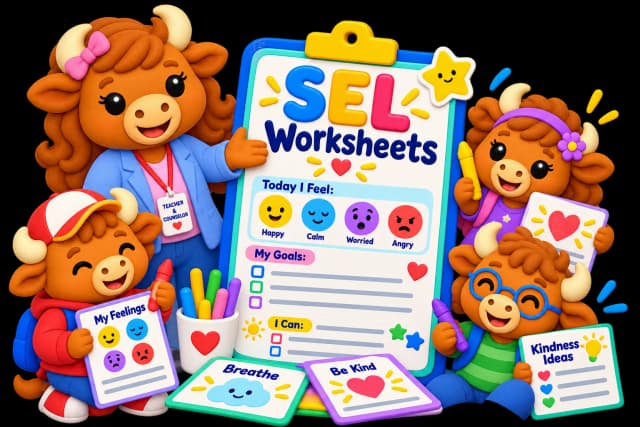
Search for “SEL worksheets” and you will find thousands of them: feelings charts, coloring pages, “how do you feel today?” faces, and fill-in-the-blank kindness pledges. Some are useful. Many are busywork with an emoji on top.
A good social emotional learning worksheet does something specific. It helps a student practice a skill, reflect on an experience, or bring a class discussion down to their own level. A weak one asks students to color a heart and call it empathy.
This guide covers what the research says about worksheets and SEL, the types of SEL worksheets that are most useful, real examples organized by CASEL competency, how to use worksheets so they actually build skills, and where to get free bilingual printables for kindergarten through fifth grade.
Disclosure: This guide is published by Be The Buffalo Classroom. The worksheet examples below come from our library of 160 printables, and we have tried to describe them accurately along with general guidance that applies to any SEL worksheet.
What the Research Says About SEL Worksheets
There is no research showing that worksheets on their own build social-emotional skills. The evidence supports SEL programs as a whole, and worksheets are one part of how those programs are delivered.
A major meta-analysis of 213 school-based SEL programs found that participants gained in social-emotional skills, behavior, and academic achievement, with an average 11-percentile-point gain in achievement.[1] A more recent meta-analysis of 424 studies confirmed improvements across skills, attitudes, behavior, and academics.[2]
The 2011 meta-analysis also identified four features of more effective programs, summarized as SAFE:[1]
Sequenced
Activities build on each other in a connected order
Active
Students practice skills, not just hear about them
Focused
Time is set aside specifically for skill development
Explicit
Programs target specific, clearly defined skills
SAFE is a useful test for any worksheet. A worksheet that is part of a sequence, asks students to actively practice or reflect, and targets one clear skill is far more likely to be useful than a standalone page with a generic theme.
Types of SEL Worksheets (and What Each Is Good For)
8 Worksheet Types at a Glance
Discussion Worksheets
Turning class discussion into individual thinking
Reflection Journals
Processing real challenges or connecting lessons to life
Cut-and-Sort Cards
Hands-on practice and younger students
Posters & Anchor Charts
Keeping strategies visible after the lesson
Step & Strategy Cards
Skills students need in the moment
Skill-Practice Worksheets
Building a concrete skill through repetition
Trackers & Goal Sheets
Self-management and building habits
Family Take-Home Pages
Connecting school and home language
💬 Discussion Worksheets
Students answer open-ended questions, usually after a lesson, story, or class conversation. Good discussion worksheets have a few specific questions, space to write or draw, and a reflection or action step at the end.
Best for: Turning a whole-class discussion into individual thinking, and giving quieter students a way to participate.
Example: Our Growth Mindset Discussion Worksheet asks questions like “What’s something you couldn’t do before but can do now? How did you learn it?” and “What does ‘not yet’ mean?”, followed by a reflection page and a Growth Mindset Action Plan where students name a challenge, three things they will do, and who can help them.
📓 Reflection Journals
Multi-page journals that walk students through an experience step by step.
Best for: Helping students process a real challenge or connect a lesson to their own life.
Example: Our Bounce Back Journal walks students through What Happened, My Feelings (a checklist of emotions plus a 1-to-4 intensity scale), How I Bounced Back (a checklist of strategies), My Helpers (naming a support team), and Growing Stronger (what I learned and what I’ll do next time).
✂️ Cut-and-Sort Cards
Cards students cut out and sort, match, or use in games.
Best for: Hands-on practice, partner work, and younger students who are still building writing skills.
Example: Our Storm & Sunshine Cards pair “storm” cards (challenges like “I made a mistake in front of others”) with “sunshine” cards (outcomes like “I learned to ask for help”). Students sort them on a mat, tell stories, or create their own cards.
📊 Posters and Anchor Charts
Visual references for the classroom wall or a student folder.
Best for: Keeping language and strategies visible after the lesson ends.
Example: Our Growth Mindset Poster set includes a main poster, a “Change Your Words, Change Your Mind” page that turns “I can’t do this” into “I can’t do this YET,” an explanation of how the brain grows, and a page of growth mindset affirmations.
🃏 Step Cards and Strategy Cards
Short, visual sequences students can follow during a real situation.
Best for: Conflict resolution, calming routines, and any skill students need to use in the moment.
Example: Our Peace Path Steps printable includes a five-step poster (Stop and Calm Down, Talk and Listen, Think of Solutions, Choose a Solution, Try It), cut-out step cards, practice scenarios like “You and a friend both want the same library book,” and a page where students draw a time they solved a problem.
✏️ Skill-Practice Worksheets
Fill-in-the-blank or scenario-based practice of one specific skill.
Best for: Building a concrete skill through repetition.
Example: Our I-Statement Cards teach the “I feel... when... because...” structure, include feeling word cards and blank templates, and give students practice changing you-statements like “You always cut in line!” into I-statements.
📈 Trackers and Goal Sheets
Pages students use over several days to track progress toward a goal.
Best for: Self-management, goal setting, and building habits.
Example: Our Brain Power Worksheet includes a weekly My Challenge Tracker, where students record a brain-building challenge each day, their biggest challenge of the week, how they grew from it, and the strategy that helped.
🏠 Family Take-Home Pages
Best for: Connecting school and home, and helping families use the same words and strategies.
SEL Worksheets by CASEL Competency
Organizing worksheets by the five CASEL competencies helps make sure you are covering the full range of skills, not just feelings and kindness. For background, see understanding the CASEL framework.
Worksheet Coverage by CASEL Competency
🪞 Self-Awareness
- •Feelings check-ins and feeling word banks
- •"All about me" strengths pages
- •Growth mindset reflections
- •"Something I couldn’t do before but can do now" prompts
🧘 Self-Management
- •Calming strategy menus and "my calm-down plan" pages
- •Feelings thermometers and intensity scales
- •Goal trackers
- •Resilience journals
👥 Social Awareness
- •"How might they feel?" scenario pages
- •Perspective-taking prompts that look at a situation from two sides
- •Gratitude and noticing-others pages
🤝 Relationship Skills
- •I-statement practice
- •Friendship skill scenarios
- •Kindness planning pages
⚖️ Responsible Decision-Making
- •Problem-solving step cards
- •"What could I do?" scenario pages
- •Conflict resolution reflections and peace plans
How to Use SEL Worksheets So They Actually Build Skills
Teach first, worksheet second
A worksheet works best after a lesson, story, or discussion has introduced the skill. On its own, it often becomes a coloring or writing exercise.
Talk before writing
Have students discuss the questions with a partner or the class before writing. Many students, especially younger ones, think more clearly out loud.
Use them as part of a sequence
Worksheets connected to a weekly theme and to each other are more useful than one-off pages. That reflects the “Sequenced” part of SAFE.
Choose active practice over passive coloring
Sorting, role-playing scenarios, and planning are more active than filling in a picture.
Keep reflections private when personal
Students should not have to share personal answers aloud. Make sharing optional.
Revisit them
A peace plan or calm-down plan is most useful when students look at it again in a real moment.
Send the language home
Family pages help students hear the same words at school and at home.
See elementary SEL scope and sequence for how to connect worksheets into a weekly sequence.[1]
Differentiating SEL Worksheets by Grade Band
Every printable in our library comes in three grade-band versions, because the same skill looks very different at age 5 and age 10.
- •Big pictures, simple phrases, and few words
- •Drawing, circling, and matching instead of writing
- •Cut-and-sort cards and posters
- •Teacher reads prompts aloud
- •Short writing prompts with sentence starters
- •A mix of writing and drawing
- •Guided reflection with structured questions
- •Partner discussion before writing
- •Extended writing and open-ended reflection
- •More complex scenarios and critical thinking prompts
- •Goal setting and self-monitoring over time
- •More student choice in how to respond
Bilingual SEL Worksheets
For dual-language classrooms and schools serving Spanish-speaking families, bilingual worksheets let students reflect in the language where they can best express their feelings and send the same SEL language home to families.
Every printable in the Be The Buffalo library has a full English and Spanish version, switchable with one click before printing. When choosing bilingual SEL worksheets from any source, check that the Spanish version is complete rather than partially translated, and that feeling words are translated naturally rather than literally.
See why bilingual SEL matters and our free bilingual SEL activities.
Free SEL Worksheets
No signup required
Storm & Sunshine Cards, a resilience cut-and-sort activity with storm cards, sunshine cards, blank cards, and a sorting mat, in all three grade bands and in English and Spanish. See our free SEL activities for elementary classrooms.
Free with a free account (no credit card):
The first four weeks of the Be The Buffalo curriculum, including three printables per week plus a teacher guide:
Growth Mindset
Self-Awareness
- •Growth Mindset Poster
- •Brain Power Worksheet
- •Growth Mindset Discussion Worksheet
Resiliency
Self-Management
- •Resiliency Discussion Worksheet
- •Bounce Back Journal
- •Storm & Sunshine Cards
Kindness
Relationship Skills
- •3 printables included
Conflict Resolution
Responsible Decision-Making
- •Peace Path Steps
- •I-Statement Cards
- •Conflict Resolution Discussion Worksheet
Every free printable comes in K–1, 2–3, and 4–5 versions and in English and Spanish.
What to Avoid
Worksheets as the whole SEL program
Worksheets support instruction. They do not replace teaching, discussion, and practice.
Coloring pages labeled as SEL
Coloring can be calming, but a coloring page of a heart is not a lesson on empathy.
One worksheet for every grade
A page designed for second graders is too hard for kindergartners and too simple for fifth graders.
Forced personal disclosure
Prompts like "What is the worst thing that ever happened to you?" can be too personal. Keep sensitive reflection optional.
Grading SEL reflections
Grading personal reflections can discourage honest answers. Check for completion and effort, not "correct" feelings.
Worksheets with no follow-up
A calm-down plan that goes into a folder and never comes out again has limited value.
Measuring Whether SEL Worksheets Are Helping
Worksheets can give you useful information about student growth when you look at them over time:
Feeling vocabulary
Are students using more specific feeling words?
Strategy use
Are students naming the same strategies they use in real situations?
Depth of reflection
Are answers getting longer and more thoughtful over the year?
Transfer
Do students refer to worksheets or plans during real conflicts?
Keeping a few worksheets in a student portfolio across the year makes this growth easier to see. For more ways to evaluate printables, see CASEL-aligned printable activities for K–5.
Final Thoughts
The best SEL worksheets are not the cutest ones. They are the ones that help students practice a specific skill, connect a lesson to their own life, and keep useful language in front of them after the lesson ends. Used as part of a sequenced program, alongside discussion and practice, they can help turn SEL lessons into habits.
Print less. Choose better. Talk first, then write.
Sources
Get 12 Free SEL Printables
Be The Buffalo includes 160 printables across a 40-week CASEL-aligned K–5 curriculum, every one in three grade bands and in English and Spanish, alongside projector activities, original songs, stories, and teacher guides. The first four weeks, including 12 printables, are free with no credit card. No student devices. No prep.
Sign Up FreeRelated Resources
CASEL-Aligned Printable Activities for K-5
How to tell whether a printable actually builds a CASEL skill.
Free SEL Activities for Elementary Classrooms
Free printables and projector activities with no signup required.
Free Bilingual SEL Activities for K-5
English and Spanish SEL resources for dual-language classrooms.