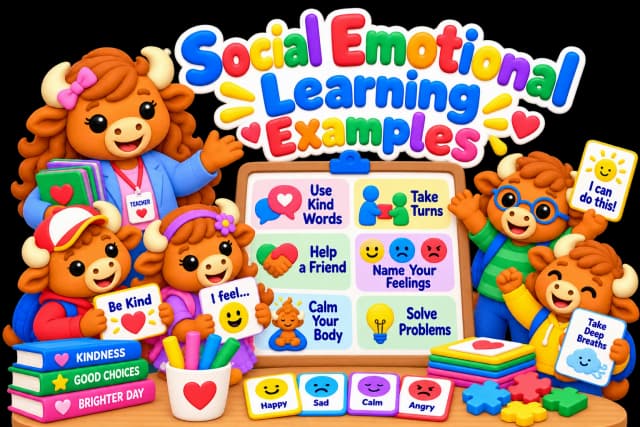
“Social emotional learning” can sound abstract until you see it in action. In practice, SEL is a first grader taking three deep breaths instead of grabbing a toy back, a third grader saying “I feel frustrated when you skip my turn,” a fifth grader inviting a new student to join a lunch table, or a teacher saying “Mistakes help our brains grow” after a hard math problem.
This guide is a collection of concrete social emotional learning examples for elementary school: what each of the five core SEL skills looks and sounds like at different ages, real classroom scenarios, a sample SEL lesson, examples of SEL built into academic subjects, and what SEL is not.
A Quick Definition
Social emotional learning is the process of developing the skills to understand and manage emotions, set and reach goals, show care for others, build relationships, and make responsible decisions. The most widely used framework, from CASEL, organizes these into five competencies: self-awareness, self-management, social awareness, relationship skills, and responsible decision-making.[1]
Research supports teaching these skills. A meta-analysis of 213 school-based SEL programs found gains in social-emotional skills, behavior, and academic achievement, including an average 11-percentile-point gain in achievement.[2] A more recent meta-analysis of 424 studies confirmed those benefits.[3]
For a fuller explanation, see what is social emotional learning and understanding the CASEL framework.
Examples of Each SEL Skill
🧠 Self-Awareness
Understanding your own emotions, strengths, and challenges.
| Grades K–2 | Grades 3–5 | |
|---|---|---|
| Looks like | Pointing to a feelings chart to show how you feel | Writing in a journal about what caused a strong feeling |
| Sounds like | “I feel mad.” | “I felt nervous before the test because I didn’t study enough.” |
| Example | A kindergartner notices her face feels hot and tells the teacher she is angry. | A fourth grader says, “I’m good at drawing, but I need more practice with fractions.” |
⏱️ Self-Management
Managing emotions, controlling impulses, and working toward goals.
| Grades K–2 | Grades 3–5 | |
|---|---|---|
| Looks like | Taking three deep breaths before speaking | Using a planner to break a project into steps |
| Sounds like | “I need a break.” | “I’m frustrated, so I’m going to try a different strategy.” |
| Example | A first grader waits for his turn on the slide instead of pushing. | A fifth grader keeps working on a hard problem instead of giving up. |
👥 Social Awareness
Understanding others’ feelings and perspectives, and showing empathy.
| Grades K–2 | Grades 3–5 | |
|---|---|---|
| Looks like | Bringing a tissue to a crying classmate | Considering how a character in a book might see a situation differently |
| Sounds like | “Are you okay?” | “Maybe she was quiet because she’s new and doesn’t know anyone yet.” |
| Example | A second grader notices a classmate sitting alone and asks him to play. | A third grader recognizes that a friend who snapped at her might be having a bad day. |
🤝 Relationship Skills
Communicating, cooperating, resolving conflict, and asking for help.
| Grades K–2 | Grades 3–5 | |
|---|---|---|
| Looks like | Sharing materials during centers | Taking a role in a group project and doing it |
| Sounds like | “Can I have a turn when you’re done?” | “I feel left out when you all go to recess without me.” |
| Example | Two kindergartners use “rock, paper, scissors” to decide who goes first. | Fourth graders in a group disagree about a plan, listen to each idea, and choose one together. |
🧐 Responsible Decision-Making
Making caring, constructive choices and thinking about consequences.
| Grades K–2 | Grades 3–5 | |
|---|---|---|
| Looks like | Telling a teacher when someone is hurt | Choosing to tell the truth about a mistake |
| Sounds like | “That’s not safe.” | “If I copy his homework, I won’t learn it, and that’s not fair to him.” |
| Example | A first grader returns a pencil she found to its owner. | A fifth grader decides not to share a rumor about a classmate. |
Everyday Classroom Examples
SEL often happens in small moments throughout the day. Here are examples of what it looks like when a teacher uses those moments well.
A recess conflict
Two second graders come in from recess arguing about a game. Instead of deciding who was right, the teacher has both students take a breath, then asks each to describe what happened using "I feel... when..." statements. They agree on a new rule for next time.
Skills practiced: Self-management, relationship skills, responsible decision-making
Frustration during math
A third grader crumples his paper and says, "I'm bad at math." The teacher responds, "You're not bad at math. You haven't figured this one out yet. What's one thing we could try?" Together they try a different strategy.
Skills practiced: Self-awareness, self-management
A new student
A new student joins a fourth grade class. During Morning Meeting, classmates each share one thing they like, and two students volunteer to show the new student around at lunch.
Skills practiced: Social awareness, relationship skills
A big feeling in kindergarten
A kindergartner starts crying because she cannot find her favorite crayon. The teacher kneels down, names the feeling ("You look really sad"), offers the calming corner, and helps her look once she is calm.
Skills practiced: Self-awareness, self-management
A mean comment
A first grader tells a classmate, "Your drawing is ugly." The teacher checks on the student who was hurt first, then talks privately with the speaker: "How do you think she felt when you said that? What could you do to make it right?"
Skills practiced: Social awareness, responsible decision-making
A group project
Fifth graders working on a science project assign roles, set a goal for the day, and check in at the end about what went well and what they would change.
Skills practiced: Self-management, relationship skills
See Teamwork activities.
Example of an SEL Lesson
A short, explicit lesson for grades 2–3 focused on using I-statements.
Connect (3 min)
Has anyone ever felt upset with a friend but didn’t know what to say?" Take a few answers.
Teach (5 min)
Introduce the I-statement: "I feel ___ when ___ because ___." Compare it to a you-statement: "You always cut in line!" versus "I feel frustrated when people cut in line because I’ve been waiting."
Model (3 min)
The teacher acts out a short scenario and uses an I-statement.
Practice (6 min)
Partners take turns changing you-statements on cards into I-statements.
Reflect (3 min)
"When might you use an I-statement this week?"
Follow-up during the week
Post the I-statement frame on the wall, remind students during real conflicts, and praise students when they use it.
This structure reflects features linked to more effective SEL programs: it is explicit about one skill, active, and part of a larger sequence.[2] See weekly SEL lessons for elementary teachers.
Examples of SEL in Academic Subjects
SEL does not have to be separate from academics. Researchers have argued that everyday strategies and routines matter alongside packaged programs.[4]
📚 Reading
"How do you think the character felt when her friend moved away? What clues tell you that?"
✍️ Writing
A personal narrative about a time you overcame a challenge, or a letter written from another person’s point of view.
📏 Math
A class discussion about what to do when a problem feels hard, and partner work with clear roles for explaining and checking.
🔬 Science
Group investigations where students practice respectful disagreement: "I see it differently because..."
🌍 Social Studies
Discussing different perspectives on a historical event, or how communities solve problems together.
🎨 Art & Music
Expressing feelings through drawing or color, or singing songs that teach calming strategies.
Examples of Schoolwide SEL
A shared calming routine used in every classroom
Common SEL language posted in hallways, the cafeteria, and on the playground
Morning announcements that highlight a weekly SEL skill
Recess staff trained to coach students through conflicts using the same steps teachers use
Family newsletters sharing the week’s SEL skill in multiple languages
Examples of SEL Programs
Many schools use a structured SEL curriculum to make sure skills are taught in a sequence. Examples include Second Step, Harmony SEL, CharacterStrong’s PurposeFull People, PATHS, RULER, and Be The Buffalo.
Examples of SEL at Home
A parent naming feelings: "You seem disappointed that the game ended."
A family “calm-down spot” with a few calming tools
Talking at dinner about one hard thing and one good thing from the day
Practicing problem-solving steps when siblings argue
Reading picture books and talking about how characters feel
What SEL Is Not
SEL is not therapy
Teachers teach skills. Students who need mental health support should be referred to school counselors or other professionals.
SEL is not just being nice or quiet
The goal is skill-building, including expressing disagreement respectfully, not simply compliance.
SEL is not only for students who struggle
These are skills every student uses throughout life.
SEL is not a replacement for academics
Research suggests SEL tends to support academic achievement rather than compete with it.
What to Avoid
Treating SEL as a poster on the wall
Skills grow through practice, not display.
Only teaching SEL after something goes wrong
Teach skills proactively so students have them when they need them.
Using SEL language to control behavior
“Use your calm-down strategy!” said sharply to an upset student rarely helps. Help them calm down first.
Expecting adult-level skills
A kindergartner who can name one feeling and take one deep breath is showing real SEL growth.
Final Thoughts
Social emotional learning looks like ordinary moments handled well: a deep breath before reacting, a kind word to a classmate, an honest choice, a disagreement solved with words. The examples above show that SEL happens in explicit lessons, everyday routines, academic subjects, and the way teachers respond in real time.
Once you know what to look for, you will see SEL examples everywhere. The goal is to make them happen on purpose.
References
- CASEL. (n.d.). What is SEL? (The CASEL 5). casel.org
- Durlak, J. A., et al. (2011). SEL meta-analysis. Child Development, 82(1), 405–432. DOI
- Cipriano, C., et al. (2023). SEL meta-analysis. Child Development, 94(5), 1181–1204. DOI
- Jones, S. M., & Bouffard, S. M. (2012). Social and emotional learning in schools: From programs to strategies. Social Policy Report, 26(4), 1–33. PDF
See SEL in Action Every Week
Be The Buffalo gives you a 40-week CASEL-aligned K–5 curriculum with projector activities, original songs, stories, discussion prompts, and printables, so examples like the ones in this guide happen on purpose, week after week. Bilingual. No student devices. No prep. The first four weeks are free.
Sign Up Free