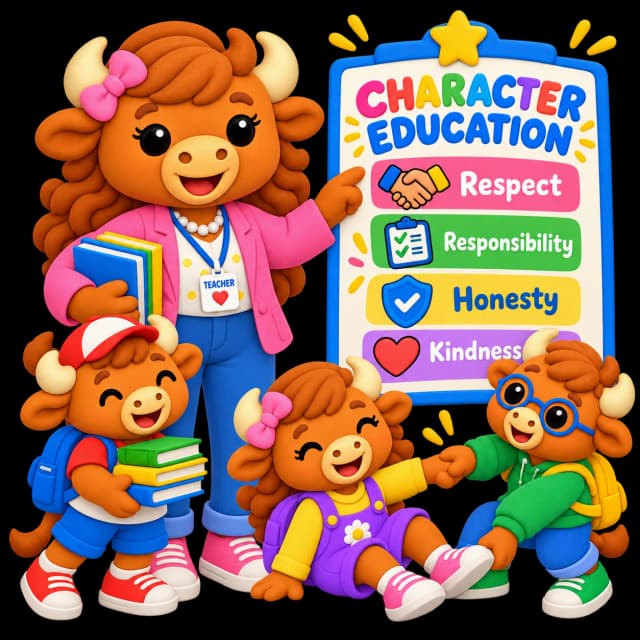
Character education is one of the oldest goals of American schooling and one of the most debated. Nearly everyone agrees schools should help children become honest, respectful, responsible people. Far fewer agree on how to do it, whether a program can actually change character, and how character education relates to social-emotional learning.
This guide covers what character education is, a brief history, what the research honestly shows, the character traits most schools teach, the main approaches schools use, how character education fits with SEL, and how to build a K–5 character program that goes beyond posters and slogans.
What Is Character Education?
Character education is the intentional effort by schools to help students understand, care about, and act on core ethical values, such as honesty, respect, responsibility, fairness, kindness, and perseverance.
Most definitions include three parts:
Knowing the good: Understanding what values mean and why they matter
Caring about the good: Wanting to act on those values
Doing the good: Actually practicing them in everyday situations
That third part is where many programs fall short. A student who can define “respect” on a worksheet but interrupts classmates all day has learned about character, not developed it.
A Brief History
Character education has been part of American schooling since its beginnings. Nineteenth-century textbooks such as the McGuffey Readers combined reading lessons with moral lessons. Interest declined for much of the 20th century, then revived in the 1990s, when several national organizations formed to promote character education. One of them, the Character Education Partnership, is now known as Character.org.[1] The CHARACTER COUNTS!™ framework also emerged in that period.
Since the 2000s, social-emotional learning has become the more common framework in many schools, while character education remains prominent in others, and many schools now combine the two. See character education vs. SEL.
What the Research Says
The research on character education is more mixed than many program websites suggest, and it is worth knowing before choosing an approach.
Some programs show positive effects
A research review of character education identified a number of programs with scientific evidence of effectiveness, along with practices common to effective programs, such as peer interaction, family involvement, and professional development for teachers.[2]
Positive Action shows results
Positive Action, a program that combines character and social-emotional development, showed improvements in achievement, absenteeism, and discipline in a cluster-randomized trial in Hawaii elementary schools.[3]
A large federal study found no effects
A major federal evaluation of seven schoolwide social and character development programs in elementary schools found that the programs increased classroom activities aimed at character development, but had no detectable effect on students’ social and emotional competence, behavior, academic performance, or perceptions of school climate compared with control schools.[4]
SEL research is stronger
Meta-analyses of school-based SEL programs, many of which overlap with character education in what they teach, show gains in social-emotional skills, behavior, and academic achievement.[5]
The honest takeaway: Character education can work, but simply adopting a program or a list of values does not guarantee results. What students actually practice, how consistently, and how the whole school reinforces it appear to matter more than the label.
The Character Traits Schools Teach Most
Most character education programs focus on a similar set of traits, even when they use different names.
Helping the classroom and community
Some well-known frameworks organize traits into named sets, such as the Six Pillars of Character™ from CHARACTER COUNTS!, which is a trademark of the Josephson Institute.
Common Approaches to Character Education
Trait-of-the-month programs
A school chooses one trait per month, displays it, and recognizes students who show it. Simple and common, but on its own often limited to posters and awards.
Explicit curriculum
Regular lessons that teach character traits through stories, discussion, role-play, and practice. This approach gives students direct instruction rather than just exposure.
Schoolwide culture approaches
Frameworks that build character into the whole school: discipline, relationships, staff modeling, family partnerships, and student leadership. Character.org’s 11 Principles framework is one example, emphasizing core values modeled throughout school culture, a caring community, opportunities for students to practice, intrinsic rather than reward-based motivation, shared leadership, family partnership, and annual assessment.[1]
Integration into academics
Character discussions built into reading, social studies, and other subjects, such as discussing a character’s choices in a novel or a historical figure’s courage.
Service learning
Projects where students help their school or community, giving them real chances to practice responsibility, kindness, and citizenship.
Combined character and SEL programs
Programs that teach both character traits and social-emotional skills together. Kansas, for example, adopted combined Social, Emotional, and Character Development standards.[7]
Character Education and SEL: How They Fit Together
Character education and SEL overlap heavily but emphasize different things:
Character Education
“What kind of person should I be?”
Focuses on values and virtues.
Social-Emotional Learning
“What skills do I need?”
Focuses on competencies such as managing emotions and resolving conflict.
In practice, students need both. A student who values kindness also needs the skill to notice when someone is left out and the confidence to invite them in. A student who values honesty also needs the self-control to tell the truth when lying would be easier.
Many schools find that combining the two works better than choosing one. The terminology also matters locally: some communities and states prefer character education language, while others use SEL. See our state-by-state SEL requirements.
How to Build a Character Education Program in K–5
Choose a small set of core values
Five to eight is manageable. Involve staff, families, and students in choosing them.
Define what each value looks like and sounds like
At each grade band, give concrete examples.
Teach the values explicitly
Regular, short lessons with stories, discussion, and practice.
Practice, don’t just display
Role-plays, scenarios, and real classroom jobs give students chances to act on values.
Model them
Students learn character from how adults treat each other and them.
Build values into discipline
When students make mistakes, connect consequences and repair to the school’s values.
Involve families
Share the values and the language at home.
Avoid relying on rewards
Recognition is fine, but character built only on prizes may disappear when the prizes do.
Assess and adjust
Use climate surveys, behavior data, and student reflection once or twice a year.
For curriculum options, see best character education curriculum for elementary schools.
Character Education by Grade Band
• Concrete behaviors: sharing, taking turns, saying thank you, telling the truth
• Stories and characters who model values
• Songs and simple role-plays
• Immediate, specific praise: “You told the truth even though it was hard.”
• Connecting values to choices: “What would a fair person do?”
• Scenario discussions and partner role-plays
• Classroom jobs that build responsibility
• Beginning to discuss why values matter
• Moral dilemmas and discussion of competing values
• Service learning and leadership roles
• Historical and literary figures as examples
• Student-led character projects
What to Avoid
Posters without practice
Displaying a trait of the month is not the same as teaching it.
Lecturing about values
Children learn character through practice, discussion, and example more than through being told.
Reward-heavy systems
Prizes for good character can shift students’ attention from the value to the reward.
Adults who don’t model the values
Students notice when staff behavior contradicts the values on the wall.
Treating character education as a one-time event
An assembly or a theme week without follow-up has limited impact.
Using character language to shame students
“That wasn’t very respectful” said publicly can feel like a label rather than a lesson.
Measuring Character Education
Look for change over time, and interpret data carefully, since many factors affect behavior and climate.
Behavior data: Office referrals, conflicts, and attendance
School climate surveys: Student, staff, and family perceptions of respect and safety
Student reflection: Can students explain values and give examples of acting on them?
Observations: Do students show values without being prompted?
Family feedback: Are values showing up at home?
Final Thoughts
Character education aims at something every school wants: students who are honest, respectful, responsible, and kind. The research shows that good intentions and a list of values are not enough. Programs that work tend to teach values explicitly, give students real chances to practice them, involve the whole school and families, and avoid relying on rewards.[1][2]
Character is not taught in an assembly. It is built in the small choices students make every day, with adults who help them practice.
References
Character.org. (2026). 11 Principles of effective character education. https://character.org/11-principles-in-schools/
Berkowitz, M. W., & Bier, M. C. (2005). What works in character education: A research-driven guide for educators. Character Education Partnership. https://www.researchgate.net/publication/251977043_What_Works_In_Character_Education
Snyder, F., Flay, B., Vuchinich, S., Acock, A., Washburn, I., Beets, M., & Li, K.-K. (2010). Impact of a social-emotional and character development program on school-level indicators of academic achievement, absenteeism, and disciplinary outcomes: A matched-pair, cluster-randomized, controlled trial. Journal of Research on Educational Effectiveness, 3(1), 26-55. https://doi.org/10.1080/19345740903353436
Social and Character Development Research Consortium. (2010). Efficacy of schoolwide programs to promote social and character development and reduce problem behavior in elementary school children (NCER 2011-2001). National Center for Education Research, Institute of Education Sciences, U.S. Department of Education. https://ies.ed.gov/use-work/resource-library/report/research-report/efficacy-schoolwide-programs-promote-social-and-character-development-and-reduce-problem-behavior
Durlak, J. A., Weissberg, R. P., Dymnicki, A. B., Taylor, R. D., & Schellinger, K. B. (2011). The impact of enhancing students’ social and emotional learning: A meta-analysis of school-based universal interventions. Child Development, 82(1), 405-432. https://doi.org/10.1111/j.1467-8624.2010.01564.x
Cipriano, C., Strambler, M. J., Naples, L. H., et al. (2023). The state of evidence for social and emotional learning: A contemporary meta-analysis of universal school-based SEL interventions. Child Development, 94(5), 1181-1204. https://doi.org/10.1111/cdev.13968
CASEL. (n.d.). Frameworks, competencies, standards, and guidelines. State Resource Center. https://casel.org/state-resource-center/frameworks-competencies-standards-and-guidelines/
Character Education and SEL in One K–5 Curriculum
Be The Buffalo combines character education and CASEL-aligned SEL in a 40-week K–5 curriculum, with weekly lessons on traits like kindness, respect, responsibility, courage, and perseverance, plus projector activities, original songs, stories, and printables. Bilingual. No student devices. No prep. The first four weeks are free.
Sign Up Free